
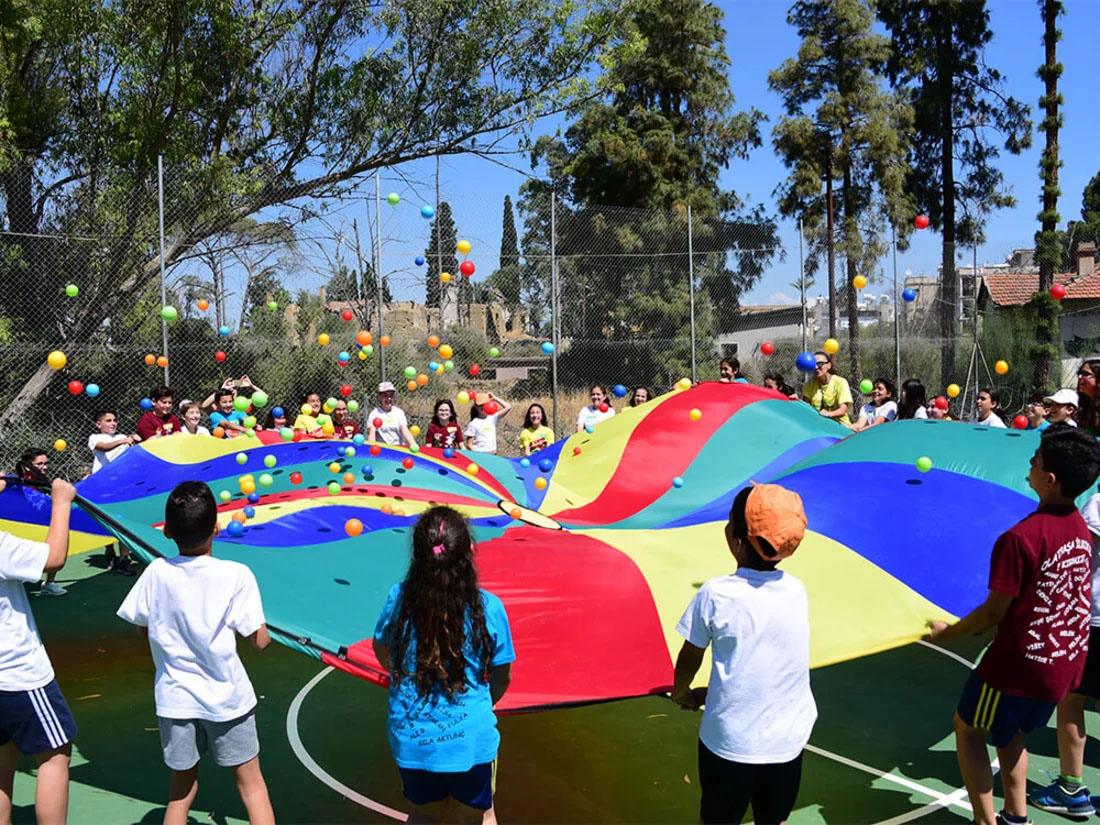
What’s now in store for a bicommunal programme that brought together teachers and students from across the divide?
In the halcyon days of 2016 when there still seemed to be hopes for progress in the Cyprus talks, the Imagine programme offered the potential to turn the page on the usual entrenched narratives on both sides.
Launched by the Association for Historical Dialogue and Research (AHDR) under the auspices of the bicommunal Technical Committee on Education, Imagine brought together thousands of students and hundreds of teachers from Greek and Turkish Cypriot communities.
The programme operated largely through the Home for Cooperation, a venue adjacent to the now dilapidated Ledra Palace hotel, enabling activities in the neutral buffer zone.
Its methods included workshops and team-building exercises that fostered empathy and cooperation amongst Cypriots who might otherwise grow up never engaging with those on the other side of the divide.
A pilot scheme was launched in the school year 2016-2017 and even after the Cyprus talks crashed spectacularly in Crans-Montana in 2017, the Imagine project survived until October 2022 when then Turkish Cypriot leader Ersin Tatar unilaterally withdrew from the bicommunal component.
Mono-communal teacher training for Greek Cypriots remained, and bicommunal sessions persisted on weekends and after school hours.
The programme has returned to public focus following the recent election of Tufan Erhurman, which has revived expectations that the Turkish Cypriot side may resume participation.
His administration is anticipated to appoint new members to the Technical Committee on Education for the programme, a step that educators on both sides view as essential for facilitating reintegration.
Across the divide, Turkish Cypriot teachers remain hopeful despite the signal going cold some three years ago.
Cansu Karsili, AHDR educational officer and geography teacher in Famagusta, recalled fondly the monumental interest when the programme was announced in 2017 and now eagerly awaits the appointment of new board members.
Hale Silifkeli, AHDR co-president and an English teacher in Kyrenia, observed firsthand the programme’s profound effect on her students with broader perspectives, recognition of shared experiences, and an emerging sense of empathy.
Both spoke of how desperate teachers and students alike were to see it recommence.
Almost a decade since its initiation, however, the programme faces uncertain waters.
This comes not from parental cautiousness, nor teachers baulking at its curriculum, but as is so often the case, the political machinery decided that education was less important than electoral calculus.
Michalinos Zembylas, Greek Cypriot co-chair to the Technical Committee on Education expressed mounting frustration at the government’s inaction.
“Say what you will for the Turkish Cypriot position in withdrawing but at the very least it was consistent; the Republic’s is not,” he said.
Circulars to schools have not been issued and verbal support from the government in public discourse is distinctly absent.
Teachers’ workshops are ignored, and the United Nations’ repeated endorsements of the programme as a confidence building measure, treated as a matter of convenience rather than obligation.
“How are we meant to discuss seriously complicated matters if we cannot even agree on something as simple as this?” Zembylas asks, his exasperation palpable.
Loizos Loukaidis, AHDR director, further stressed that the ‘study visits’, often mischaracterised in the press and right-wing circles as ‘excursions’, were never political in nature.
“They were carefully designed educational experiences, exploring cultural heritage and environmental sustainability, always with voluntary parental approval,” said Loukaidis.
Meanwhile, Greek Cypriot parents, far from objecting, continued to volunteer their children in droves.
George Constantinou, former head of Ayia Napa primary school, recalled how parental anxiety over “meeting the unknown”, was quickly replaced by enthusiasm and admiration for the programme’s impact.
“Children don’t resent as adults tend to; they just play,” he observed.
“The benefits of the programme were countless, those activities built bonds that carried over into the home and really shaped family attitudes as a whole.”
Koulla Aristodimou, teaching in the conservative rural province of Akaki, echoed his sentiment.
“Positions were eagerly claimed by students, and the weekend schedule ensured no interference with regular school hours,” she said.
Parents always gave consent, and teachers reported tangible changes in student attitudes after engagements.
Children, it seems, understood cooperation far more readily than the officials who preside over them.
Yet misinformation was hastily utilised by parties who sought to extinguish the programme’s efforts, and the silence from the education ministry only amplified this.
The ministry, speaking to the Sunday Mail, insisted its position is only to disseminate programme information to school boards.
It stopped short of endorsing the programme itself and openly rejected visits across the divide in any capacity.
This includes, crucially, even to the neutral buffer zone Home for Cooperation, leaving teachers and administrators in limbo.
The government’s strategic ambiguity leaves the initiative stranded, undermined by what many regard as short-term political manoeuvres to pander to nationalist element.
“What remains to be seen now is the political will,” said Zembylas.
“Teachers have carried this programme for years, students have embraced it, and parents have consistently supported it. The only hesitation comes from those in power.”
The stakes are not abstract. Imagine has trained more than 8,200 students and 2,600 teachers to date, fostering both understanding and critical thinking.
It was internationally recognised, receiving the GENE Global Education Award in 2021.
Empirical evidence suggests these programmes work and the plethora of anecdotes from teachers certainly gives its credence.
Alexandra Attalides, president of Volt and one of the first MPs to publicly support Imagine at its inception, echoed Zembylas’ concerns over whether political leaders can match their commitments with concrete action.
“We must be actively supporting initiatives that cultivate a culture of peace, not quietly distancing ourselves from them,” she insisted. “Programmes like Imagine allow young people to approach history with curiosity rather than fear, and with empathy rather than division.”



Click here to change your cookie preferences