
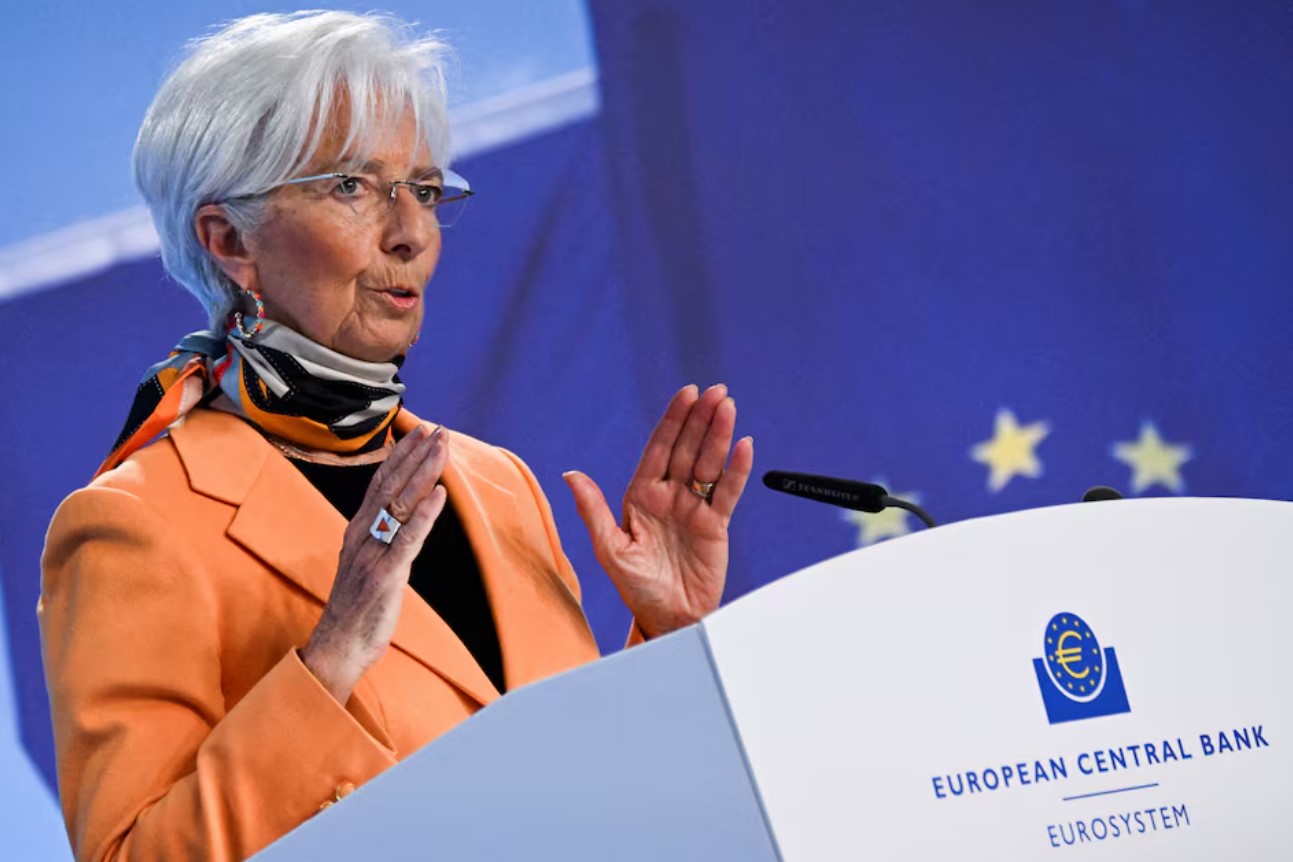
The European Central Bank kept its policy rates steady on Thursday and took a more positive view on a euro zone economy that has shown resilience to global trade shocks.
The central bank for the 20 countries that share the euro raised several of its growth and inflation projections for the bloc, in a move that likely closes the door to further rate cuts in the near term.
“Inflation has been revised up for 2026, mainly because staff now expect services inflation to decline more slowly,” the ECB in a press release.
Recent growth figures for the euro zone have beaten ECB expectations, buoyed by exporters navigating US tariffs more effectively than anticipated and by domestic spending that has counterbalanced a malaise in manufacturing.
Inflation, meanwhile, has been hovering around the ECB’s 2 per cent target, boosted by price hikes in the services sector, and is expected to stay there for the foreseeable future.
The more upbeat data has already led investors to draw a line under an easing cycle that saw the ECB halve its policy rate from 4 per cent to 2 per cent in the year to last June.
But the ECB formally kept its options open on Thursday, repeating its mantra that it would set borrowing costs “meeting-by-meeting” depending on incoming data and that it was “not pre-committing to a particular rate path”.
RATE HIKE NEXT?
ECB President Christine Lagarde was nevertheless certain to be asked if rates were next set to go up, as some traders have been betting. But this debate was seen by many as premature given ample idle capacity in the manufacturing sector.
“I would expect Christine Lagarde to steer clear of rate hike conversations,” Spyros Andreopoulos, founder of the Thin Ice Macroeconomics consultancy, said.
Some comments from ECB board member Isabel Schnabel, chief economist Philip Lane and Lagarde herself have helped fuel some speculation about a rate hike late next year.
Financial markets have begun pricing modest chances of a rate hike late next year or early in 2027 .
But most economists polled by Reuters expect the ECB to leave rates where they are through 2026 and 2027, although the forecast range for the latter year was wide at 1.5 per cent-2.5 per cent.
“The reality is, the bar is probably quite high for a move in either direction in the next few meetings,” BNP Paribas chief economist Isabelle Mateos y Lago said.
HIGHER PROJECTIONS FOR GROWTH AND INFLATION
The ECB could do little but acknowledge that economic activity in the euro zone economy, while unspectacular, has been better than expected.
It now expects growth of 1.4 per cent this year, 1.2 per cent in 2026, and 1.4 per cent in 2027 and 2028.
Private sector economists, too, expect growth to carry forward into next year, supported by the German government’s planned investments in defence and infrastructure and a relatively tight labour market, where workers have finally seen wages catch up with the post-pandemic surge in prices.
“A stable labour market, a growing service sector, and the German fiscal stimulus will provide a tailwind to the euro zone economy in the coming months,” Felix Schmidt, a senior economist at Berenberg, said.
The ECB’s core inflation forecasts for 2026-27 were nudged higher too.
These are crucial as they factor out the effect of a delay to the European Union’s new carbon trading scheme, which will mechanistically bring down headline inflation in 2026-27 and push it up in 2028.
Among factors likely to weigh on inflation is the euro’s strength against the Chinese yuan or renminbi, which is making it even harder for the euro zone to compete with China, and against the US dollar, which may fall further if the Federal Reserve cuts rates more rapidly under a new chair.
“When you look at the trade balance of Europe, it appears that the competitiveness problem is much more pronounced against China than against the US For me, the exchange rate to look at is not the dollar-euro, it’s the euro-renminbi,” BNP’s Mateos y Lago said.




Click here to change your cookie preferences