
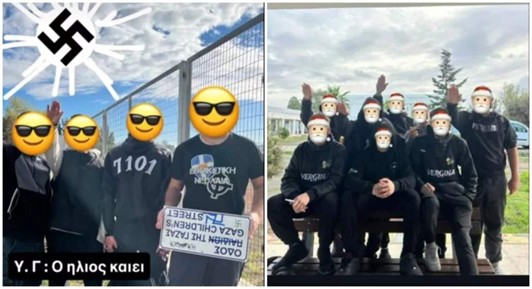
Recent images of Larnaca secondary school pupils performing Nazi salutes and emblazoning swastikas on campus came to light on Wednesday and prompted great alarm among parents and the wider public.
Photographs circulating online show more than ten pupils performing Nazi salutes on school grounds and posing beside swastikas drawn on walls and school property.
The images were shared through social media accounts created by students, some of which carried slogans such as “action brings reaction” and “learning from a young age”.
Parents say the scale of the activity suggest this was not a standalone provocation but a deliberate and sustained effort that sought to recruit from the student body.
The incidents occurred at Vergina high school in Larnaca, where pupils are alleged to have vandalised classrooms and communal areas with fascist symbols.
Parents reported that a social media account using a name combining the school’s identity with Nazi references was used to circulate images and related material.
Larnaca district parents’ association confirmed they had received multiple complaints.
Their president, Costas Costa, said parents were unequivocal in their condemnation and had formally raised the matter with the education ministry.
“Anything that refers to the Nazi past and especially to symbols associated with the murder of millions of people is unacceptable,” he said.
“Ideologies of hatred have no place in schools.”
Beyond the salutes and graffiti, further concern was raised by images showing pupils holding a roadside sign which had been desecrated.
The sign which had read Gaza Children’s Street, was originally placed by activists near the school in response to a controversial tree-planting ceremony organised by the Jewish community.
Pupils are seen proudly holding the sign now with the addition of a swastika.
Deputy director of secondary education, Yiorgos Koutsides, affirmed that the education ministry would investigate the “reckless action” undertaken by the students, and that “penalties shall be enforced.”
Despite referring to the social media pages in question as “purely personal publications”, Koutsides admitted that the severity of the images warranted the ministry to pay a formal visit to Vergina high school.
He said they shall examine if this is indeed an isolated incident or suggestive of a more complex network.
The case has intensified a broader debate about the presence of fascist symbolism in schools and how authorities respond.
Such concern was echoed in reactions to a previous incident in the Famagusta district, where pupils in Dherynia were photographed performing Nazi salutes in a class photograph.
The response drew sharp criticism from Akel, which accused the ministry of failing to confront the substance of the issue.
The party argued that downgrading a Nazi salute to a ‘misrepresented’ gesture ignored the role of historical ignorance and the spread of far-right ideology among the youth.
It also raised questions about the responsibility of teachers and school management, alleging that a teacher present had allowed the photographs to continue.
The association of political science graduates has called for the reintroduction of political history lessons in schools, abolished since 2015, arguing that the state has not invested sufficiently in democratic education.
Parliament has previously passed a resolution in 2017 stating that the historical context of fascism must be taught within the syllabuses of public schools.
The resolution also demanded that Cyprus’ own previous experiences with fascism be included in history lessons.


Click here to change your cookie preferences