
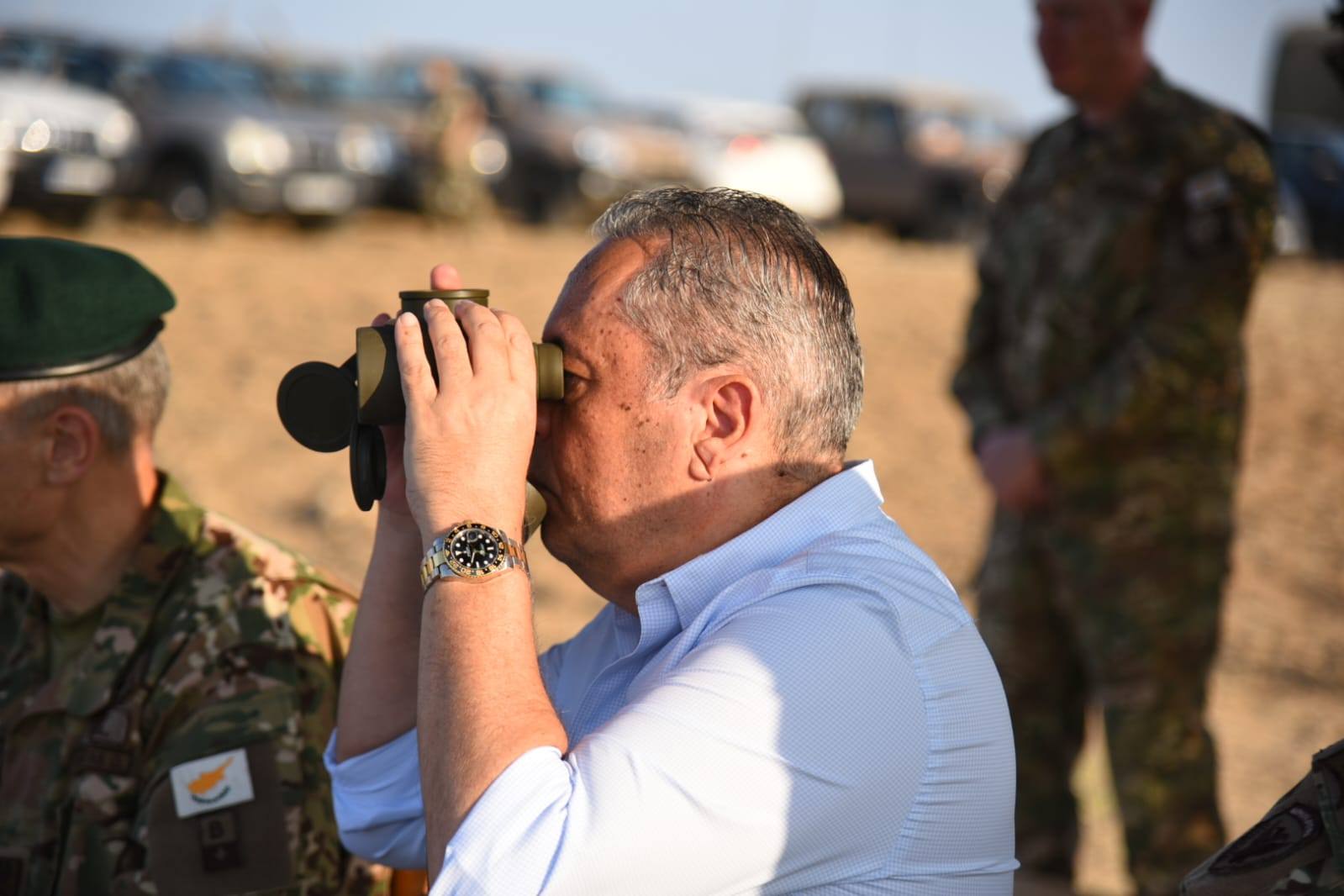
Defence Minister Vasilis Palmas on Thursday denied reports that the governments of Cyprus, Israel, and Greece are planning to combine to create a military “rapid reaction force” to counter Turkish forces in the eastern Mediterranean.
“I am telling you that these issues which have such a high level of decisions are made by the political leadership, and as the political head of the defence ministry, I am telling you that no such issue has been raised and we have not discussed any issue,” he told television channel Alpha.
Asked whether the idea would be an “unlikely or fantasy scenario”, he said that “even if a meeting were to take place which had different contents, it would be wrong for us to bring some confidential issues to light”.
Earlier, he had told CyBC that “the relationship between Cyprus and Israel, between Greece and Israel, and between Greece, Israel, and Cyprus is well known”, and that “it is known that Cyprus cooperates with Israel in the context of armament programmes”.
Pressed on the reports regarding the “rapid reaction force”, he said that “no such meeting with such an agenda has taken place” and that while “contacts and meetings take place on a daily basis” between Cyprus, Greece, and Israel, “such a specific issue did not exist, nor does it exist”.
He had visited the State of Israel on Tuesday, and said on Thursday that he had “held a meeting with my Israeli counterpart [Israel Katz] and we discussed bilateral issues which we have with the State of Israel”.
“We discussed our cooperations and at the same time, we discussed the situation in the region, namely the situation in the eastern Mediterranean, but also the situation which emerged after the peace process in Gaza,” he said.
During his visit, he had also visited the civil-military coordination centre (CMCC), which is located northeast of the Gaza strip in the Israeli town of Kiryat Gat. The Cyprus Mail learned on Tuesday that Cyprus is one of around 20 countries which have stationed personnel at the CMCC.
Meanwhile, according to media reports in Greece, President Nikos Christodoulides and Greek Prime Minister Kyriakos Mitsotakis are to visit Jerusalem on Monday to hold a trilateral meeting with Israeli Prime Minister Benjamin Netanyahu.
Christodoulides had been due to visit the State of Israel in October, but was forced to postpone his visit as Netanyahu was due to appear in court to attend a hearing a criminal trial he faces over allegations of bribery, fraud, and breaches of trust by him and close political allies.
That trial is ongoing, despite Netanyahu last month asking Israeli President Isaac Herzog to grant him a pardon, with its most recent hearing on Wednesday centring around allegations that Netanyahu had demanded that Israeli media outlets remove articles containing less than flattering reporting about him.
According to Israeli newspaper the Jerusalem Post, Netanyahu told the court on Wednesday that he “occasionally contacted publishers”, but that “everyone asks to remove articles” and that “it happens all the time”, before adding, “what’s unusual here is now infrequent it was”.
The reports of a “rapid reaction force” first appeared in Greek newspaper Ta Nea, which stated that a 2,500-strong brigade-level force, armed with boats, planes, and other infrastructure would be formed, with stations on one of either Rhodes or Karpathos, in Cyprus, and in the State of Israel.
It added that 1,000 Greek soldiers, 1,000 Israeli soldiers, and 500 Cypriot soldiers would be brought into the force, as well as one squadron each from the Greek and Israeli air forces, a frigate and a submarine from Greece, and a corvette boat and a submarine from the Israeli navy.
The newspaper reported that the aim of the force would be to protect Greek, Cypriot, and Israeli interests from “Turkish revisionist provocations”, with Greece and Turkey having long been at odds over their maritime borders in the Aegean sea and the eastern Mediterranean.




Click here to change your cookie preferences