
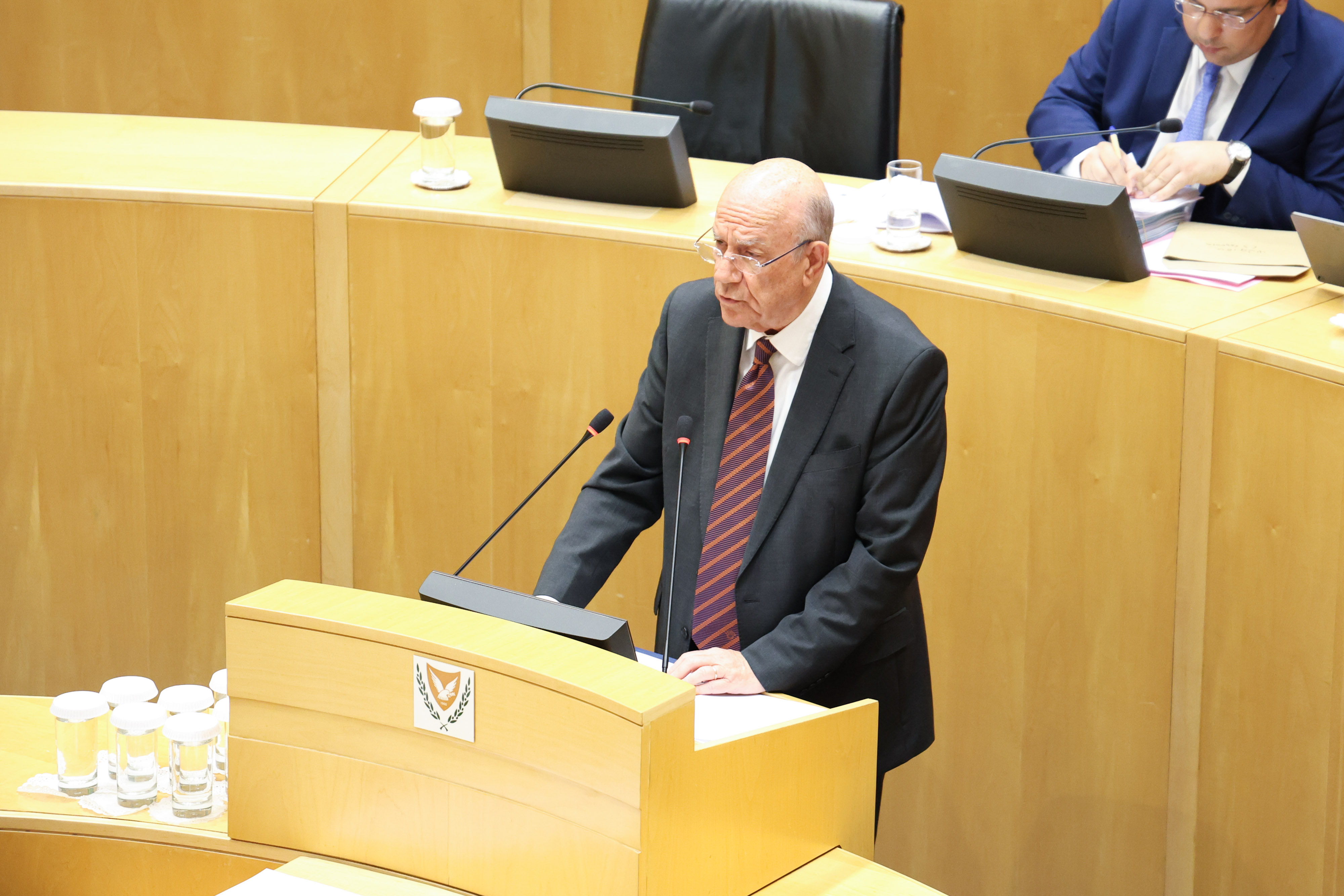
Unless something totally out of the ordinary happens on Monday the legislature will approve the government’s tax reform package, as the three parties supporting it have a majority. After a meeting of Finance Minister Makis Keravnos, with representatives of Diko, Dipa and Disy, at which he agreed to several changes suggested, the most important being the raising of the income tax threshold from the proposed €20,500 to €22,000, the reform secured a majority.
The changes, which were proposed by the three parties, also included the broadening of the criteria for tax allowance for children, some minor adjustments to income brackets and scrapping of stamp certification. In effect, the surplus cushion of €112m that was provided in the original reform proposal was absorbed by these changes although the effect of the reform remains neutral. This would, however, put additional pressure on the authorities to collect the forecasted tax so that the government is not faced with deficits.
There could not be tax reform without a populist element and the raising of the tax threshold for everyone, at a cost €45m was an example of this. The threshold should probably not have been raised for people on big incomes as well. The offer of tax allowances on children for a family with a joint annual income of €100,000 and €150,000 seems excessive but the government did say that the reform was aimed at helping the ‘middle class’. Ironically, the ‘lower class’ does not benefit from the reform, especially those with annual incomes below €19,000.
All in all, this is a mild tax reform, featuring moderate changes to the regime that existed for the last two-and-a-half decades. This is no bad thing considering that attracting foreign businesses and investors is a government priority. No state that engages in radical reform of its tax system can win the confidence of foreign investors who, invariably, seek stability, certainty and economic management that errs on the side of caution.
This is exactly what the government offered with its tax reform, even the increase in corporate tax from 12.5 per cent to 15 per cent being something that businesses can live with. It would still be one of the lowest in the EU but accusations of Cyprus being a ‘tax haven’ cannot hold any longer.
The only criticism that could be levelled against the government was that it did not give enough time to the legislature to go through the reform package properly. Allowing just a few weeks for discussion of such an important piece of legislation was a mistake that could have backfired if the biggest party, Disy, had decided not to take a responsible approach. In the end, the package had to be passed before the end of the year so that it could come into force in 2026. If it were not passed, the year’s wait would have caused uncertainty among businesses and created the ground for more populist amendments.
Even in the short time provided Akel tried to impose some of its leftist ideas on the reform, but met the resistance of Diko and Disy, both of which stood firmly against the proposal for the taxation of the banks’ super-profits and for an annual tax on big properties. It suffices to say that Akel accused these parties of acting as the defenders of the greedy banks, which reported record profits this year. What Akel fails to realise is that randomly taxing so-called super-profits (it had also unsuccessfully proposed taxing renewable energy producers) is bad for the image of a country that wants to bring in foreign business. No business would set up operations in a country, in which political parties, out of the blue, impose additional taxation on what they regard as super-profits.
During the debates in the House, parties also tabled four proposals for VAT reductions on specific products but eventually withdrew them until January. The government had set the bad example with the VAT reductions, which had been introduced as a relief measure when prices had soared. These VAT reductions are no longer justified and should stop being considered as instruments of social policy. In fact, the government should have used the tax reform as a reason for ending the current VAT reduction once and for all.
Perhaps this will be done next year, after the income tax reform has been approved.





Click here to change your cookie preferences