
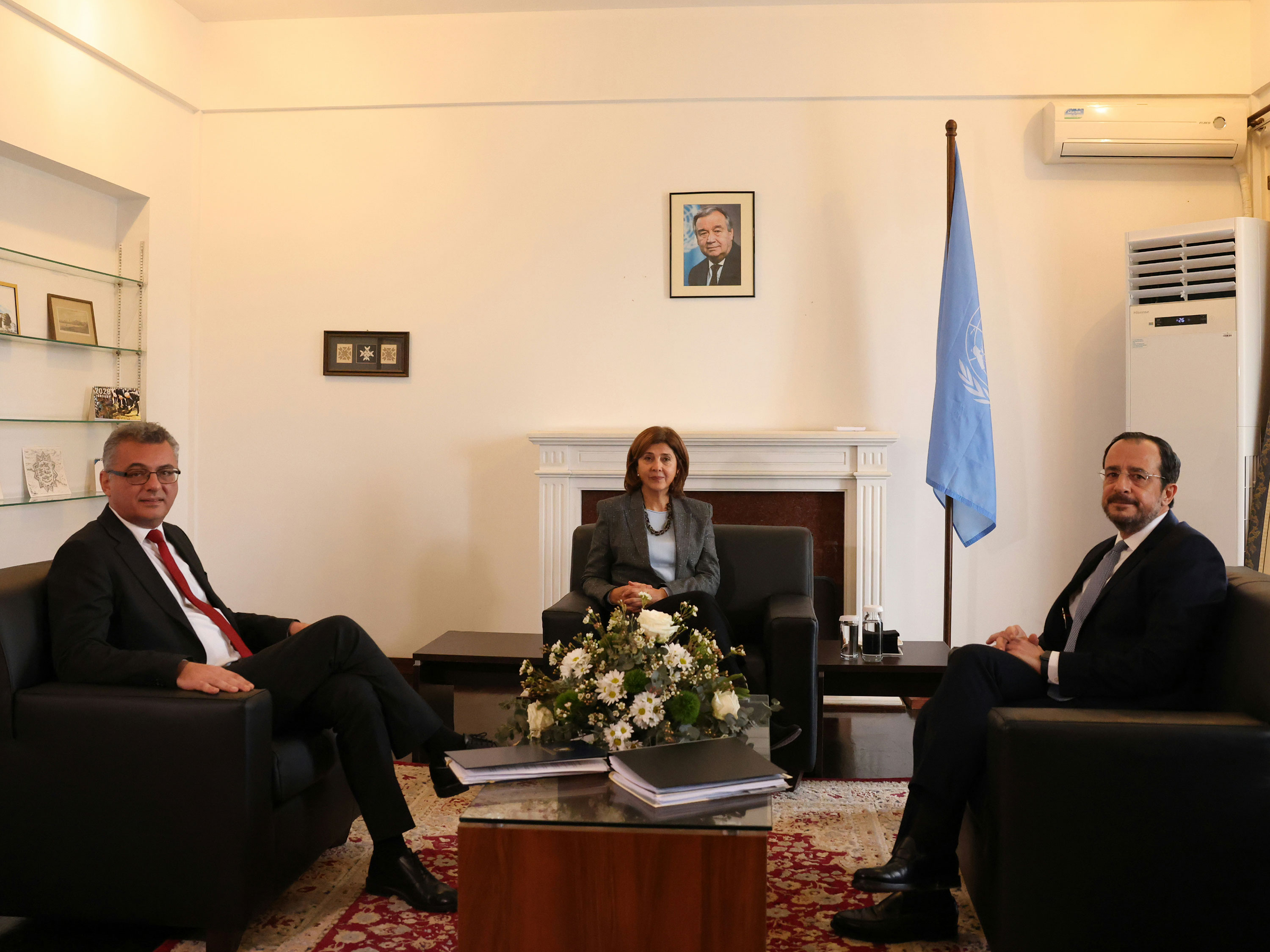
The latest meeting of the two leaders in the presence of the UN Secretary-General’s personal envoy, Maria Angel Holguin, turned out to be more of the same. More of nothing would be more precise because the only thing that was agreed was to continue these fruitless meetings in one form or another. The two leaders could meet again in a few weeks, without the presence of Holguin, said President Nikos Christodoulides, although this could hardly be seen as a positive sign.
There was nothing positive to come out of the meeting, Holguin informing journalists after the meeting that the two leaders had “not yet” responded to her call, a day earlier, for more progress. “I think they might,” she said to maintain an air of optimism, for which there was no justification. She was not disappointed with the lack of results during her latest visit, before coming up with the platitude that “all processes are dynamic; this one’s a little slower but we are continuing.”
The process was not dynamic enough to justify the calling of an enlarged five-party meeting, like those held under the UNSG last year. “We need results on the confidence-building measures,” before such a meeting is called, said Holguin. The two sides have been unable to open any crossing point, despite having agreed, in theory, at the last meeting with the UNSG in New York, to do so. The Turkish Cypriots were represented by Ersin Tatar at the last enlarged meeting, but his successor, Tufan Erhurman, has also been unable to reach an agreement on the crossings with Christodoulides.
This failure to agree on something as straightforward as the crossings, despite months of talks, suggests the entire process is a waste of time, each side behaving as if the way forward is making proposals that the other side will not accept. Christodoulides took five proposals to Wednesday’s talks, presumably in response to Erhurman’s four proposals, on the methodology for the process. Erhurman wants the building of trust and confidence, before there is a resumption of talks. Christodoulides presented his own five proposals on Wednesday, by which confidence-building measures such as the opening of more crossings would be introduced only after the resumption of talks is agreed at an enlarged meeting.
Predictably, the two leaders will use disagreements over the process – a practice as old as the Cyprus problem – to avoid substantive talks. Neither is prepared to show a hint of goodwill in order to push the process, which Holguin, rather generously, claimed was “a little slower.” The truth is it has been stagnating since the last enlarged meeting in New York more than six months ago. If it had been moving at all, something would have been agreed since then, but nothing has, because the leaders enjoy bickering about the process.
This is all they are capable of doing about the Cyprus problem.


Click here to change your cookie preferences