
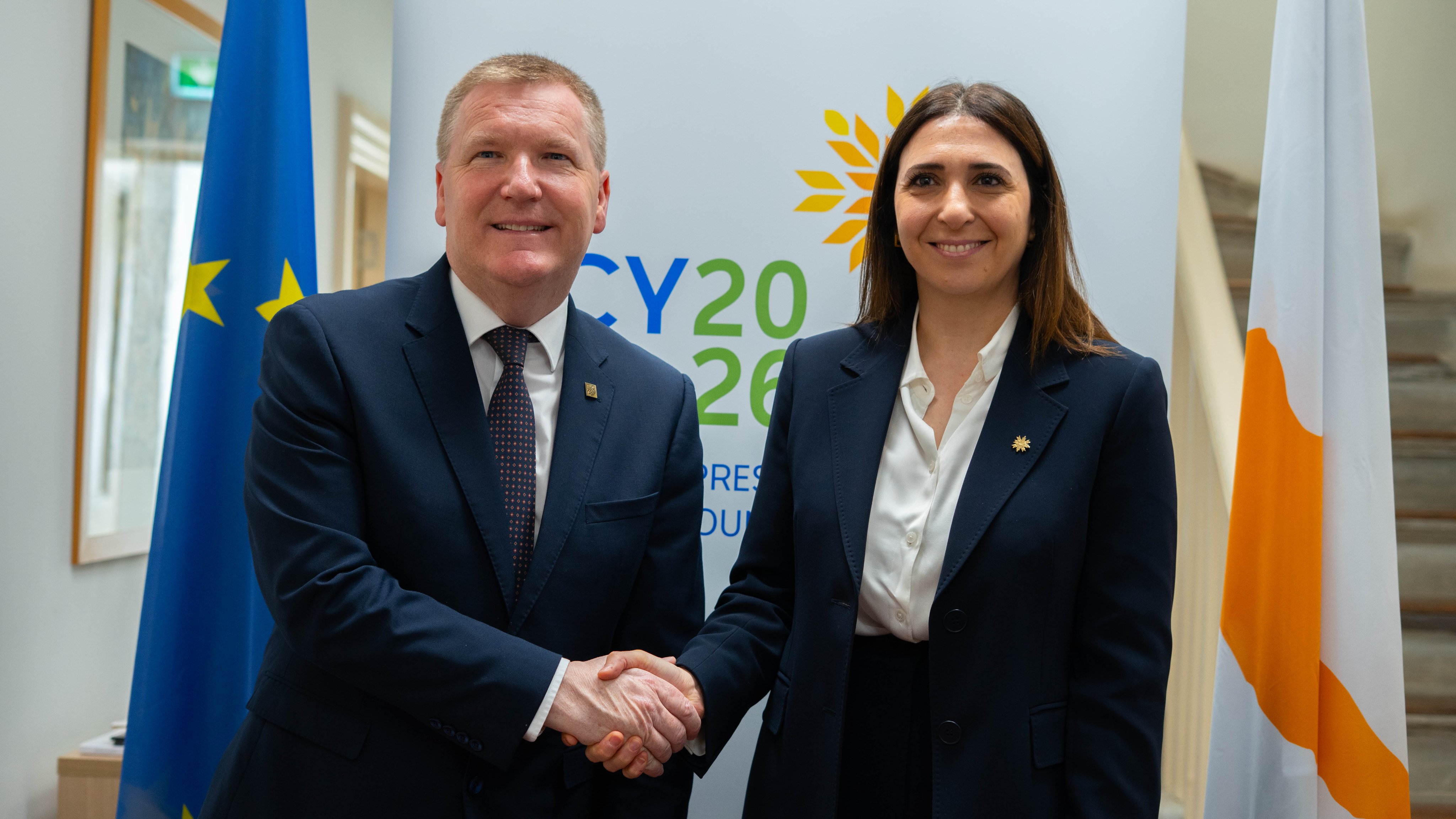
European Affairs Deputy Minister Marilena Raouna and European Democracy Commissioner Michael McGrath on Tuesday discussed the planned “European democracy shield” – a set of measures the commission hopes will “empower, protect and promote” democracies in Europe.
McGrath said that in line with the “democracy shield” plan, the commission’s focus “is now on the creation of the European centre for democratic resilience”, which he said will be “effectively launched” at a European general affairs council (Gac) meeting on February 24.
This, he said, “will be an excellent opportunity, once again, to engage all member states and ensure that we work together to protect the integrity of our precious democracy”.
“The threats we face do not recognise borders,” he said.
The commission unveiled the European democracy shield in November last year alongside the “EU strategy for civil society”, which it said will provide for “stronger engagement, protection and support to civil society organisations which play essential roles in our societies”.
Both initiatives, the commission said, “present measures to protect the key pillars of our democratic systems: free people, free and fair elections, free and independent media, a vibrant civil society, and strong democratic institutions”.
According to the commission, the democracy shield will further boost our collective capacity to counter information manipulation and disinformation and strengthen our resilience through a whole-of-society approach.
This, it said, will take place across three main pillars: the safeguarding of the “integrity of the information space”, the strengthening of institutions, free and fair elections, and free and independent media, and the bolstering of “societal resilience and citizens’ engagement”.
To this end, it said that the centre for democratic resilience will “bring together EU and member states’ expertise and resources to increase our collective capacity to anticipate, detect, and respond to threats, and build democratic resilience”.
The centre, it said, will work in “close coordination” with the European external action service’s rapid alert system – the EU’s dedicated digital platform where member states and institutions share insights on disinformation and coordinate responses.
European Commission President Ursula von der Leyen had in November extolled the plan’s virtues, saying that “democracy is the foundation of our freedom, prosperity, and security”.
“The European democracy shield will reinforce the core elements that allow citizens to live our shared democratic values every day – free speech, independent media, resilient institutions, and a vibrant civil society. This is Europe’s strength and we must increase our collective capacity to protect it at all times,” she said.


Click here to change your cookie preferences