
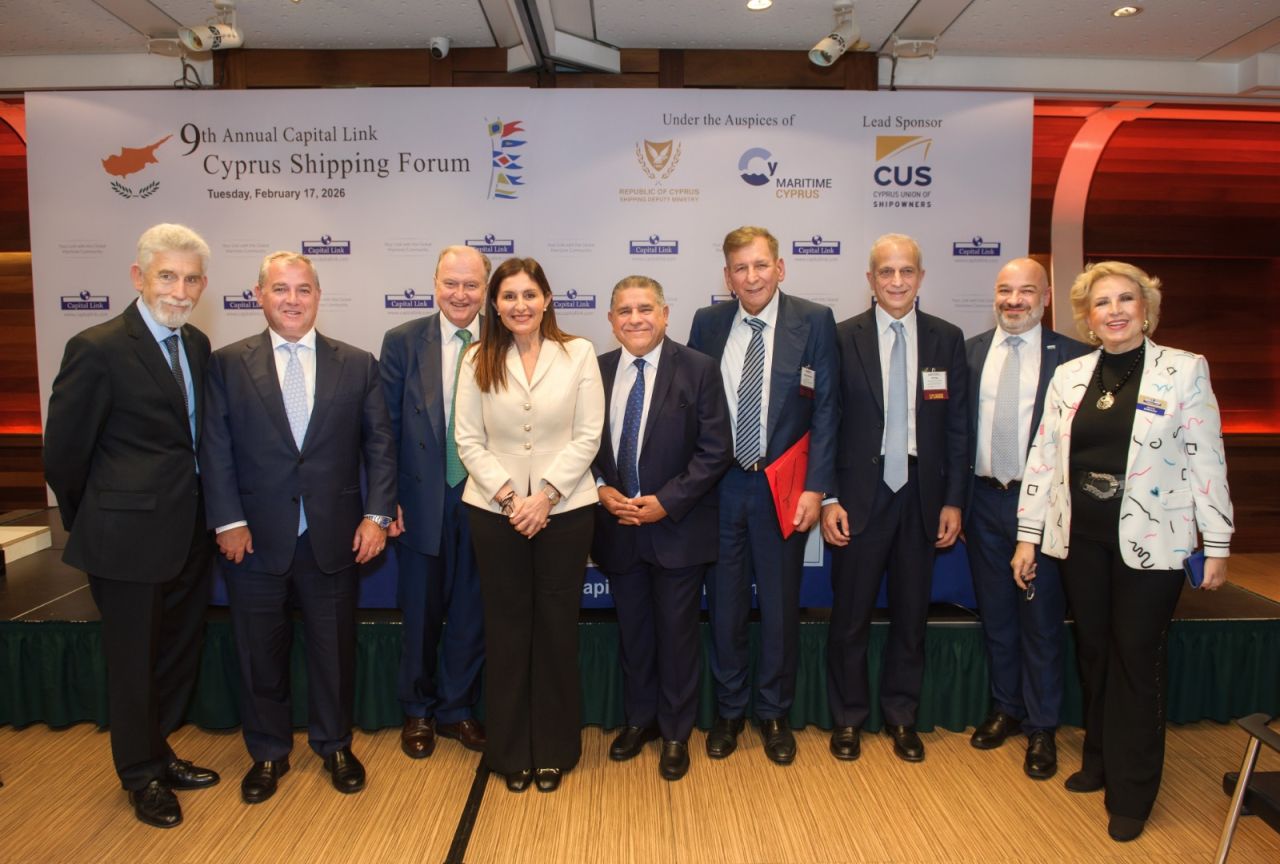
Shipping is entering a demanding phase shaped by geopolitics, environmental regulation and uncertainty over future fuels, shipowners said at the 9th Annual Capital Link Cyprus Shipping Forum in Limassol.
In addition, they said that the sector is moving beyond a traditional cycle and into structural transition after a strong five-year period.
Polys Hajioannou, CEO of Safe Bulkers and president of the Cyprus Union of Shipowners (CUS), and Aristides Pittas, chairman and CEO of Euroseas, focused on investment decisions.
Meanwhile, Andreas Hadjiyiannis, CEO of Cyprus Sea Lines/Hellenic Tankers and former CUS president, and Giorgos Mouskas, president of Olympia Ocean Carriers and CUS vice president, addressed regulation, financing and operational realism, outlining an environment defined by security risks, regulatory pressure and fuel uncertainty.
The environment, they indicated, is unlike previous phases of the cycle, combining attacks on sea lanes, a dense regulatory framework and technological uncertainty, as mentioned in Newmoney.
Hajioannou said the last four to five years had been positive but the current environment involves increased commercial and geopolitical risk.
Referring to attacks in the Red Sea, he noted ships were withdrawn immediately despite charterer pressure, with seven vessels changing course as the cost of deviation was negligible compared with the possibility of a serious incident.
Each company, he added, must decide the level of risk it is willing to take, while higher returns in high-risk markets require conscious and manageable exposure.
Recalling the company’s 2018 investment in scrubbers ahead of sulphur regulations, he said orders were placed early despite doubts the fuel spread would justify the investment, the decision ultimately proving profitable when price differences widened, timing, he indicated, often being more decisive than the technology itself.
Turning to fuels, he said the company has taken limited exposure to methanol-capable vessels, describing the additional cost as manageable compared with other technologies, adding that “If the bet pays off, we will be ahead. If not, we will not have lost control”.
He also said shipping cannot immediately transition to zero emissions because fuel availability and infrastructure are not yet established globally, meaning the transition will be gradual and require cooperation between shipping, fuel producers and regulators.
Pittas said the strong market of the last five years boosted liquidity, yet the next phase may be more complex because the issue is not cyclicality but the accumulation of uncertainties, emissions regulation, fuel availability and cost, geopolitical shifts and high shipbuilding prices.
He said, “I can’t tell you what the fuel of the future will be”.
Accordingly, he said the company orders conventional vessels with LNG-ready capability to maintain flexibility while limiting the initial investment cost, stressing that “I am not trying to predict, I am trying to adapt”.
Financial discipline is therefore necessary in an environment of high newbuilding prices, he said, warning against overinvestment, “Don’t go to extremes”.
Recalling previous crises, he added investment must continue but without risking survival in a downturn, noting that “We have had five very good years. We have to do something”.
Meanwhile, Hadjiyiannis said shipping investments have a life cycle exceeding two decades and therefore require a predictable regulatory framework, while competitiveness depends on continuous dialogue between the state and shipowners.
European bureaucracy and delays, he said, create additional burdens compared with non-EU registries, warning that strict environmental measures without adequate technological and energy infrastructure could lead to distortions, increased transport costs and loss of competitiveness because green fuel supply remains limited, prices volatile and technologies transitional.
Access to bank capital has improved since the financial crisis, he added, but lending conditions are stricter and increasingly linked to environmental criteria, meaning owners must balance fleet renewal with maintaining a healthy capital structure.
He also stressed the need to invest in education and attract younger professionals, as future shipping will require digital knowledge, energy understanding and the ability to manage complex systems alongside traditional seamanship.
In turn, Mouskas said high newbuilding prices and long delivery times make orders particularly risky, noting that “There is no point in locking up capital today in something that will be delivered in three or four years, when you don’t know where the market will be”.
The strategy, he explained, is selective participation in the second-hand market with careful assessment of price and technical condition.
On fuels, improving energy efficiency through design, engines and operational optimisation is currently the most realistic option, he said, adding emissions reductions achieved so far largely came from technological progress and economies of scale rather than regulatory pressure.
He also warned against decisions based on market “fads”, stressing that maintaining strong liquidity and financial discipline is the most important competitive advantage in periods of uncertainty.
From different perspectives, the four shipowners converged on the same conclusion, that the sector is entering a period where strategic flexibility, disciplined capital allocation and careful risk management will determine competitiveness.
The next decade, they said, will be judged less by freight rates and more by the ability of companies to survive and adapt in an environment of rapid regulatory and technological change.




Click here to change your cookie preferences