
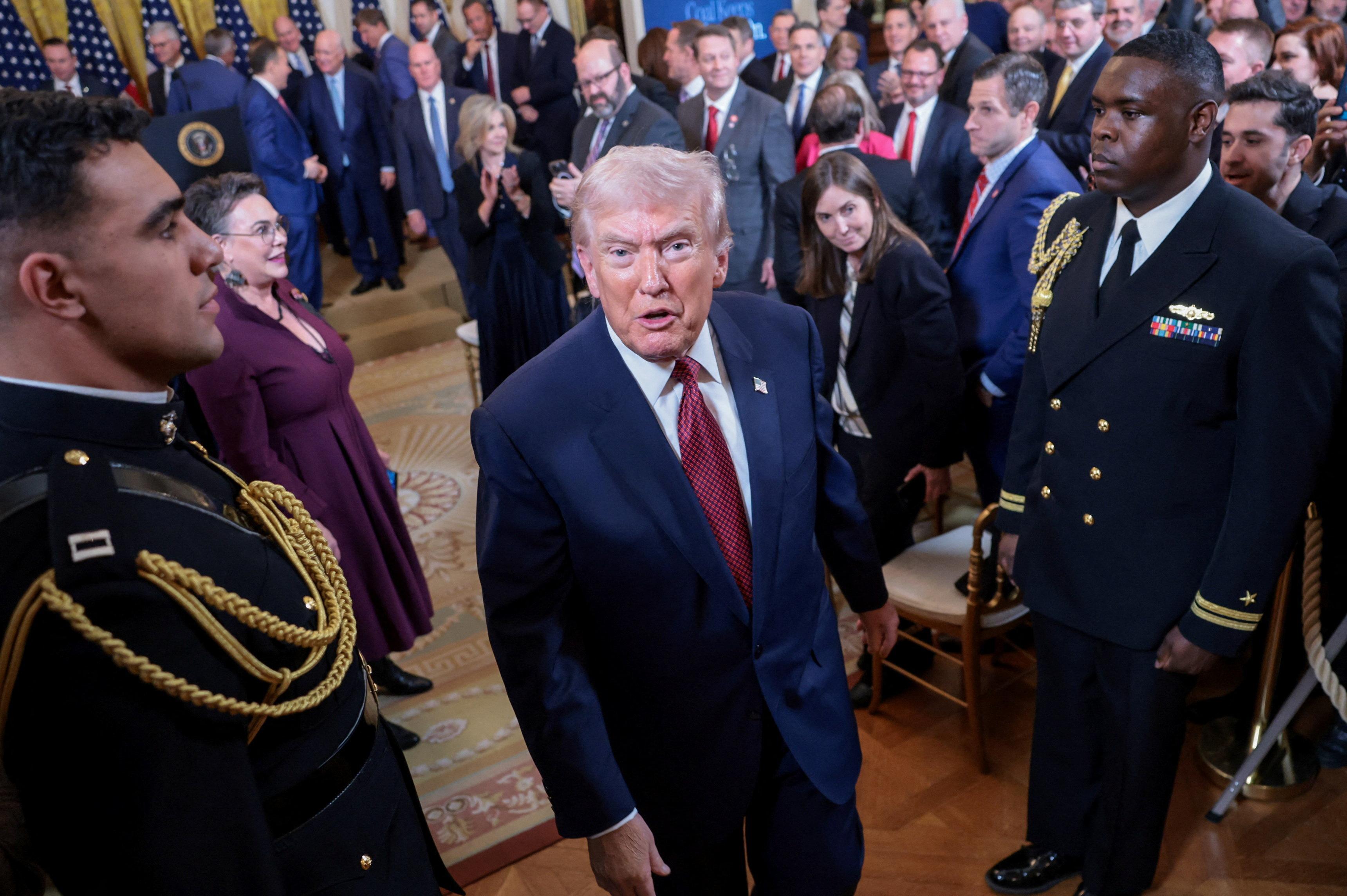
President Donald Trump will deliver the traditional State of the Union address to Congress on Tuesday at a fraught moment for his presidency, with his approval ratings slumping, anxieties rising over Iran and Americans struggling with the cost of living as the November midterm election nears.
The televised prime-time speech to Congress, his second in the 13 months since returning to the White House, offers Trump a chance to persuade voters to keep Republicans in power. But it comes as he faces stiff political headwinds at home and abroad.
The appearance follows a turbulent few days for his administration, including a Supreme Court decision invalidating his global tariff regime and new data showing the economy slowed more than expected while inflation accelerated.
The Department of Homeland Security is mostly shut down due to a dispute between congressional Republicans and Democrats over the administration’s aggressive immigration tactics, following the fatal shootings of two U.S. citizens in Minneapolis. Meanwhile, Trump has struggled to turn the page on the scandal surrounding the government’s release of files related to convicted sex offender Jeffrey Epstein.
Trump, who has openly coveted the Nobel Peace Prize and set up his own “Board of Peace,” appears to be inching closer to a military conflict with Iran over its nuclear program, moving warships to the Middle East and developing plans that could include a change of government, according to U.S. officials.
How many wars has US president solved?
ARMENIA AND AZERBAIJAN
Trump brought together the leaders of Armenia and Azerbaijan on August 8 to sign a joint declaration pledging to seek peaceful relations between nations that have been at odds since the late 1980s.
“I got to know them through trade,” Trump said later in a radio interview. “I was dealing with them a little bit, and I said, ‘Why you guys fighting?’ Then I said, ‘I’m not going to do a trade deal if you guys are going to fight. It’s crazy.'”
The two countries had committed to a ceasefire in 2023. In March, they said they had agreed on the text of a draft peace agreement, but that deal has not been signed.
The subsequent White House-brokered declaration falls short of a formal peace treaty that would place legally binding obligations on both sides. Issues remain, including whether an agreement requires Armenia to revise its constitution.
The leaders struck economic agreements with Washington that granted the U.S. development rights to a strategic transit corridor through southern Armenia. The Trump administration said this would allow for more energy exports. In documents released at the time, the corridor was named after Trump. U.S. Vice President JD Vance visited both countries in February, signing a strategic partnership with Azerbaijan and a nuclear deal with Armenia.
CAMBODIA AND THAILAND
Tensions remain between Thailand and Cambodia despite the fragile ceasefire earlier brokered in part by Trump.
The U.S. president had helped bring Thailand to the table for talks after long-simmering tensions with Cambodia spilled over in July into a five-day military conflict, the deadliest fighting between the two in more than a decade.
Trump had reached out to then-acting Thai Prime Minister Phumtham Wechayachai two days after fighting erupted along a stretch of the border. Trump withheld trade deals with both countries until the conflict ended.
The U.S. president oversaw the signing of a ceasefire deal between the two countries in Malaysia in October, which broke down within a matter of weeks before a new ceasefire was reached on December 27.
ISRAEL, IRAN AND THE PALESTINIAN TERRITORIES
Trump chaired the first meeting of his Board of Peace initiative on Thursday, as part of a bid to direct a deal aimed at ending conflict in – and redeveloping – Gaza.
Israel and the Palestinian militant group Hamas agreed in October to the first phase of a Trump-brokered hostage and ceasefire deal. Hostilities have continued.
But the agreement nonetheless marked a major step forward for efforts to end a two-year war in Gaza in which more than 67,000 Palestinians have been killed. Under the deal, Hamas handed over hostages seized in the deadly attacks that started the assault. Both, however, have repeatedly accused each other of violating the truce.
Both sides remain far apart on major issues, including Hamas’ disarmament, the governance of post-war Gaza and the composition and mandate of an international security force in the enclave.
The U.S. president has also been working to expand the Abraham Accords, an initiative from his first term aimed at normalizing diplomatic ties between Israel and Arab nations.
The Republican initially pursued talks with Iran over its nuclear program. Israel launched an aerial war on Iran on June 13 and pressed Trump to join in. He did on June 22, bombing Iranian nuclear sites. He then pressed Israel and Iran to join a ceasefire that Qatar mediated.
Trump said at the time that Iran’s key nuclear sites were obliterated and disputed reports that the program had merely been set back. But in recent weeks, Trump has threatened Iran over both that nuclear program and the government’s human rights practices. He has ordered a huge buildup of forces in the Middle East and preparations for a potential multi-week air attack on the country.
RWANDA AND DEMOCRATIC REPUBLIC OF THE CONGO
The Rwanda-backed rebel group M23 staged a lightning offensive this year and now holds more territory than ever in the eastern Democratic Republic of Congo. Its recent advances have stirred fears of further regional spillover of fighting.
Under pressure from Trump, Rwanda and Congo signed a U.S.-brokered peace agreement on June 27. It hasn’t been implemented.
Trump brought the leaders of Congo and Rwanda to a Washington event on December 4 at a peace institute that his administration unofficially renamed in honor of the U.S. president. There, they signed more documents affirming their commitment to Trump’s peace plan.
But the fighting has continued. Congolese President Felix Tshisekedi has said that Rwanda is violating its commitments, as has U.S. Secretary of State Marco Rubio. Rwanda has long denied backing M23, but U.N. experts and Congolese leaders disagree. Qatar has brokered separate talks between Congo and M23.
Meanwhile, the leader of a Congolese rebel coalition that includes the M23 group has said a deal on critical minerals signed in December between Congo and Washington was unconstitutional, raising doubts about its implementation.
The insurgency is the latest episode in a decades-old conflict with roots in the 1994 Rwandan genocide.
Trump has warned of “very severe penalties, financial and otherwise” if the agreement is violated. The U.S. is seeking access to Congo’s vast array of critical minerals as it competes with China for control of natural resources.
INDIA AND PAKISTAN
U.S. officials worried conflict could spiral out of control when nuclear-armed India and Pakistan clashed in May following an attack in India that Delhi blamed on Islamabad.
Consulting with Trump, Rubio and Vance pushed Indian and Pakistani officials to de-escalate the situation.
A ceasefire was announced on May 10 after four days of fighting. But it addressed few of the issues that have divided India and Pakistan, which have fought three major wars since their independence from the United Kingdom in 1947.
Days after the ceasefire, Trump said he used the threat of cutting trade with the countries to secure the deal. India disputed that U.S. pressure led to the truce and that trade was a factor.
EGYPT AND ETHIOPIA
Egypt and Ethiopia have a long dispute over the Grand Ethiopian Renaissance Dam, which Cairo regards as a national security issue and fears will threaten its Nile River water supplies.
“We’re working on that one problem, but it’s going to get solved,” Trump said in July.
White House spokeswoman Karoline Leavitt later included Egypt and Ethiopia in a list of conflicts that “the president has now ended.”
It is unclear what Trump is doing on the issue, though he has said he wants to bring the parties together for talks. In public comments, Trump has largely echoed Cairo’s concerns.
Ethiopia’s Prime Minister Abiy Ahmed opened the dam in September despite objections from both Sudan and Egypt. Egypt’s president, Abdel Fattah al-Sisi, has vowed to protect his own country’s interests.
SERBIA AND KOSOVO
Kosovo and Serbia maintain tense relations five years after agreements Trump brokered with both during his first term to improve their economic ties.
Without providing evidence, Trump said in June he “stopped” war between the countries during his first term and that “I will fix it, again,” in his second.
Kosovo declared independence in 2008, almost a decade after NATO bombed Serb forces to halt the killing and expulsion of ethnic Albanians from the region during a 1998-1999 counter-insurgency war.
But Serbia still regards Kosovo as an integral part of its territory. The countries have signed no peace deal.
Kosovo’s prime minister, Albin Kurti, has sought to extend government control over the north, where about 50,000 ethnic Serbs live, many of whom refuse to recognize Kosovo’s independence.
Kosovo’s president, Vjosa Osmani, said in July that over “the last few weeks,” Trump had prevented further escalation in the region. She did not elaborate, and Serbian President Aleksandar Vucic denied that any escalation had been looming.
RUSSIA AND UKRAINE
Trump, who said during the 2024 presidential campaign that he could solve the war in Ukraine in one day, has so far been unable to end the nearly four-year-old conflict that analysts say has left more than 1 million people dead or wounded.
“I thought this was going to be one of the easier ones,” Trump said on August 18. “It’s actually one of the most difficult.”
Trump’s views on how to best bring peace have swung from calling for a ceasefire to saying a deal could still be worked out while fierce fighting continued. He imposed sanctions on Russia’s two biggest oil companies in October.
More recently, Trump has attempted to press Ukrainian President Volodymyr Zelenskiy into accepting a deal to end the war that European leaders worry would favor Moscow and destabilize the continent. Talks in recent days have produced few signs of progress.
SOUTH KOREA AND NORTH KOREA
Trump has said he wants to meet North Korean leader Kim Jong Un and make another push towards peace.
“We’ll come back, and we’ll, at some point in the not-too-distant future, meet with North Korea,” Trump told reporters in October on a trip to South Korea.
Trump and Kim held three summits during Trump’s 2017-2021 first term. They also exchanged several letters that Trump called “beautiful” before the unprecedented diplomatic effort broke down over U.S. demands that Kim give up his nuclear weapons.
North Korea has surged ahead with more and bigger ballistic missiles, expanded its nuclear weapons facilities, and gained new support from its neighbors in the years since. In his second term, Trump has acknowledged that North Korea is a “nuclear power.”
Kim said in September that there was no reason to avoid talks with Washington if it dropped its demands that his country give up nuclear weapons. Trump agreed to support Seoul’s pursuit of a nuclear-powered submarine for its own defense.
A PUBLIC CASE AGAINST IRAN
Tuesday’s speech could offer Trump a chance to mount for the first time a public case for military intervention in Iran.
Two White House officials, speaking on condition of anonymity, said Trump will discuss his plans for Iran but did not offer details.
He will also tout his record of brokering peace deals, they said. He will be speaking on the fourth anniversary of Russia’s invasion of Ukraine, a reminder that he has yet to resolve the war he once said he could end “in 24 hours.”
The president is expected to address the Supreme Court’s decision on tariffs, arguing that the court erred and outlining alternative laws he can use to reconstitute most of the levies.
Trump reacted with fury to the ruling last week, targeting several justices with personal attacks. A repeat performance on Tuesday could make for some awkward moments; at least some of the court’s nine justices are expected to attend.
White House aides and Republican campaign advisers, eyeing a challenging congressional midterm election, have urged Trump to focus on Americans’ economic worries. Trump’s victory in the 2024 election was based in large part on his promises to ease the cost of living, but opinion polls show voters are unconvinced by his efforts so far.
Trump has struggled to stay on message, straying in public speeches from the economy to his long list of grievances while at other times declaring he has already solved the problem.
One of the White House officials said Trump will “claim victory on the economy,” a message Republican lawmakers running for reelection are unlikely to welcome. He will argue that he inherited a poor economy from Democratic predecessor Joe Biden and that Democrats have overstated affordability concerns, both officials said.
Trump will point to stock market gains, private-sector investments and his tax cut legislation as evidence that he has helped the economy, the officials said. The president will also tout his tough border policies and his deportation campaign, despite polls showing most Americans believe his administration has gone too far in rounding up undocumented immigrants.
“This is the one opportunity the president has where the whole world is looking at what he has to say, and this is his opportunity to summarize everything that he’s done and not go off script,” said Amanda Makki, a Republican strategist and former Florida congressional candidate.
Trump, who has a propensity for ad-libbing, said on Monday his address would be lengthy. His 100-minute speech last March – technically not a State of the Union speech, but otherwise similar – was the longest presidential address to Congress in modern history.
The White House officials said this year’s edition was crafted with room for unscripted moments.
“We are planning around it,” one official said.
SOME DEMOCRATS OPTING OUT
Last year, some Democrats interrupted Trump’s speech with jeers before walking out in protest. This time around, more than 20 Democrats in the House of Representatives and Senate plan to skip the speech altogether in favor of an outdoor rally on the National Mall.
Senator Jeff Merkley of Oregon, one of those Democrats, told reporters on Monday the event would offer a more “honest description” of Trump’s record, rather than the “propaganda push” of the speech.
Virginia Governor Abby Spanberger, whose decisive victory in November was seen as an early midterms warning sign for Republicans, will deliver the official Democratic response to the speech.
Democratic U.S. Senator Alex Padilla of California, who was shoved to the ground and handcuffed last year after attempting to ask a question of Homeland Security Secretary Kristi Noem at a press conference, will give the Spanish-language rebuttal.




Click here to change your cookie preferences