
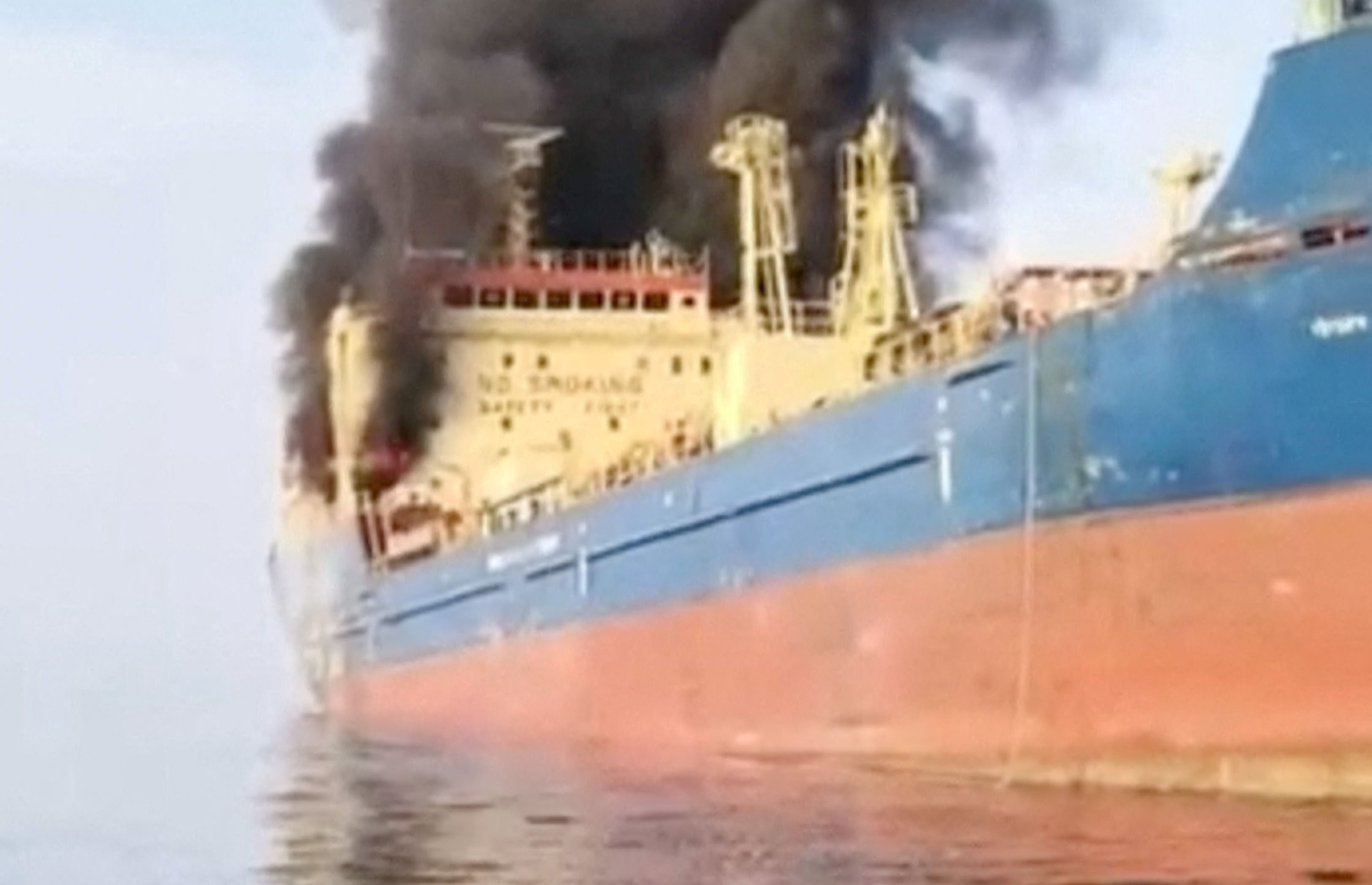
Iran’s Revolutionary Guards said a fuel tanker, identified as the Honduran-flagged Athe Nova, was burning in the Strait of Hormuz after being hit by two drones, Iranian news agencies reported on Monday.
The strait is the world’s most vital oil export route, connecting the biggest Gulf oil producers, such as Saudi Arabia, Iran, Iraq and the United Arab Emirates, with the Gulf of Oman and the Arabian Sea.
A Guards statement said the vessel was acting in “unison with America” and identified it as Athen Nova. VesselFinder and other tracking data providers showed the Athe Nova, a 96-meter tanker, was in the area shortly before the attack.
An Iranian military spokesman did not explicitly state that the ship was hit by Iranian drones but named the incident in a report he gave on state TV about the Guards’ military operations in the Gulf area.
Iranian media reports suggested that the vessel was providing fuel for US Navy ships.
Reuters was not immediately able to contact Athe Nova’s registered owner. The ship’s manager did not immediately comment.
Meanwhile, an Iranian Revolutionary Guards senior official said on Monday that the Strait of Hormuz is closed and Iran will fire on any ship trying to pass, Iranian media reported.
This is Iran’s most explicit warning since telling ships it was closing the export route on Saturday, a move that threatens to choke a fifth of global oil flows and send crude prices sharply higher.
“The strait (of Hormuz) is closed. If anyone tries to pass, the heroes of the Revolutionary Guards and the regular navy will set those ships ablaze,” Ebrahim Jabari, a senior adviser to the Guards commander-in-chief, said in remarks carried by state media.
The strait is the world’s most vital oil export route, which connects the biggest Gulf oil producers, such as Saudi Arabia, Iran, Iraq and the United Arab Emirates, with the Gulf of Oman and the Arabian Sea.
The closure was triggered by US and Israeli strikes on Iran on February 28 seeking to topple its leaders, with US President Donald Trump offering Iranians help in ousting the ruling clerics.
In response, Iran fired several barrages of missiles at its Gulf neighbours hosting US military bases such as Qatar, Kuwait and Bahrain. Tehran also fired missiles at the United Arab Emirates, Saudi Arabia and Oman.
With this closure, Tehran made good on years of threats to block the narrow waterway in retaliation for any attack on the Islamic Republic.
About 20 per cent of the world’s daily oil consumption passes through the Strait of Hormuz, which is about 33 kilometers (21 miles) wide at its narrowest point.
Oil markets have focused on tensions between Tehran and its old foes, the US and Israel, fearing that a full-blown conflict would disrupt supplies and destabilise the region.
The move also comes after global shipping had already experienced disruptions linked to drone and missile attacks carried out by Yemen’s Iran-aligned Houthi militants. The group has targeted vessels in the Red Sea and the Gulf of Aden since the Gaza war broke out in 2023.





Click here to change your cookie preferences