
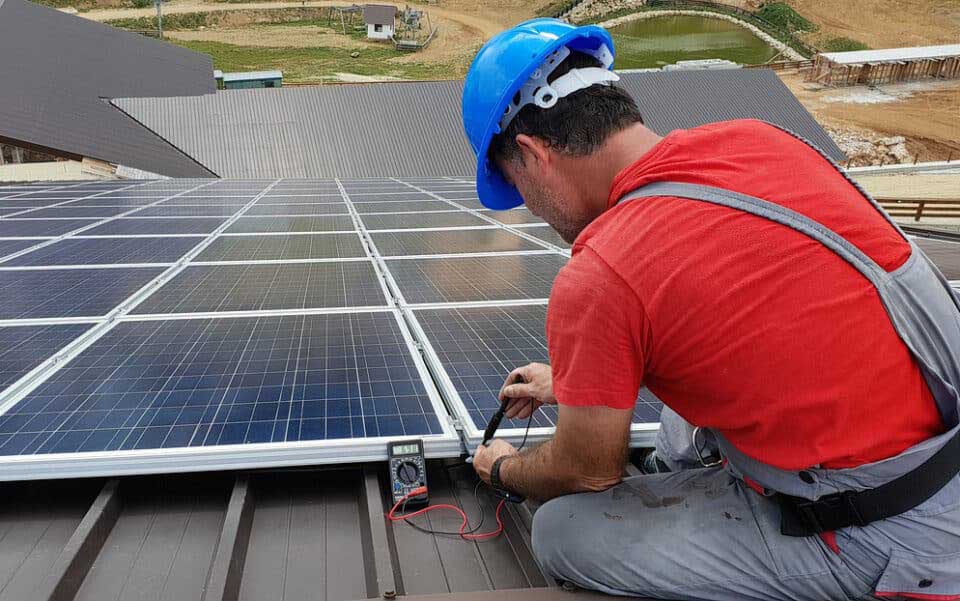
A law requiring compensation for surplus electricity generated by photovoltaic systems has been referred back to parliament on Thursday by President Nikos Christodoulides.
The decision was taken following the law’s passage in March and centres on provisions that would have obligated the state to cover the cost of compensating households and small businesses for excess solar energy.
The legislation, proposed by Diko MP Michalis Yiakoumis, aimed to address distortions in existing photovoltaic schemes by ensuring that surplus energy fed into the grid would be compensated rather than written off.
It required the cabinet to determine compensation rates through a decree, while explicitly preventing those costs from being passed on to electricity consumers or incorporated into system charges.
In a letter to House speaker, Annita Demetriou, Christodoulides outlined three main grounds for referral.
He argued that the exclusion of cost recovery through the electricity market effectively leaves the state budget as the only source of funding.
This, he said, conflicts with Article 80 of the constitution, which prohibits parliament from imposing expenditure without the consent of the executive.
According to the president, the structure of the law “necessarily leads to a burden on the state budget”, making it constitutionally problematic.
The president also raised concerns over the law’s retroactive application.
He insisted that its provisions extend to support schemes that were already in place before the legislation entered into force.
While retroactively amending a decree is not explicitly prohibited under case law of the supreme court, he stated that it is considered undesirable and creates legal uncertainty.
The inclusion of earlier schemes within the scope of the law was therefore identified as a second point requiring reconsideration.
A third objection relates to the principle of separation of powers.
Christodoulides argued that the legislature had overstepped its role by directing the government to act in a specific manner.
By obliging cabinet to issue a decree setting compensation terms, the law was seen as intervening in executive functions.
The president stated that this constitutes an infringement on the constitutional balance between the branches of government.
Christodoulides stated that the proposed measure would affect existing policies governing self-consumption and “could create inconsistencies with current energy support schemes”.
The legislation was designed to correct perceived inequities in residential photovoltaic programmes, where surplus electricity is often not remunerated.
Under the proposed law, the cabinet would have been required to establish a mechanism for compensating surplus generation from residential and small commercial installations.
However, by excluding the possibility of recovering costs through tariffs or market mechanisms, the financial responsibility would fall entirely on public funds.





Click here to change your cookie preferences