
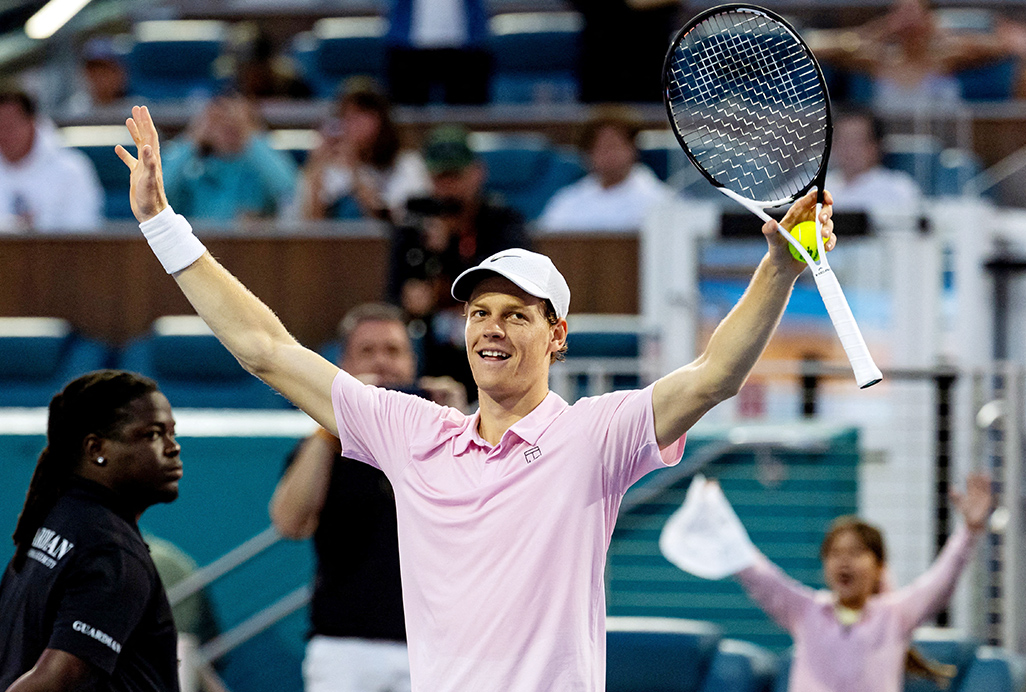
Jannik Sinner was once viewed as an explosive talent custom-built for hardcourt tennis but the four-times Grand Slam champion’s assiduous work on his patience and control has made him the man to beat on clay heading into the French Open.
It had long been assumed that in his era-defining rivalry with Carlos Alcaraz, Sinner would scoop up more Grand Slam titles on faster surfaces while the Spaniard would have the edge on red dirt.
Alcaraz, who has won seven majors, remains a formidable claycourt player and is the reigning Roland Garros champion but lost to Sinner in the Monte Carlo final earlier this month. He then suffered a wrist injury in Barcelona that has disrupted his preparations for Paris.
Sinner’s progression will continue this week in Madrid, which is at a higher altitude than the other European clay venues and quickens the pace of the surface, offering another opportunity for the 24-year-old to showcase his adaptability.
“Here it’s a very unique playing style,” Sinner said.
“It’s a very high altitude and it can be windy at times, so it’s very difficult to play. But I think every different kind of claycourt can help me as I’m trying to improve as a player.”
Results at the big tournaments seemingly offer little to choose between Sinner and Alcaraz over the last couple of years but former player and sports psychologist Jeff Greenwald believes he has identified some subtle differences emerging.
“Sinner, even more than Alcaraz, has this unflappable demeanour that is built from this deep love and appreciation of the process,” Greenwald told Reuters.
“He’s the poster child for mastery, a desire to be as good as he can be, which overrides the ever fluctuating, short-term obsession with this point, this win, that is almost always trading the short-term result for longer-term success.”
DECISIVE ADVANTAGES
That focus on mastery over moments has steadily reshaped Sinner’s approach on clay, where his tactical discipline and ability to handle uncertainty are standing out as decisive advantages ahead of the French Open, which begins on May 24.
Sinner’s mental strength could be tested in a different way as he confronts the weight of expectation that comes with being seen by many as the favourite rather than the challenger over the next few weeks.
Greenwald said expectations were the most natural, yet potentially damaging, distractions for even great players.
“They try to not get preoccupied by them with the ‘process mindset’ as best they can but most of the players are vulnerable to this reality, given that their livelihoods are on the line,” he added.
“This is where Sinner has an advantage … he didn’t develop this (mindset) after becoming successful. It was baked into his training and development. So whether he’s labelled a favourite by the media and other players, this will not affect him.
“More than anything, it’ll only solidify the confidence, remarkable resilience and joy he brings to every match.”
If Alcaraz is fit to play, the French Open could prove a major mental test for Sinner after he lost to his great rival in last year’s epic title clash.
However, with the career Grand Slam on the line for the Italian, he wants Alcaraz to be on the other side of the net at Roland Garros.
“When you want to win, you want to do it by beating the best and he’s among them,” Sinner said.



Click here to change your cookie preferences