
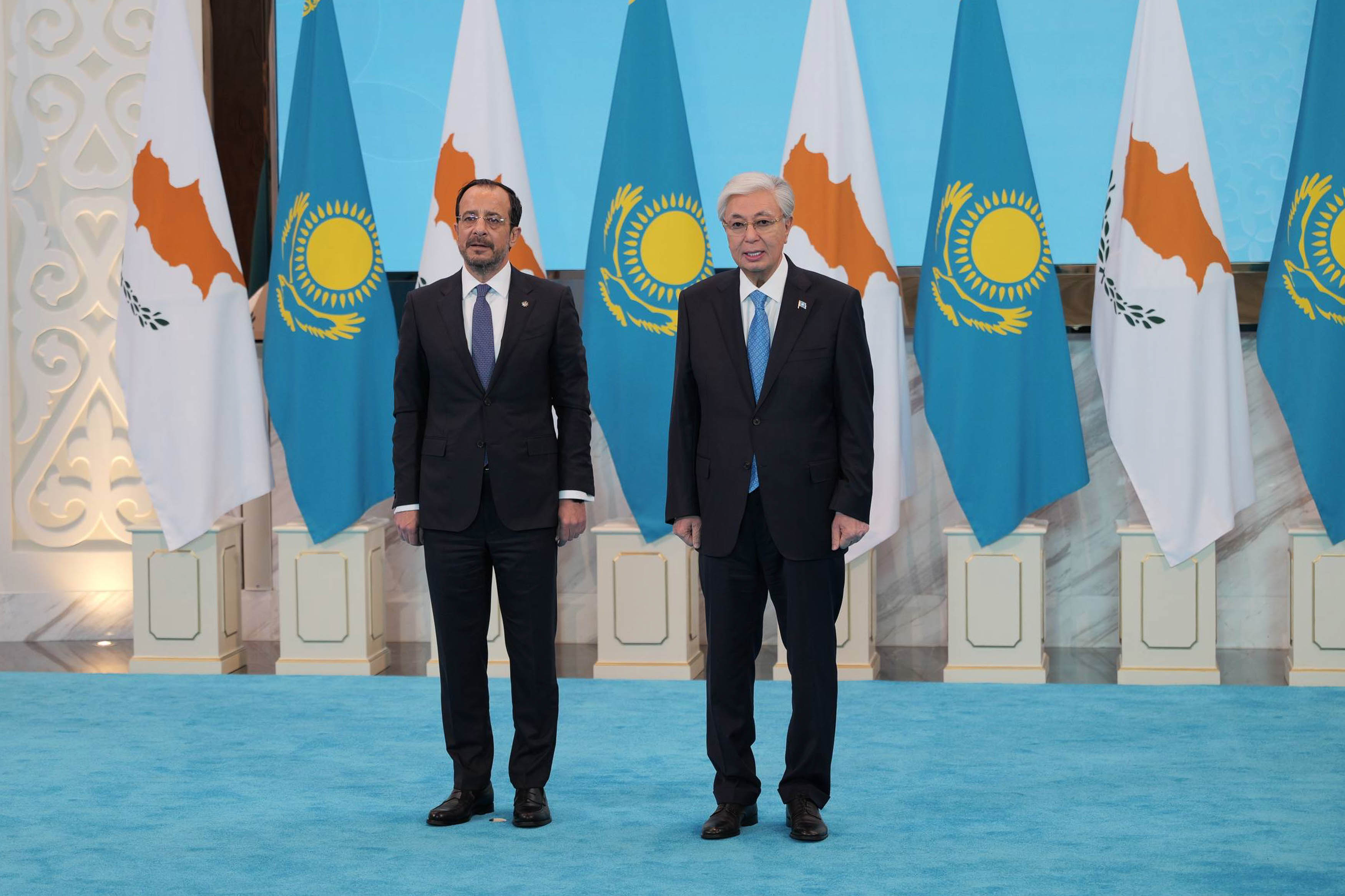
Cyprus stands ready to strengthen cooperation with Kazakhstan, particularly in business, connectivity, energy, investments and tourism, President Nikos Christodoulides said on Wednesday.
Christodoulides also attended the official inauguration of the Cyprus embassy in Astana, in a move described as a milestone in strengthening bilateral relations between the two countries.
Christodoulides, who is on an official visit in Astana, held a private meeting with President Kassym-Jomart Tokayev and signed a number of memoranda of understanding (MoU) in “important fields”, including in higher education, scientific research, culture, sports, innovation, digital governance and information technologies.
These agreements, he said, were not simply technical arrangements, but “tangible proof of our shared ambition to transform the great potential of our bilateral relations into a more structured and substantive framework of cooperation”.
Christodoulides said it was “a true pleasure, as well as a distinct honour to be in Kazakhstan today – a distinct honour because I have the privilege of being the first ever president of the Republic of Cyprus to visit Kazakhstan”.
Tokayev reaffirmed the mutual will to enhance cooperation and supported constructive diplomacy and stability through dialogue.
The Kazakhstani president decorated Christodoulides with the medal of the order of friendship for promoting international cohesion, coexistence and cooperation among nations.
He furthermore said he had invited Cyprus to participate in the TransGas project concerning, as the island was considered an international shipping centre.
Tokayev pointed out that over 400 companies with Cypriot capital were operating in Kazakhstan.
“In our discussions today with the president, we confirmed our strong political will to further strengthen relations between Cyprus and Kazakhstan. Relations that continue to grow stronger – politically, economically and strategically,” Christodoulides said.
He added that they “also underlined the importance of maintaining regular exchanges at all levels, because sustained political dialogue is essential to building trust and delivering tangible results”.
The two presidents also discussed the “significant opportunities” that exist in the fields of trade, investment and economic cooperation where Cyprus and Kazakhstan possess “complementary advantages that can bring our peoples and economies even closer together”.
“Kazakhstan continues to strengthen its role as a major economic and transport hub in Central Asia, and Cyprus, as a member state of the European Union and the Eurozone, offers stability, predictability and a fully EU-aligned business environment – a reliable gateway to Europe and the Eastern Mediterranean,” Christodoulides pointed out.
He explained that this was the reason the two presidents “also explored opportunities for enhanced cooperation in areas such as financial services, shipping, ICT, FinTech, logistics and renewable energy, as well as closer cooperation with the Astana International Financial Centre – an important platform for investment and business synergies”.
“And when speaking about synergies, I would be remiss not to highlight the launch of direct air connectivity linking Larnaca with Astana and Almaty. This is a substantial development in our efforts to bring our people closer together and to open new avenues for tourism, trade and broader business cooperation. And I am very pleased that yesterday, my delegation and I arrived in Astana with the inaugural direct flight from Larnaca,” he added.
They also discussed the important step they took in establishing resident embassies in Astana and Nicosia in 2025.
Speaking at the official inauguration of the Cyprus embassy in Astana Foreign Minister Constantinos Kombos said Cyprus and Kazakhstan had coordinated the simultaneous opening of diplomatic missions in Nicosia and Astana, demonstrating their shared commitment to deepening cooperation.
He added that the presidents of both countries had provided clear political direction for advancing bilateral relations and described the opening of the embassy as the beginning of a more ambitious and forward-looking partnership. The ceremony was also addressed by Cyprus’ ambassador to Kazakhstan, Petros Nakouzis, and Kazakhstan’s ambassador to Cyprus, Nikolay Zhumakanov.



Click here to change your cookie preferences