
Government defends Mafia State investigators amid conflict claims
The government on Friday sought to defend the composition of the criminal investigation team appointed to carry out an inquiry into the Mafia State report after concerns over potential conflicts of interest were raised.
Speaking to Omega, government spokesman Konstantinos Letymbiotis rejected claims that the appointments were an improvised solution after a series of refusals from other lawyers.
“None of the five reputable lawyers participating in this group was a last resort, for God’s sake,” he exclaimed, insisting the investigators were selected for their experience and that “their resumes precede them”.
He confirmed that the government had indeed been aware of criminal law professor Christos Mylonopoulos’ previous involvement in the Focus case before the appointments were finalised and said his exclusion from that part of the inquiry was to ensure there was no conflict of interest.
Deputy government spokesman Yiannis Antoniou said there was “no issue of conflict of interest” in the investigative team tasked with examining allegations arising from the anti-corruption authority’s findings, including possible criminal offences involving former president Nicos Anastasiades and other public officials.
Speaking on CyBC radio, Antoniou said safeguards had been introduced to protect the integrity of the investigation.
The cabinet named a five-member team on Thursday.
Antoniou said Mylonopoulos had disclosed from the outset that he had previously acted in matters connected to the Focus case, adding that this admission demonstrated “good faith and transparency”.
He said the head of the investigative team, former European Court of Justice president Vassilios Skouris, subsequently decided that Mylonopoulos would be excluded from all aspects of the inquiry concerning Focus “so that no issue arises surrounding the process”.
Although Mylonopoulos’ exclusion from the Focus element of the investigation was later confirmed, questions emerged over why the conflict had not been publicly addressed when the appointments were first announced.
Letymbiotis subsequently confirmed the cabinet had been aware of the issue before the appointments were finalised and said the exclusion had formed part of the agreed arrangements.
The investigative team is headed by Skouris and in addition to Mylonopoulos, consists of former Family Court president Sotiris Liasides, lawyer Nikolas Koursaris and criminal lawyer Dimitris Tsolakidis.
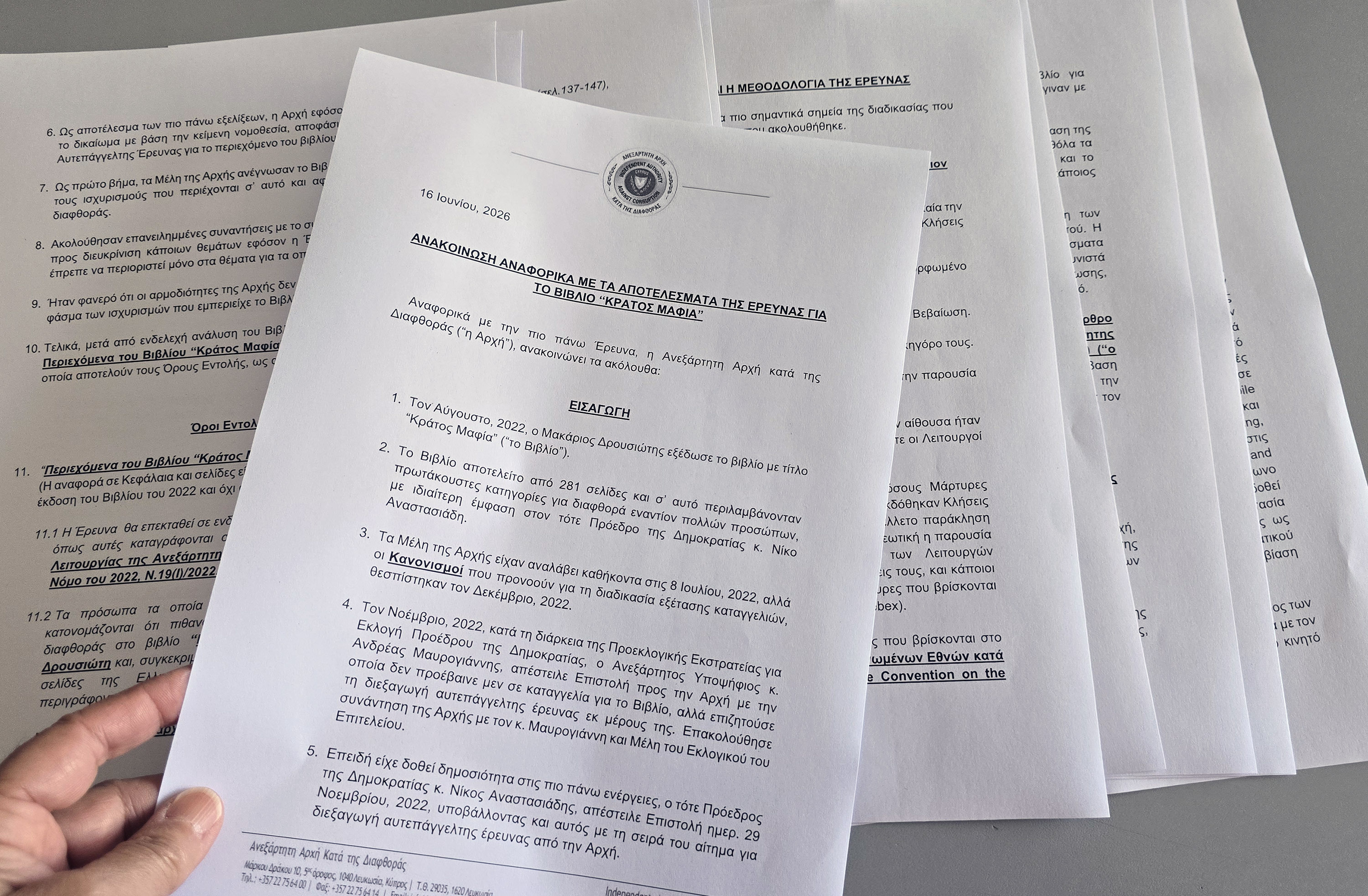
Their appointment follows the completion of the anti-corruption authority’s investigation into allegations contained in journalist Makarios Drousiotis’ book Mafia State, an inquiry involving around 150 witnesses, approximately 200 hearings and hundreds of exhibits.
The appointments have also prompted wider debate within the legal community over whether an independent prosecutor should supervise the investigation rather than the legal service.
Speaking to news outlet Reporter, advocate Achilleas Demetriades argued that appointing independent investigators represented “only 50 per cent of the effort”, saying an independent prosecutor should oversee the evaluation of evidence and determine whether criminal charges should ultimately be brought.
Demetriades also questioned whether Mylonopoulos’ partial exclusion adequately addressed the issue of impartiality.
“If what they say is true, he should not take the job,” he said.
Other legal commentators have also questioned the continued involvement of the legal service in the next stage of proceedings after the attorney-general George Savvides and deputy attorney-general Savvas Angelides recused themselves from handling the matter.
They argue that any prosecutorial decisions should instead be entrusted to an independent prosecutor to strengthen public confidence in the process. In the absence of Savvides and his deputy, the legal service’s prosecutorial council is set to make any decisions about the case.
Antoniou rejected suggestions that political considerations would influence the inquiry and said responsibility for any future criminal prosecutions rests solely with the legal service.
He stressed that “the entire process should proceed with full respect for the presumption of innocence” while reiterating that “no one is above the law”.
He also said the government hoped the investigators would complete their work before the initial six-month mandate expires, although he acknowledged that a reasonable extension could be granted if properly justified.
The five investigators are expected to begin reviewing the anti-corruption authority’s report immediately before determining the direction and scope of the criminal investigation.





Click here to change your cookie preferences