
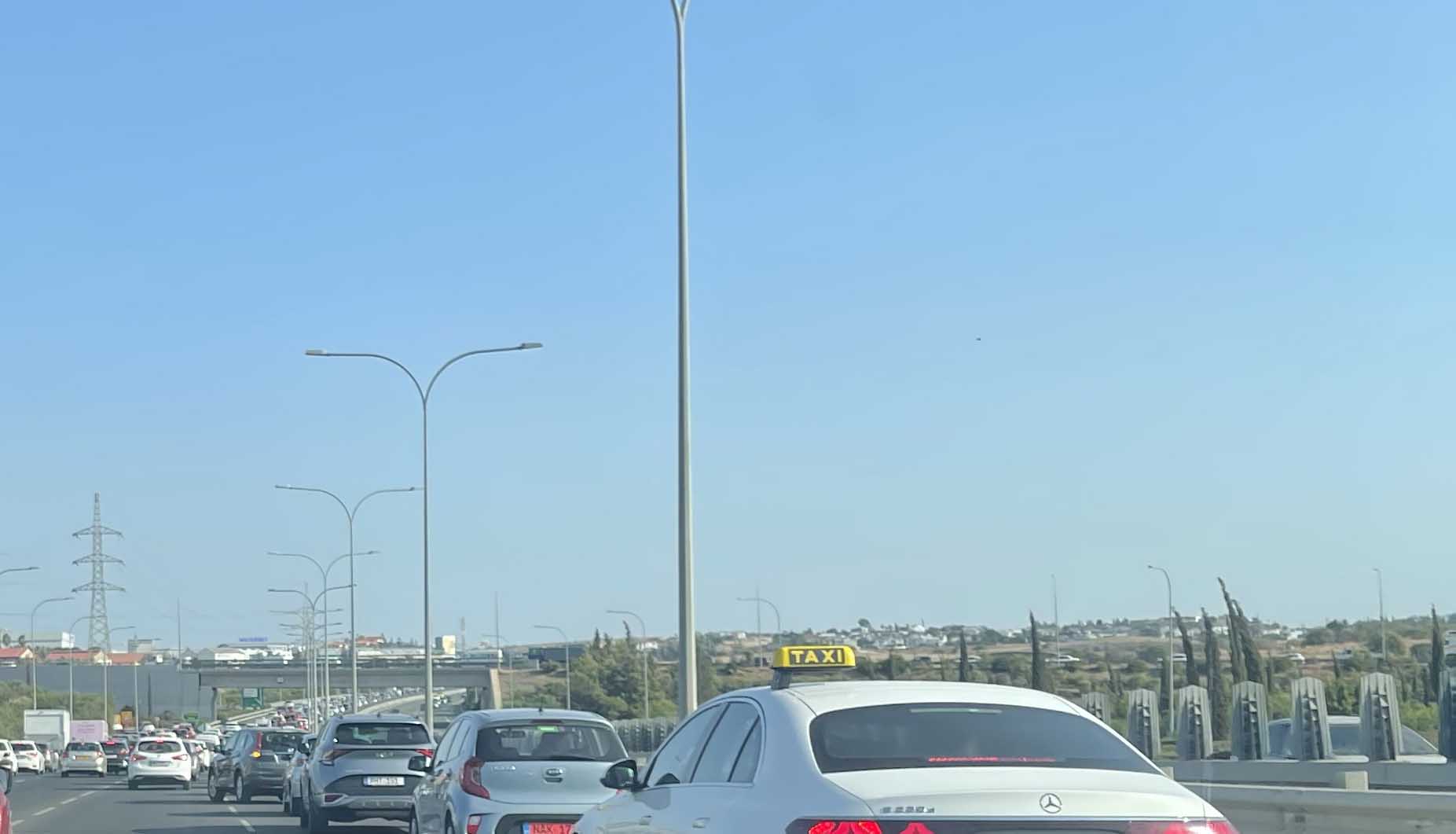
Police have defended their handling of Thursday’s motorway closure, saying the hours-long disruption on the Limassol-Nicosia highway was unavoidable because of the complexity of recovering a heavy goods vehicle and clearing tonnes of gravel from the carriageway.
Speaking to the Cyprus Mail, traffic police spokesman Giorgos Milis said the incident affected traffic in both directions after a truck weighing more than 35 to 40 tonnes overturned and spilled its load onto the road.
“The incident affected both directions because of the cargo that was spilled onto the carriageway,” he said. “We were dealing with a truck weighing more than 35 to 40 tonnes, so cranes were needed to recover it and the road also had to be cleaned.”
Milis explained that whenever a heavy goods vehicle is involved, specialised recovery cranes must be used and these can be located anywhere in Cyprus.
“In this case, the crane came from Larnaca,” he said, adding that the cranes are called by the truck’s insurance company rather than by police. Ultimately, two cranes were required to recover the vehicle.
Asked why motorists remained trapped for several hours, Milis said safety could not be compromised.
“Safety rules do not allow for haste. If a crane lifts the load incorrectly, the crane itself could overturn.”
He described incidents of this scale as rare, occurring only once or twice a year, but noted that any prolonged closure on the Limassol-Nicosia motorway has major consequences because it is Cyprus’ busiest road.
Responding to criticism over the apparent lack of police presence, Milis said officers had been deployed to manage traffic and divert vehicles onto the old Limassol-Nicosia road.
“We staffed three key junctions with police officers to help keep traffic moving. We had a three-lane motorway that suddenly had to be channelled into a single lane before traffic could be diverted.”
He added that every major incident is assessed according to its circumstances and that delays are inevitable when several agencies are involved.
“In this case, the public works department, the fire service and the two crane operators were all involved. We immediately issued announcements informing the public that the motorway had been closed and that traffic was being diverted.”
The motorway was closed shortly after 5.15pm on Thursday after a truck overturned near the Dali industrial area, spilling a large quantity of gravel across both carriageways. Traffic was diverted onto the old Limassol-Nicosia road, with the motorway reopening shortly after 11pm.
Following the incident, civil engineer and transport expert Neophytos Zavrides suggested restricting heavy goods vehicles from using motorways during peak hours.
He proposed banning trucks above a certain weight from category A roads between approximately 7am and 5pm, arguing that vehicles carrying construction materials and other heavy loads could instead use the old category B road network.
“It is not logical for these vehicles to be using the busiest roads during the hours when people are taking their children to school or travelling to work,” he said, adding that exceptional journeys could still be permitted through a police authorisation and escort system.
Despite the diversion measures, hundreds of motorists remained trapped for hours on what was the hottest day of the year.
Cyprus Mail journalist Rebekah Gregoriades was among those caught in the congestion.
“It normally takes me 25 minutes to get home, but on Thursday it took me four hours, and I was one of the lucky ones,” she said. “Others told me they had been stuck for seven hours.”
With temperatures reaching 40C, conditions quickly became unbearable.
“It wasn’t just the air temperature. It was also the heat coming from hundreds of engines.”
Some vehicles succumbed to the conditions.
“There were cars breaking down, with water pouring from overheated engines. Many of us, especially those driving older cars, switched off the air conditioning to stop the engines overheating.”
The greatest concern, however, was for vulnerable passengers.
“There were elderly people and children suffering. I saw one man get out of his car, open the back door and lift an infant into his arms while blowing on the baby to try to cool it down.”
Access to drinking water also became a problem.
“For a journey that usually takes half an hour, you don’t keep large supplies of cold water in the car. We were desperate. By the time I finally reached a kiosk, my mouth was so dry I could barely speak.”
Looking back, she said there were lighter moments amid the frustration.
“There was a man in a sports car who kept changing lanes every time traffic moved a few metres. After a couple of hours he started sounding his horn, eventually annoying everyone around him, who all began hooting back. After all that, he still ended up a few cars behind me when we finally started moving.”




Click here to change your cookie preferences