
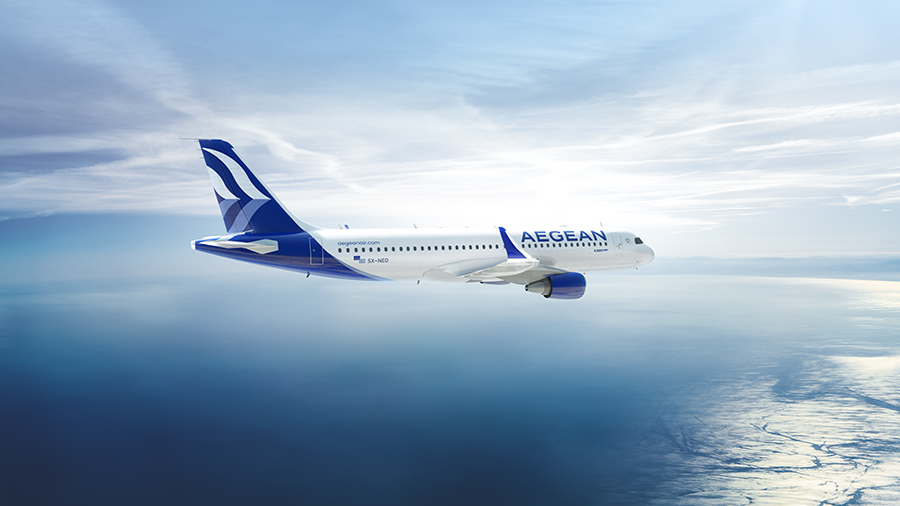
Aegean Airlines returned to profit in the second quarter of 2026, but it was not enough to prevent a €3.3 million net loss for the first half, as higher fuel and emissions costs and disruption to its Middle East network weighed heavily on earnings.
The Greek carrier’s first-half revenue rose 4 per cent to €816.6m, from €787m a year earlier, while passenger traffic increased 3 per cent to 7.77m despite four months of flight suspensions across parts of the Middle East.
Profitability, however, moved in the opposite direction. EBITDA fell 7 per cent to €145.3m, EBIT dropped 35 per cent to €38.5m and Aegean moved from a €66m pre-tax profit a year earlier to a €5.7m loss.
The bottom line also swung sharply, from a €47.9m profit in the first half of 2025 to a €3.3m loss this year.
The result nevertheless shows a marked improvement from the first quarter, when Aegean reported a €21.7m loss after tax, compared with €6.6m a year earlier, as rising fuel prices, foreign exchange movements and the suspension of Middle East flights hit performance.
Aegean returned to the black in the second quarter, recording €18.5m in net profit, although this was 66 per cent below the €54.5m reported a year earlier.
Second-quarter revenue increased 3 per cent to €495.8m and passenger traffic rose 1 per cent to 4.54m, but EBITDA fell 12 per cent to €98.8m and EBIT dropped 29 per cent to €43.6m.
The main pressure came from higher fuel and emissions costs. Aircraft fuel expenses increased 11 per cent to €184.3m in the first half, while emissions costs doubled to €43.8m from €21.9m.
Maintenance expenses were also 15 per cent higher at €112.1m, while employee costs rose 7 per cent to €105.1m.
Overall, Aegean put the net impact from higher fuel prices and emissions allowances at €40m, even after taking into account the benefit of its hedging contracts.
By contrast, cost per available seat kilometre at EBIT level, excluding fuel and ETS costs, was virtually unchanged at 5.59 euro cents, compared with 5.60 cents a year earlier.
Foreign exchange movements also worked against the airline. Aegean recorded €14.1m in foreign exchange valuation losses, against gains of €30.6m in the corresponding period of 2025.
Chief executive Dimitris Gerogiannis described the first half as being “shaped by the initial impact of the war in the Middle East”, adding that “the outcome was constrained operations across parts of the network in the area, while higher key input costs weighed on the company’s financial performance.”
“Yields remained stable but also did not increase to offset the rise in fuel costs,” he added.
The disruption was particularly visible in Aegean’s international operations. Flights across parts of the Middle East were suspended for four months, from March to June, affecting both direct services and connecting traffic through Athens.
Domestic passenger traffic still rose 6 per cent to 3.28m, while international traffic was essentially unchanged at 4.49m.
Overall available seats increased 3 per cent to 9.69m, while the RPK-based load factor slipped to 80.3 per cent from 81.1 per cent a year earlier.
Scheduled-service revenue rose 4 per cent to €708.5m, while charter revenue fell 18 per cent to €19.6m. Other revenue increased 11 per cent to €88.5m.
Revenue per available seat kilometre increased 2 per cent to 8.09 euro cents and yield rose 3 per cent to 10.09 euro cents, although that improvement was not enough to absorb the increase in fuel costs.
There were also signs of firmer demand after the half-year period. Gerogiannis said “Demand in July and August has been satisfactory, with Aegean recording a 4.8 per cent increase in passenger traffic, with balanced growth across both the domestic and international networks.”
Gerogiannis noted that “Given that jet fuel prices remain twice as high as at the beginning of the year, the company plans to maintain a highly disciplined capacity outlook for at least the next 6 – 8 months.”
He also stressed that “the group remains committed to the flexible management of its capacity, enabling it to respond effectively to market needs and our passengers’ preferences.”
Investment in the fleet has continued despite the more difficult operating backdrop. Aegean took delivery of five new Airbus A321neo aircraft in the first half, bringing total deliveries from the Airbus neo family to 43 aircraft, including 21 A320neos and 22 A321neos. Two more A321neos are expected by the end of September.
Gerogiannis said “The group continues to invest in new aircraft, the ongoing enhancement of its products and services and the expansion of its network through new destinations, supporting its competitive position and long-term strategy”.
Aegean also ended June with a strong liquidity position. Cash, cash equivalents and other financial investments stood at €956.1m, €114m higher than a year earlier, despite the payment in May of an €81.1m dividend for 2025, equivalent to €0.90 per share.
Net debt stood at €676.4m, slightly below €680.2m at the end of 2025, while net cash excluding lease liabilities improved to €437.8m from €290.9m. Operating cash flow also strengthened to €299.4m from €228.9m a year earlier.
The first-half accounts include the full consolidation of ICT, which owns ATCOM. ATCOM recorded €11.5m in revenue and €1.86m in pre-tax profit during the period, with its consolidation contributing €7.1m in revenue and €314,700 in pre-tax profit to the group.





Click here to change your cookie preferences