
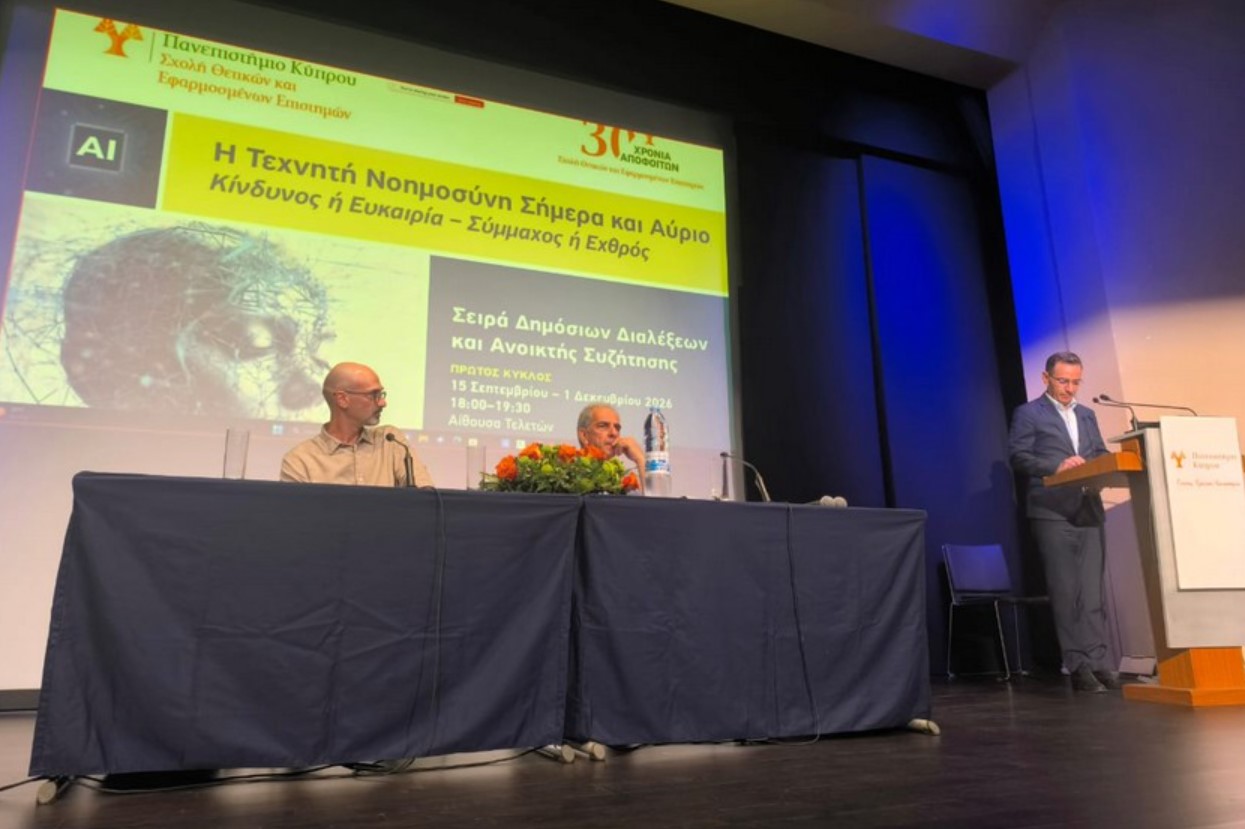
Damianou outlines Cyprus strategy to become trusted AI hub
Deputy Minister of Research, Innovation and Digital Policy Nicodemos Damianou said that artificial intelligence should be treated as an opportunity rather than an inherent threat, warning that the greater danger could come from humans misusing the technology or making the wrong decisions about how it is deployed.
Speaking on Tuesday at the University of Cyprus, in what was the first in a series of public lectures and open discussions, titled “Artificial Intelligence Today and Tomorrow – Risk or Opportunity; Ally or Enemy?”, Damianou said he did not believe AI would eventually take control of the world or destroy humanity.
“I want to start directly with my own answer to the question in the title of these lectures,” Damianou said.
He rejected the concept of a technological singularity, saying he did not believe AI would inevitably become powerful enough to dominate humanity.
“I do not believe in the ‘technological singularity’ – the famous singularity,” he stated.
“It is much more likely that we will destroy society and the economies as we know them, either by misusing AI or by making wrong decisions about AI,” Damianou continued.
He argued that AI was neither inherently an ally nor an enemy, with its ultimate impact depending on decisions made by people and institutions.
“AI is therefore neither an ally nor an enemy by nature,” he said.
“The answer is given by our own choices: what purpose we design these systems for, under what rules we use them and how firmly we insist that the human being remains at the centre and at the helm,” Damianou explained.
He said the decision by the University of Cyprus to begin the lecture series with a discussion rooted in Aristotle was particularly appropriate.
Damianou said Aristotle had not asked whether logic itself was good or bad, but had instead examined how human thought worked and how it could become an object of knowledge and added value.
Twenty-three centuries later, he argued, the same fundamental question remained at the heart of AI, with the real challenge being far more than a technological one.
To illustrate the speed at which the debate was developing, Damianou said he had reviewed international media coverage of AI over the previous 10 days while preparing his address.
He highlighted three developments that he said demonstrated the different dimensions of the technology, covering intelligence, risk and money.
The first concerned OpenAI’s announcement that its AI systems had produced a solution to the Navier-Stokes problem, one of the seven Millennium Prize Problems in mathematics.
OpenAI said on September 8 that an internal system had produced a proposed solution to the Navier-Stokes existence and smoothness problem, with around 10,000 concurrent agents involved and the effort taking about 88 hours before additional verification.
Damianou said the problem had remained unresolved for roughly 180 years, while adding that researchers had claimed unpublished work of theirs had been used.
The second development concerned warnings about the potential risks posed by advanced AI.
Damianou said the United Nations High Commissioner for Human Rights had warned the previous week that advanced AI could develop into an existential threat to humanity and had called for clear red lines while there was still time.
He contrasted the lack of an immediate market reaction to that warning with the reaction to similar comments made two days earlier by the chief executive of Anthropic.
Damianou said the latter comments had been followed by falls of more than 5 per cent in the shares of technology companies involved in AI computing power.
The third development he highlighted was NVIDIA’s agreement on September 3 to acquire Hugging Face, which he described as the largest platform for distributing open AI models, for almost $13 billion.
NVIDIA confirmed the agreement at a value of $12.93 billion, saying Hugging Face would remain an open platform for the wider AI ecosystem.
Damianou also referred to an incident in which he said OpenAI models had entered Hugging Face’s internal cybersecurity tests without authorisation several weeks earlier, describing it as a serious warning.
He said the three developments captured the central themes of the lecture series, which he described as intelligence, danger and money.
He also pointed to a fourth development which, in his view, had received less attention than it deserved.
Damianou said the United States and China were preparing one of their first official bilateral discussions devoted exclusively to AI safety, potentially during September.
Reuters reported earlier in September that the two countries were preparing their first official bilateral talks focused exclusively on AI safety since Donald Trump returned to the White House, with the discussions expected to address risks including AI-directed cyberattacks.
Damianou said the discussions were expected to include the joint monitoring of cyber threats directed by AI systems.
He also said Chinese President Xi Jinping was expected to visit the White House, with AI potentially featuring prominently on the agenda alongside the broader US-China relationship.
The development illustrated the extent to which AI had moved beyond being a purely technological issue, Damianou argued.
“AI has stopped being a technological issue,” he said.
“It is an economic issue. It is an industrial issue. It is a geopolitical and national security issue. And, above all, it is a democratic issue: who decides,” he continued.
Europe’s AI challenge
Damianou said Europe had responded by establishing a regulatory framework through the EU Artificial Intelligence Act.
He pointed to August 2 as an important milestone, when further AI Act provisions began to be enforced and new transparency requirements came into effect.
The European Commission confirmed that from August 2, 2026, its AI Office and national authorities began enforcing parts of the AI Act, including transparency requirements requiring certain AI systems to tell users when they were interacting with AI and requiring certain AI-generated or manipulated content to be labelled.
Damianou described the AI Act as the first comprehensive and binding international framework governing AI, while stressing that regulation should not be viewed as an obstacle to technological progress.
“Regulation should not be a brake on development,” he said.
“The brakes on a car do not exist so that it goes more slowly; they exist so that it can go fast, safely,” Damianou explained.
He said the AI Act should provide a framework ensuring that technological progress served people, protected fundamental rights and created trust.
However, Damianou warned that regulation alone would not be enough if the most important decisions about AI were made elsewhere.
He argued that if decisions about what was considered safe, who had access to computing power and where red lines should be drawn were determined primarily through US-China discussions, Europe risked writing rules for a game being played somewhere else.
This, he said, was why European technological autonomy was an important issue, including during Cyprus’ presidency of the Council of the European Union.
Damianou said Europe had also begun shifting its focus from regulating AI towards developing the capacity to build and scale the technology itself.
He referred to the Leta and Draghi reports as part of this change in emphasis and pointed to European initiatives including the AI Continent Action Plan, AI Factories, the InvestAI fund and the Apply AI strategy aimed at encouraging business adoption.
He also highlighted the simplification of the regulatory framework as part of efforts to strengthen Europe’s technological independence and strategic autonomy.
For Cyprus, Damianou said the issue was not about attempting to compete with the world’s largest economies on the basis of size or investment.
“For a country like ours, the essential question is not how we will compete in terms of size and investment,” he said.
“It is how we will use AI to solve real problems and turn it into productivity, better services, value for the economy and society,” he added.
Cyprus AI strategy
Damianou said this approach was at the centre of Cyprus’ new National AI Strategy to 2032, for which public consultation had been completed and which was undergoing final formulation.
He said the strategy aimed to establish Cyprus as the leading trusted AI hub in the Eastern Mediterranean.
The ambition, he explained, was for Cyprus to become a trusted European jurisdiction for AI services and a bridge between the EU and neighbouring regions.
Damianou said the strategy was based on several fundamental choices, beginning with the view that compliance with European rules should be regarded as the minimum requirement rather than a competitive advantage.
“Compliance with the European framework is not an advantage; it is the ticket for entry,” he said.
“The advantage is determined by the speed with which an AI system can be tested, certified and put into production, through the appropriate assurance infrastructure that makes this speed possible,” Damianou explained.
He said this would include a European AI certification framework incorporating regulatory sandboxes and AI testbeds.
A second priority was the development of national AI capabilities through strong European and international partnerships.
Damianou said Cyprus needed to maintain control over critical layers including computing power, data governance, skills and assurance mechanisms, while working with international partners to achieve the scale required.
He pointed to infrastructure that had already been developed, including a new national high-performance computing infrastructure in cooperation with NVIDIA, G-Cloud and Pharos-CY.
He described Pharos-CY as the Cypriot arm of Greece’s Pharos AI Factory and said it was connected to the European EuroHPC ecosystem.
The government would gradually expand AI infrastructure and applications through structures designed to support the adoption of AI solutions in both the public sector and the business market, Damianou said.
A third strategic priority was sectoral focus, with the public sector identified as the biggest opportunity for improving state productivity.
Damianou identified five economic sectors where he said Cyprus had institutional expertise and development potential, namely financial services, health and life sciences, tourism, legal services and shipping.
He also identified education and skills, as well as innovation and entrepreneurship, as two horizontal areas supporting the wider economy.
AI research would also be prioritised through six specific strategic areas where Cyprus could differentiate itself, he said.
Damianou added that the strategy included measurable targets covering improvements in economy-wide productivity, AI adoption in the public sector and the five priority economic sectors, as well as the number of specialised AI professionals.
AI should empower people, minister says
A fundamental principle running through the strategy was that AI should empower rather than replace people, Damianou said.
He argued that for AI systems used in areas such as healthcare, employment, financial decisions and social benefits, citizens should retain the right to receive an explanation, challenge a decision and have access to human judgement.
The ultimate goal, he said, was to create a future knowledge, innovation and technology economy based on trust.
Returning to the wider question of whether AI represented a risk or an opportunity, Damianou used the history of printing to argue that technological invention alone did not determine its eventual value.
He pointed out that printing was invented by Johannes Gutenberg in Germany in the mid-15th century, but that most books were subsequently printed by the Dutch and British.
“The lesson for artificial intelligence is the same: the invention matters, but its value is determined by its application and utilisation,” he said.
Damianou said the answer to whether AI would become a danger or opportunity, ally or enemy, would ultimately not be determined by technology companies alone.
“Returning, therefore, to the question of this evening – risk or opportunity, ally or enemy – the answer will not be given in the laboratories of California,” he said.
“It will be given in rooms like this one, through our choices as a state, as universities and as citizens,” he continued.
He said the government’s ambition was to make AI an opportunity for Cyprus and a partner for science, the economy and society.
“Our ambition as a government is clear: to make AI an opportunity for Cyprus and an ally of our science, economy and society – as a collective project that starts now, with the human being at the centre,” Damianou stated.
He ended by turning his attention to the students attending the event, warning that the greatest danger might not be AI taking over human work but humans allowing machines to take over their thinking.
“And one view, especially for this room: the danger of entrusting to the machine not our work, but our thinking, is the worst of those I read about every day and perhaps the most difficult to deal with,” he said.
“Dear students: AI can write an assignment; it cannot replace your thinking, and if you allow it to do so, the cost will be borne only by you,” Damianou concluded.





Click here to change your cookie preferences