
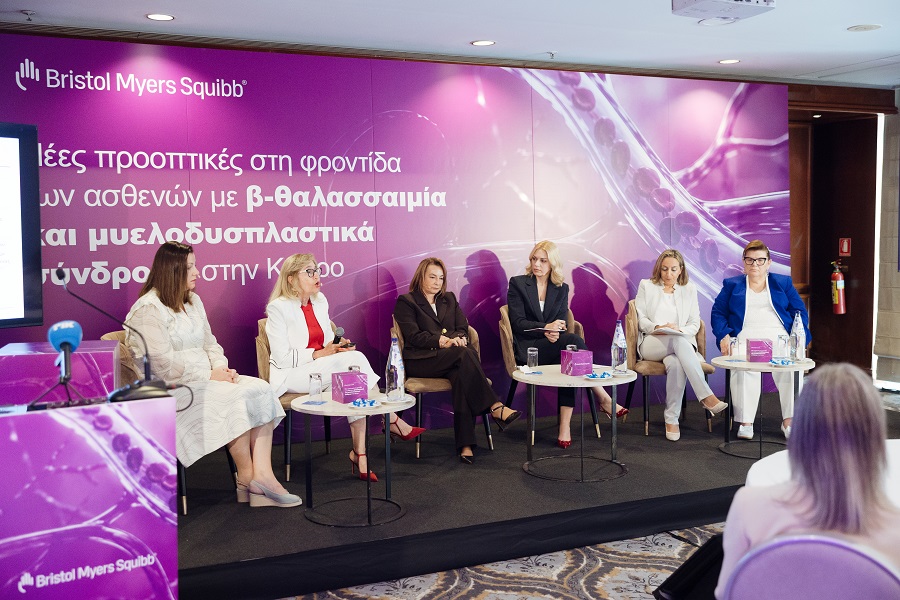
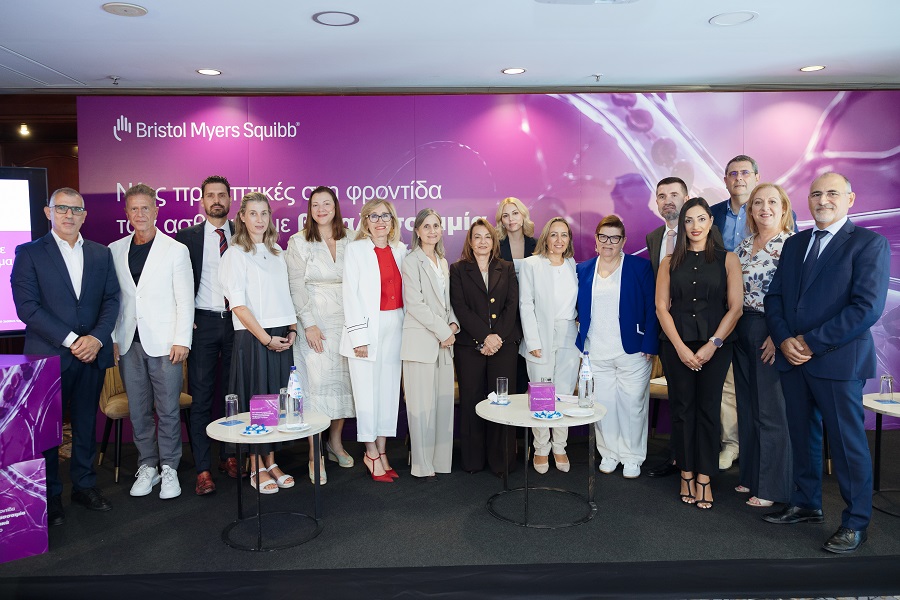
Contemporary challenges, the value of institutional collaboration and new therapeutic options in the management of beta-thalassaemia and myelodysplastic syndromes were the focus of a press conference held in Cyprus by the biopharmaceutical company Bristol Myers Squibb on September 23, 2026. The conference was attended by representatives from the haematology and academic communities, as well as from the patient community. The State was represented by Maria Adamou, Grade A Hospital Laboratory Officer at the Ministry of Health, and by Iphigenia Kammitsi, Deputy Director-General of the Health Insurance Organisation (HIO).
Important new scientific findings and prospects for better disease management were presented by Dr Sotiroula Christou, Senior Medical Officer and Head of the Thalassaemia Clinic in Nicosia, Archbishop Makarios III Hospital; Dr Niki Vyrides, Consultant Haematologist and Associate Professor at the University of Nicosia’s School of Medicine; and Dr Maria Vergoulidou-Stylianidi, Haematologist, General Practitioner and Oncologist, Dr Androulla Eleftheriou, Executive Director of the International Thalassaemia Federation, Chair of the National Committee on Thalassaemia and Other Haemoglobin Disorders at the Cyprus Ministry of Health, Member of the Board of Directors of the State Health Services Organisation OKYPY, and Maria Oikonomou, Treasurer of the Board of Directors of the Pancyprian Thalassaemia Association.
The event was moderated by journalist Dimitra Makrygianni, whilst Panikos Vassiliou, General Manager of the CPO Group, Costas Papaellinas, delivered a welcome address.
Referring to Bristol Myers Squibb’s commitment, George Tsiakalakis, Director of Market Access and Corporate Affairs at BMS, emphasised that: “At Bristol Myers Squibb, we invest in scientific research in Haematology, developing innovative treatments that are an integral part of modern haematological care. The progress we have seen in recent years in reducing the need for transfusions and improving patients’ quality of life demonstrates what science can achieve when combined with timely and equitable access. Supporting Cyprus’ national effort, which is an international model for the management of β-thalassaemia, we remain firmly committed to working closely with the Cypriot authorities, the scientific community and patient associations, with the shared goal of providing better care for patients.”
The data recorded in the international literature and presented at the conference indicate that, worldwide, approximately 1.5 per cent of the population (80–90 million people) are carriers of beta-thalassaemia and approximately 60,000 individuals with symptomatic disease are born each year. Nevertheless, it is generally accepted that these figures are significantly underestimated, given the lack of national, regional and global records and up-to-date epidemiological studies, with a significant medical, social and economic burden on individuals and families, as well as on health systems.
For Cyprus, the disease has long been a major issue, as one in seven Cypriots (15 per cent) are carriers of the disease, whilst 652 patients with beta-thalassaemia are systematically monitored at the country’s specialist thalassaemia centres, 598 of whom have the major form. At the same time, Cyprus is among the countries with the longest experience in this field, having developed a pioneering national framework for prevention and voluntary blood donation since the 1970s, whilst the first WHO Collaborating Centre for thalassaemia was established in 1985. Today, the quality of care is clearly reflected in the high rates of education and vocational rehabilitation among patients.
Analysing the clinical picture of beta-thalassaemia, Dr Christou focused on the mechanisms of ineffective erythropoiesis and chronic anaemia, highlighting the serious complications caused by iron overload resulting from chronic blood transfusions, which lead to physical, financial and psychological burdens, whilst also affecting the adequacy of blood supplies.
As Dr Christou pointed out: “The multiple comorbidities that develop over time make it necessary to establish a multidisciplinary team, ensuring a patient-centred approach in which every treatment decision is made in consultation with the patient. The goal for the future is not simply for patients to live longer, but to live better, with a lower treatment burden, fewer complications, greater independence from transfusions and a better quality of life.” She also added that: “significant progress has been made in Cyprus in both the prevention and management of thalassaemia. However, despite the considerable progress achieved, there remains substantial scope for further improvement, with the aim of continuously upgrading care and the quality of life of people living with thalassaemia”.
For her part, Dr Vyrides discussed myelodysplastic syndromes, explaining that these are a heterogeneous group of haematological disorders that primarily affect the elderly population. Dr Vyrides emphasised the burden placed on patients due to chronic anaemia and dependence on blood transfusions, highlighting the need for early diagnosis and modern treatment options, which result in fewer transfusions, fewer hospital visits and greater freedom for patients to focus on life beyond their illness.
In presenting the scientific developments, Dr Christou and Dr Vergoulidou-Stylianidi discussed new, innovative treatments and new factors influencing the maturation of red blood cells. Dr Vergoulidou-Stylianidi explained that the results of clinical trials demonstrate that “the new targeted therapies offer a substantial reduction in, or even independence from, red blood cell transfusions,” as well as “a sustained increase in haemoglobin levels and fewer hospital visits, thereby positively changing patients’ clinical course and future prospects”.
The Pancyprian Thalassaemia Association’s Oikonomou focused on the day-to-day lives of patients, noting that reducing the need for blood transfusions is a key factor, as it translates into “fewer absences from work, easier family planning, less anxiety about blood availability and, at the same time, a reduction in pressure on national blood stocks”.
At the same time, Dr Eleftheriou referred to Cyprus’s pioneering care model and its strong international presence, highlighting its contribution to the establishment of the International Thalassaemia Federation, which has grown exponentially since 1985 and now comprises 300 member organisations from 70 countries. Dr Eleftheriou also highlighted on the new National Blood Strategy and the recent signing of a Memorandum of Understanding between the International Thalassaemia Federation and the Cypriot Ministry of Health, which provides a stable channel for scientific evidence and meaningful dialogue, emphasising that “active, structured collaboration between the state, the scientific community and patients’ organisations is an essential prerequisite for ensuring equal access to innovation and the continuous improvement of patients’ well-being and autonomy”.
About Bristol Myers Squibb
Bristol Myers Squibb is a global biopharmaceutical company whose mission is to discover, develop and provide innovative medicines that help effectively treat serious diseases. For further information about Bristol Myers Squibb, please visit: www.bms-greece.gr.


Click here to change your cookie preferences