
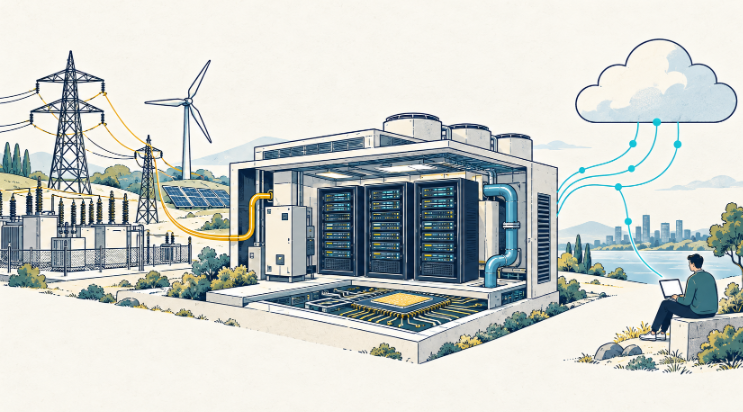
When people use AI search, generate images, or ask an AI assistant to handle a task, they usually see only the result on a screen. Behind those services is a physical infrastructure network that depends on electricity, chips, cooling systems, and high-speed connections working together.
Over the past few years, attention has focused largely on what AI models can do. In 2026, the questions extend further along the supply chain: even as models improve, can power supplies, computing equipment, and data centers keep pace with expanding adoption? That question makes AI infrastructure stocks a useful starting point for understanding the industry behind the applications.
This article examines 12 publicly traded companies across energy, semiconductors, data centers, and cloud computing. It explains how their businesses connect to AI demand and what deserves closer attention when researching them. “To watch” refers to business relevance and research interest, not a prediction of share-price gains or a ranking of stocks to buy.
AI Infrastructure: Four Layers Supporting the AI Economy
AI infrastructure stocks are shares in publicly traded companies that provide the equipment and services needed to train, deploy, and run AI models. These businesses do not necessarily develop chatbots. They may participate through electrical equipment, chip manufacturing, data center facilities, or cloud services.
If AI applications are the buildings people enter, energy, chips, and data centers provide the electrical systems, equipment, and space that keep them operating. Cloud platforms turn those resources into services that businesses and developers can access.
| Infrastructure Layer | Main Function | Companies Covered |
| Energy and power infrastructure | Generate electricity and deliver it reliably to computing equipment | Eaton, GE Vernova, NextEra Energy |
| Computing and semiconductors | Manufacture and connect high-performance computing equipment | NVIDIA, TSMC, Broadcom |
| Data centers and supporting equipment | House, power, cool, and interconnect computing systems | Vertiv, Equinix, Digital Realty |
| Cloud computing | Make computing capabilities available to businesses and developers | Microsoft, Amazon, Alphabet |
These categories describe each company’s primary role rather than rigid boundaries. Cloud providers also build data centers and develop chips, while electrical equipment companies serve industries beyond AI. Researching these stocks therefore requires understanding how much AI demand actually contributes to each company’s broader business.
1. AI Energy Infrastructure: Computing Growth Starts With Power
AI services may appear to operate in the cloud, but they still depend on physical equipment that needs electricity. Model training typically involves concentrated computing workloads, while inference takes place as users submit requests. Resource requirements vary considerably by task, but the facilities running those tasks need reliable power.
In its 2025 Energy and AI report, the International Energy Agency projected that global data center electricity consumption would reach approximately 945 terawatt-hours by 2030 in its base case, more than double the 2024 level. This forecast covers data centers as a whole. It does not mean that all of their electricity consumption comes from AI, or that related companies will achieve equivalent revenue growth.[1]
For data centers, generating capacity alone is not enough. Grid connections, electrical distribution equipment, backup power, and construction schedules all influence when servers can begin operating. Companies worth examining in this sector therefore include both electricity producers and suppliers that deliver power reliably to the equipment using it.
| Company | Exchange and Ticker | Main Connection to AI Infrastructure |
| Eaton | NYSE: ETN | Electrical distribution, uninterruptible power supplies, and power management |
| GE Vernova | NYSE: GEV | Power generation equipment, grid systems, and electrification technology |
| NextEra Energy | NYSE: NEE | Electricity supply, energy projects, and storage development |
Eaton: Delivering Reliable Power Inside Data Centers
Eaton supplies electrical distribution equipment, uninterruptible power supplies (UPS), and power management solutions that support reliable data center operations.[2] Its connection to AI lies in facility expansion and equipment upgrades, while order conversion and delivery capacity remain key factors to watch.
GE Vernova: Connecting Power Generation With Electricity Demand
GE Vernova provides generation equipment and grid technologies that support growing electricity demand, including from data centers. Its AI exposure is tied to energy infrastructure investment, with project execution and equipment deliveries influencing when orders become revenue.
NextEra Energy: Supporting Data Center Expansion
NextEra Energy operates electric utilities and develops energy projects. In December 2025, it announced an expanded partnership with Google Cloud to develop data center capacity and energy infrastructure across multiple U.S. locations.[3] Project approvals, construction costs, and financing conditions will influence how these plans translate into operating results.
51AIpower: How Can Individuals Participate in AI Energy Infrastructure?
Energy’s role in AI raises another question for individuals: beyond buying shares in related companies, are there other ways to participate in the infrastructure supporting AI services?
According to the platform description provided by 51AIpower, its power support plans offer individuals a way to participate without supplying their own hardware. Users create an account and select a suitable plan to support the electricity and computing infrastructure used in AI operations, with rewards determined by platform rules and actual operational performance. They do not need to purchase GPUs, build servers, or manage data center facilities themselves.
The model connects to the resource needs behind AI services: electricity powers GPU computing, computing supports model inference, and application usage creates ongoing demand for those services. In this context, AI tokens are units used to represent information processed by models and measure usage. They are not cryptocurrencies, and they do not correspond to a fixed amount of electricity consumption.
Participating in a 51AIpower plan does not confer ownership of shares in publicly traded energy companies. Rights and obligations are governed by the platform’s terms, including plan costs, duration, reward calculations, and exit conditions. A lower participation barrier does not mean guaranteed returns.
For platform and plan details, visit the https://www.51aipower.com?hb=AI12.
2. AI Computing and Semiconductors: From Chip Performance to System Efficiency
Electricity keeps computing equipment running; semiconductors determine how the work gets done. AI training and inference require more than an individual high-performance chip. They also depend on memory, advanced packaging, and networks that allow large numbers of processors to work together.
Companies in this sector perform different functions. Some design computing platforms, others manufacture chips, and others supply custom accelerators or networking technology. All connect to AI, but their revenue sources and competitive positions differ.
| Company | Exchange and Ticker | Main Connection to AI Infrastructure |
| NVIDIA | Nasdaq: NVDA | GPUs, computing software, and data center networking |
| TSMC | NYSE: TSM; TWSE: 2330 | Advanced semiconductor manufacturing and packaging |
| Broadcom | Nasdaq: AVGO | Custom AI accelerators and networking chips |
TSM is the ticker for TSMC’s U.S.-listed American depositary shares. Its shares trade on the Taiwan Stock Exchange under 2330.
NVIDIA: From GPUs to a Broader Computing Platform
NVIDIA’s AI business extends beyond GPUs to software tools, networking, and system-level solutions. For customers deploying large AI clusters, chip performance matters, but software compatibility and coordination between devices also affect the performance of the overall system.
Researching NVIDIA therefore involves examining both hardware demand and its broader platform ecosystem. Customer purchasing cycles, product transitions, export restrictions, and competition from alternative computing approaches are all relevant considerations.
TSMC: Turning Chip Designs Into Deliverable Products
TSMC manufactures chips for its customers, providing an important link between semiconductor design and production capacity. Advanced manufacturing processes matter for AI computing, but packaging is also crucial. TSMC’s CoWoS technology supports high-performance computing and AI products by integrating components into packages suited to high-bandwidth computing.[4]
Its relevance comes partly from serving different chip designers rather than depending on a single AI application. Research should consider advanced manufacturing and packaging capacity, production yields, capital investment, and uncertainty related to supply chains and geopolitics.
Broadcom: Custom Accelerators and High-Speed Networks
Broadcom’s AI infrastructure role includes custom accelerators and networking technology. Large computing clusters need to exchange data efficiently; even powerful individual chips can be constrained when communication between them becomes a bottleneck.
Unlike general-purpose GPU platforms, custom accelerators are often developed around particular customers and workloads. Researching Broadcom involves examining production timelines, customer concentration, and whether its networking and computing solutions can meet changing AI requirements.
3. AI Data Centers: Computing Needs More Than Floor Space
Data centers provide an operating environment for computing equipment, but facilities supporting dense AI workloads must accommodate concentrated power, cooling, and networking requirements. An empty building is not automatically a facility capable of running advanced AI servers.
Increasing computing density within a rack, for example, may require upgrades to electrical distribution, cooling equipment, and piping. The resulting opportunities extend to both data center operators and power and cooling suppliers, whose business models need to be understood separately.
| Company | Exchange and Ticker | Main Connection to AI Infrastructure |
| Vertiv | NYSE: VRT | Critical power, thermal management, and liquid cooling equipment |
| Equinix | Nasdaq: EQIX | Data center colocation and interconnection services |
| Digital Realty | NYSE: DLR | Data center capacity, colocation, and interconnection services |
Vertiv: Managing Power and Heat in High-Density Computing
Vertiv provides critical power and thermal management solutions, including liquid cooling products connected to the needs of high-density computing facilities. As more computing equipment operates within limited space, removing heat effectively becomes essential to reliable performance.
In March 2026, Vertiv announced an investment of approximately $50 million to expand its manufacturing presence and related facilities in Ohio. This included additional production capacity for liquid cooling and chilled water systems, with the Ironton expansion expected to become operational in the second quarter of 2027. The announcement illustrates a supplier preparing capacity for future demand, rather than revenue already earned from completed deliveries.[5]
Order fulfillment, manufacturing ramp-up, and profit margins are useful areas to monitor, alongside the adoption of different cooling technologies. Greater demand for cooling does not mean every product will benefit equally.
Equinix: Connecting Enterprises, Clouds, and Networks
Equinix does more than provide data center space. It also connects enterprises, network operators, and cloud providers. For businesses accessing data and computing resources across different locations, interconnection is part of the infrastructure decision.
The company offers another perspective on AI deployment: computing demand does not necessarily concentrate in one location. Relevant research areas include customer demand, facility utilization, and interconnection service growth, considered alongside power availability and expansion costs.
Digital Realty: Providing Scalable Facilities for Computing Demand
Digital Realty provides data center, colocation, and interconnection services, connecting large-scale facility development with customers’ computing needs. For businesses expanding capacity, available power, suitable locations, and delivery timelines are important considerations.
When examining this type of company, it is useful to distinguish between signing contracts, completing construction, and customers occupying the facilities. Planned capacity does not automatically produce rental or service income. Leasing activity, development costs, and financing costs all affect eventual returns.
4. AI Cloud Computing: Turning Infrastructure Into Usable Services
Businesses that want to use AI do not necessarily want to purchase servers, manage networks, or maintain data centers. Cloud platforms combine these resources into computing and development services that companies can access according to their needs.
This layer connects infrastructure investment closely to commercial AI usage: additional capacity must ultimately generate revenue through customer activity. However, cloud growth also brings equipment, energy, and depreciation costs, so revenue expansion and improving profitability do not always occur at the same pace.
| Publicly Traded Company | Exchange and Ticker | Relevant Business |
| Microsoft | Nasdaq: MSFT | Azure and enterprise AI services |
| Amazon | Nasdaq: AMZN | Amazon Web Services (AWS) |
| Alphabet | Nasdaq: GOOGL / GOOG | Google Cloud and related AI infrastructure |
Azure, AWS, and Google Cloud are businesses or platforms within their respective parent companies, not three independently listed stocks. Buying shares in a parent company also provides exposure to its other operations.
Microsoft: Bringing AI Computing Into Enterprise Workflows
Microsoft provides cloud computing and AI capabilities through Azure while also operating a broad enterprise software business. Its position spans both the underlying computing services and the business applications through which customers use them.
Areas to examine include Azure’s growth, adoption of AI services, and the relationship between infrastructure spending and revenue. Microsoft’s 2025 annual report provides information on its cloud operations and related investments that helps explain this path to commercialization.[6]
Amazon: From Computing Resources to Model Services
AWS provides computing, storage, networking, and AI services. Amazon Bedrock enables businesses to build applications using foundation models, while internally developed chips such as Trainium reflect AWS’s investment in the underlying computing layer.
Amazon is relevant because it participates in both infrastructure supply and enterprise AI services. Research should focus on AWS’s operating performance, actual customer usage, and whether investments in custom chips and large-scale facilities generate reasonable cost benefits.[7]
Alphabet: Connecting Proprietary Technology With Cloud Services
Alphabet participates in enterprise cloud computing through Google Cloud while also developing AI models and computing technologies such as TPUs. It brings models, chips, and cloud services into the same business group, offering a way to examine how AI technology becomes a commercial service.
Research should consider Google Cloud’s revenue and profitability, the efficiency of infrastructure investment, and the relationship between these operations and Alphabet’s other businesses. GOOGL and GOOG represent different share classes of Alphabet, not shares in Google Cloud as a standalone company.[8]
Evaluating AI Infrastructure Opportunities Beyond Demand Growth
These companies operate along the same supply chain, but they do not necessarily benefit at the same time. Equipment suppliers may receive orders first, data center operators must wait for construction and customer occupancy, and cloud platforms need to turn new capacity into sustained usage.
Researching AI infrastructure stocks therefore starts with how demand translates into revenue, followed by whether that revenue produces profit and cash flow. Project delays, financing costs, customer concentration, and technology changes can all affect that process.
Price matters as well. Even when a business continues growing, investment results may disappoint if its share price already reflects stronger expectations. Industry prospects, company performance, and stock returns are connected, but they are not interchangeable.
AI Infrastructure Stocks FAQ
1. What Are AI Infrastructure Stocks?
AI infrastructure stocks are shares in publicly traded companies that provide energy, chips, data centers, or cloud services for AI training, deployment, and inference. These companies participate by supplying equipment, providing facilities, or delivering computing services, although the importance of AI to their overall businesses varies.
2. What Are the Main Areas of AI Infrastructure?
AI infrastructure can be understood through four main areas: energy and power systems, computing and semiconductors, data centers and supporting equipment, and cloud computing. Together, they support the process from electricity supply to computing and service delivery, with considerable overlap—for example, cloud providers may also build data centers and develop chips.
3. How Do AI Infrastructure Stocks Differ From AI Software Stocks?
AI infrastructure stocks generally represent businesses providing power, hardware, facilities, and computing services, while AI software stocks more often represent companies using those resources to deliver applications or software products. The categories overlap because some large technology companies operate both infrastructure and software businesses, making revenue composition an important distinction.
4. What Risks Should Investors Consider When Researching AI Infrastructure Stocks?
Relevant risks include valuation, customer demand, project execution, financing costs, technological change, and policy restrictions. Growth in AI usage can create business opportunities, but it does not guarantee that an individual company will remain profitable or that its share price will rise.
5. Does Participating in an AI Infrastructure Plan Mean Owning Stocks?
No. Buying shares in a publicly traded company generally provides an ownership interest in that company, while the rights and obligations of a platform participation plan depend on its contracts and terms. Joining a plan offered by a platform such as 51AIpower does not, by itself, provide ownership of NVIDIA, Microsoft, or other publicly traded companies.
Conclusion: AI’s Next Phase Depends on Both Models and Infrastructure
Competition in artificial intelligence is expanding from model capabilities to the broader supply chain. What models can do still matters, but access to electricity, chip deliveries, and operational facilities also influence when those capabilities reach users.
From Eaton’s power management and TSMC’s chip manufacturing to data centers and cloud platforms, understanding each company’s specific role is more useful than treating AI as a single investment theme. For individual readers, that understanding can support both research into AI infrastructure stocks and clearer comparisons of the rights, costs, and risks associated with different ways to participate.
DISCLAIMER – “Views Expressed Disclaimer – The information provided in this content is intended for general informational purposes only and should not be considered financial, investment, legal, tax, or health advice, nor relied upon as a substitute for professional guidance tailored to your personal circumstances. The opinions expressed are solely those of the author and do not necessarily represent the views of any other individual, organization, agency, employer, or company, including NEO CYMED PUBLISHING LIMITED (operating under the name Cyprus-Mail).





Click here to change your cookie preferences