
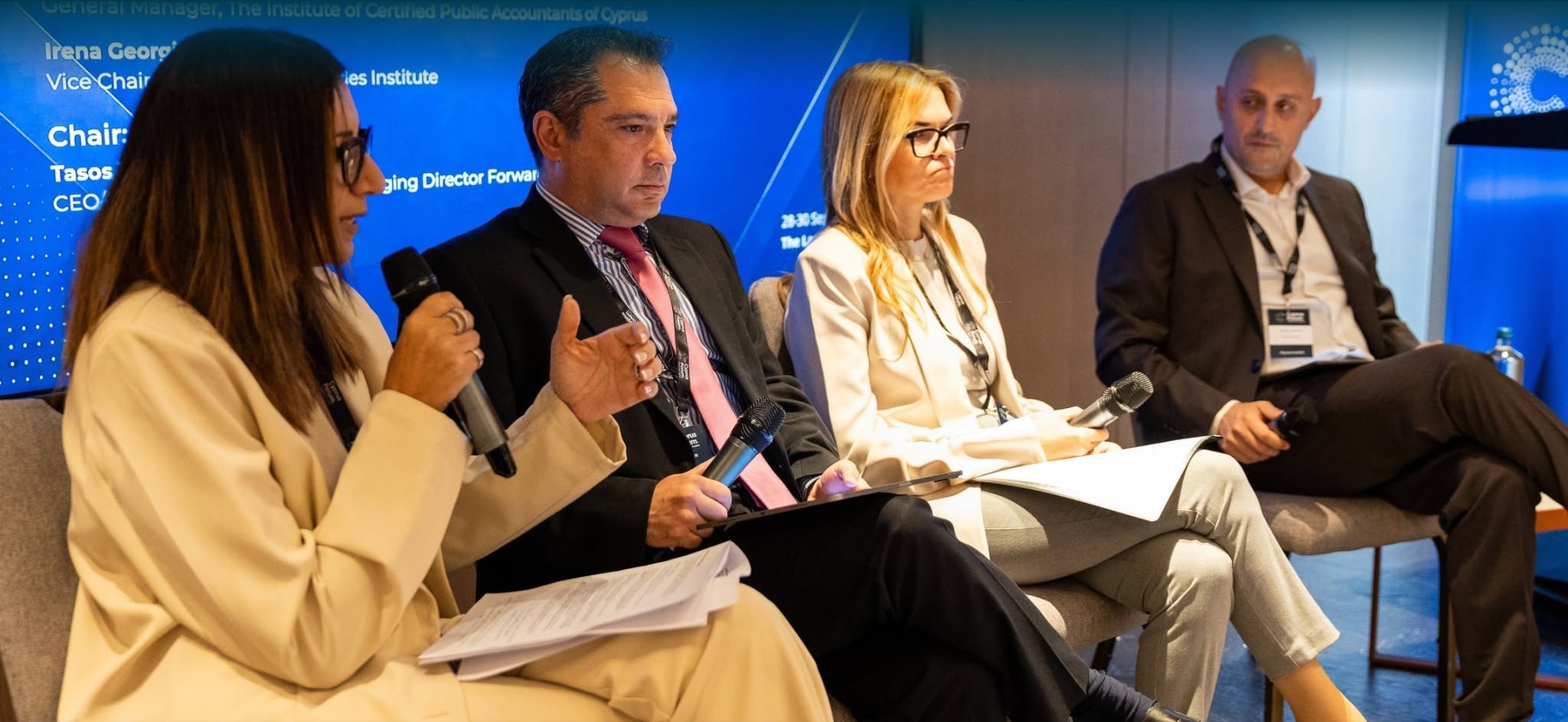
Cyprus needs closer coordination between regulators and clearer consumer safeguards as digital banking, cryptoassets and fintech increasingly blur the boundaries between financial services, industry and policy experts said at the Cyprus Forum.
Financial Commissioner Valentina Georgiadou, Institute of Certified Public Accountants of Cyprus (ICPAC) general director Andreas Papadatos and Glafkos Clerides Institute vice-president Irena Georgiadou examined how supervision can keep pace with rapidly changing technology without holding back innovation.
Valentina Georgiadou noted that financial services are changing at a pace that makes it difficult for the regulatory framework to adjust at the same speed, placing greater emphasis on effective consumer protection and stronger coordination between supervisory authorities.
She stressed that “security and trust” remain fundamental to the sector’s development, as consumers are more willing to invest when they know there is a mechanism to protect them if something goes wrong.
At the same time, Georgiadou pointed out that consumers often do not know where to turn when they encounter a problem, something also reflected in complaints reaching the Office of the Financial Commissioner.
She added that people are sometimes referred to the office without being told whether their case actually meets the requirements for examination.
Georgiadou also noted that the ease with which investments and transactions can now be carried out with a single click has changed consumer behaviour, with users often failing to check which company provides a service, which authority supervises it and what rights they have if a problem arises.
She emphasised growing risks from fraud and cyber security, stressing the importance of financial education so consumers understand both the characteristics of new financial products and their rights before investing.
Papadatos argued that the challenge went beyond technology simply developing faster than legislation, saying it has “begun in practice to remove the boundaries between activities”.
Supervision, he explained, is still organised around different types of institutions, activities and regulatory responsibilities, while consumers increasingly encounter all of these services through the same screen.
In practice, Papadatos noted, a single platform may allow a user to buy and sell cryptoassets, invest and access several other financial services, making it unrealistic to expect consumers to know which authority supervises each activity, what protection applies and where they should turn if something goes wrong.
For Cyprus, he identified three priorities, namely better coordination between the relevant authorities, minimising potential supervisory gaps and providing consumers with greater clarity over who supervises what and which rights apply.
Beyond the regulatory structure itself, Papadatos also emphasised that technology cannot replace trust, noting that every digital application is ultimately backed by a company that must have effective governance, reliable financial reporting, internal controls, risk management, regulatory compliance and independent audit.
Consumer protection, he added, “does not begin when a complaint is submitted”, but much earlier, from the design of the product itself to the quality and clarity of the information given to users.
Irena Georgiadou observed that despite major changes in how providers operate and consumers behave, the basic principles of the financial system remain the same, namely security, transparency and accountability.
In that context, she explained that transparency should not mean simply providing dozens of pages of terms and conditions, but giving consumers information they can genuinely understand.
At the same time, Georgiadou noted that regulators face the challenge of protecting users without becoming an obstacle to development and innovation.
Looking ahead, she said digital banking would eventually stop being treated as a separate category because “banking will be digital”, meaning traditional banks have little choice but to adapt.
That shift, she added, also places greater importance on supervision as a factor in Cyprus’ competitiveness as a financial centre, with credible oversight potentially becoming a competitive advantage and helping attract higher-quality international financial companies.
She noted that international businesses are increasingly looking for regulatory certainty, including clear rules, consistent application and supervisory authorities that understand emerging fintech business models and can respond quickly enough.
Cyprus has already developed a significant financial technology ecosystem, Georgiadou added, but the objective should not be to attract more companies through lighter supervision.
Instead, she argued that the country should seek better companies through a credible, flexible and effective supervisory framework, helping build a more sustainable financial model for Cyprus.





Click here to change your cookie preferences