
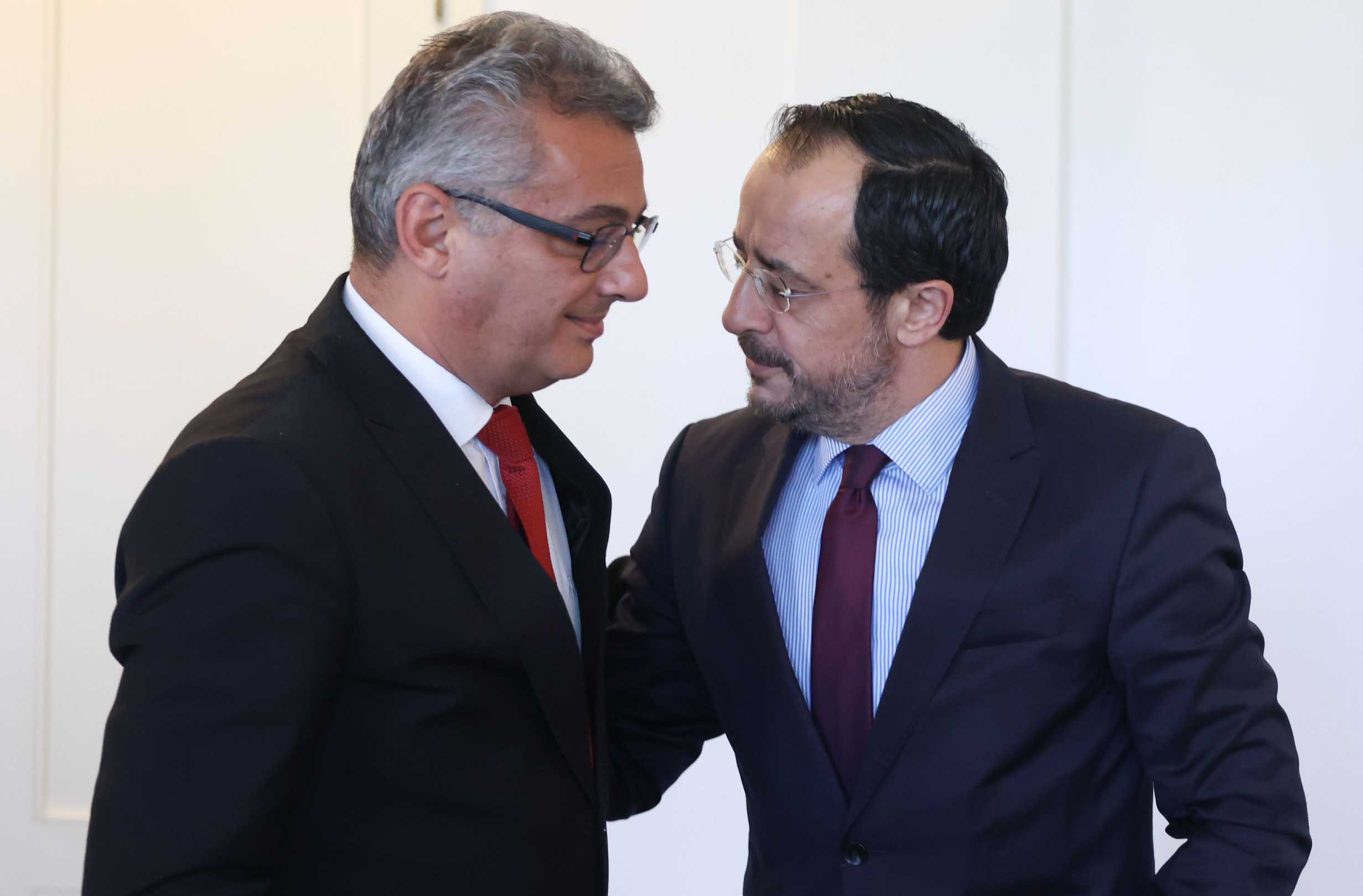
President Nikos Christodoulides on Tuesday said that he plans to request that a meeting with Turkish Cypriot leader Tufan Erhurman be held next week, following a turbulent few weeks for the Cyprus problem since the pair most recently met last month.
“Today, I will ask the Turkish Cypriot leader to arrange a meeting for next week, and I hope for a positive response so that we can continue the discussion which began before our trip to New York, and which also builds upon the facts and discussions we held with the United Nations secretary-general,” he said.
He stressed that “we are here to achieve progress” and said to this end that “there is political will and there are ideas regarding all three issues raised by the secretary-general … and we are here to move forward”.
Those three issues are confidence-building measures, the meeting’s methodology and the substance of the talks, with UN Secretary-General Antonio Guterres having said that an enlarged meeting on the Cyprus problem, involving the island’s two sides, its three guarantor powers – Greece, Turkey and the United Kingdom – and the UN would be convened only after “adequate progress” on those issues.
“For this reason, I have already asked the negotiator [Menelaos Menelaou] to contact the Turkish Cypriot side and propose a meeting for next week,” Christodoulides said on Tuesday.
Christodoulides’ call for a new meeting with Erhurman comes with the island’s two sides having ended the UN’s general assembly week last month further apart than they started it.
Holguin warned that window for progress is ‘gradually closing’
This lack of progress prompted UN Cyprus problem envoy Maria Angela Holguin to warn that “it is clear that the favourable window of opportunity we had throughout last year and earlier this year is gradually closing”.
She also warned that “rising tensions in the Middle East and the eastern Mediterranean could have negative consequences for Cyprus”, and that “the diplomatic space which is allowing for the revival of dialogue may not remain open for ever”.
Regarding her meetings with both Christodoulides and Erhurman during that week and conflicting statements regarding the prospect of a tripartite meeting of the two leaders and the UN in New York, Holguin stressed that “such a meeting was not planned beforehand”.
Instead, she said, she had informed Erhurman that Christodoulides wished for such a meeting to take place, and Erhurman had asked, “is there a new proposal which would make such a meeting meaningful?”
She said that in response, she had told Erhurman that “Christodoulides had reiterated the proposals he had presented during the most recent bilateral meeting between the leaders in Cyprus”, and that Erhurman as such declined to hold a meeting in New York.
Erhurman, she said, had found that “the meeting would not yield a positive result unless the necessary conditions for progress were met”.
This version of events was largely corroborated by Erhurman, who made reference to the seven issues upon which Guterres had demanded progress when he visited the island in July.
“If there is a chance of reaching an agreement on a few of them, and if the secretary-general has time, I would participate in such a meeting. There was no reply to this message,” he said after his return to Cyprus from New York.
Menelaou accused Turkish Cypriot side of ‘delaying tactics’
The Greek Cypriot side, however, offered a different version of events, with Christodoulides last week accusing Erhurman of “insisting on a two-state solution”, and his chief negotiator Menelaos Menelaou saying that the Turkish Cypriot side had followed a “pattern of obstruction” and employed “delaying tactics”.
Another issue which came to light in New York was a letter sent by the Republic of Cyprus’ permanent mission at the UN requesting that foreign diplomats not meet Turkish Cypriots.
Holguin said of the letter that such moves “absolutely” do not help efforts to create favourable conditions for negotiations to resume in earnest.
“These things only complicate an already complex issue. Negotiations do not arise spontaneously, nor do they stem from a hostile environment. The process requires understanding and accepting the other side and its existence,” she said.
Additionally, the pair clashed over Christodoulides’ 19 new points for discussion which he had raised during their final meeting before both headed to New York last month, with Erhurman describing them as “throwing a spanner in the works”.
“In that case, let’s bin off the seven points and have 19 points this time, and then I will bring 29 points at the next meeting. Of course, this will not lead us to a solution. This is an approach of a meeting for the sake of a meeting,” he said.


Click here to change your cookie preferences