
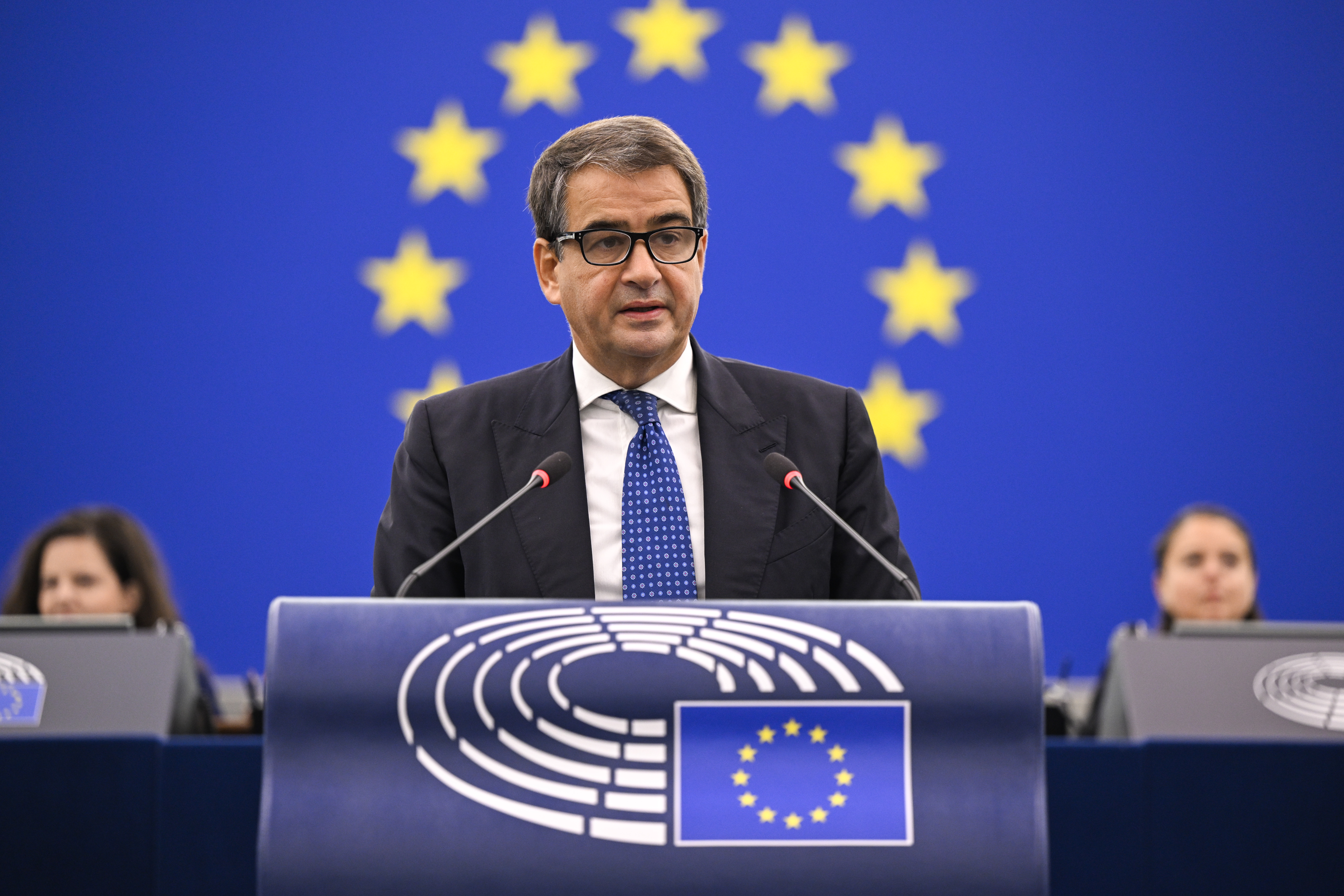
European Commission Cyprus problem envoy Raffaele Fitto on Thursday said that the European Union attaches “particular importance” to efforts to bring about a solution to the Cyprus problem, as he addressed a European Parliament debate on the matter of “persistent Turkish provocations” in both the eastern Mediterranean and Aegean seas.
“Sustainable deescalation in Greek-Turkish relations and overall in the eastern Mediterranean are essential elements for regional stability and security and for the advancement of EU-Turkish relations in a phased, proportionate and reversible manner,” he said.
He added that “in further deepening the EU-Turkey cooperation, we attach particular importance to the resumption of the Cyprus settlement talks and Turkey’s constructive engagement in that regard”.
“This is in the strategic interest of the EU and in line with the mandate we have from the European Council. We must not forget that the whole of the island of Cyprus is part of the EU and that Turkish Cypriots are EU citizens,” he said.
At the end of the debate, he took the floor for a second time, saying that “without a comprehensive settlement of the Cyprus issue, it will be impossible to bring sustainable de-escalation in the eastern Mediterranean”.
“In this regard, the EU remains fully committed to a comprehensive settlement of the Cyprus problem within the UN framework in accordance, with the UN security council resolutions, and in line with the principles on which the union is founded,” he said.
He added that in his own role as Cyprus problem envoy, “I also remain committed to supporting this process”.
Eastern Mediterranean region ‘harbours major challenges’
Earlier in his address, he had said that “the eastern Mediterranean is region of geostrategic importance for the stability and security of the EU”, and that it is a region “where the EU has a strong footprint through its member states, Greece and Cyprus”.
“It harbours major challenges that receive attention from the European Council and in some cases from the UN security council. The eastern Mediterranean hosts one of the main migratory routes as well as major trade and connection routes to the EU and it bears the brunt of climate change,” he said.
He added that for this reason, “we attach great importance to the developments in the relations between Greece and Turkey and the overall situation in the Aegean Sea and the eastern Mediterranean”.
“Turkey is a candidate country and a Nato ally for most of our member states and a key partner for the European Union. We have a strategic interest to further pursue the ongoing engagement with Turkey and keep the country anchored to the EU,” he said.
He added that cooperation was especially important for security, migration, connectivity, and developments in the EU’s neighbourhood.
However, he said, “our relationship also presents significant challenges”, pointing to renewed tension in the region.
He said that the EU has “repeatedly raised and discussed these issues with our Turkish interlocutors”, before making reference to the visit to Turkey taken by the EU’s foreign policy chief Kaja Kallas, European Internal Affairs Commissioner Magnus Brunner, and European Enlargement Commissioner Marta Kos in June.
Commissioners ‘called on Turkey to act with restraint’
During that visit, he said, the three commissioners stressed the importance the EU attaches to these issues and collectively called on Turkey to act with restraint, refrain from any unilateral action that would increase tensions.
He added that “the European Council and the European Commission have a clear position on these matters”, and that in line with this, “Turkey must respect the sovereignty and territorial integrity of all member states in accordance with EU and international law”.
This international law, he said, must include the UN convention on the law of the sea (Unclos), to which Turkey is not a signatory as it believes the convention offers too much weight to the territorial waters and exclusive economic zones generated by islands.
Later in his address, Fitto said that “it is our firm belief that any difference between Greece and Turkey should be managed through good-faith dialogue, restraint, and respect for international law and good neighbourly relations”.
Debate comes following aerial, maritime dispute in region
The debate was called with the Greek government continuing to report “airspace violations” being conducted by Turkey, with the Greek military saying that on Tuesday, a total of seven Turkish aircraft – two F-16 fighter jets, a CN-235 surveillance aircraft, and four drones – violated the country’s airspace.
Turkey disputes this version of events as it does not recognise the Greek claim to all airspace within 10 nautical miles of its coast. Greece is the only country to claim more airspace than territorial waters, something which Turkey says violates the international civil aviation organisation (Icao)’s statutes.
In the eastern Mediterranean, tensions have been raised over the matter of energy, with plans afoot for seabed surveys to be conducted between Crete and Cyprus for the construction of the Great Sea Interconnector cable, which Turkey says passes through its own exclusive economic zone (EEZ).
Meanwhile, Turkey, too, is conducting seabed surveys between its own mainland and Cyprus for the construction of a natural gas pipeline, with Kallas having previously intervened on this front, calling on Turkey to “respect” the Republic of Cyprus’ sovereignty.
On the Cyprus problem, Turkish Cypriot leader Tufan Erhurman said on Tuesday that complaints he had raised regarding initiatives undertaken by the Greek Cypriot side to bring about the cancellation of international events organised by the Turkish Cypriots had been “carefully noted” by the European Commission.
He added that the commission had also said “that its objective is to build bridges, enhance dialogue, and foster rapprochement, both between Turkish Cypriots and Greek Cypriots and between Turkish Cypriots and the European Union”.



Click here to change your cookie preferences