
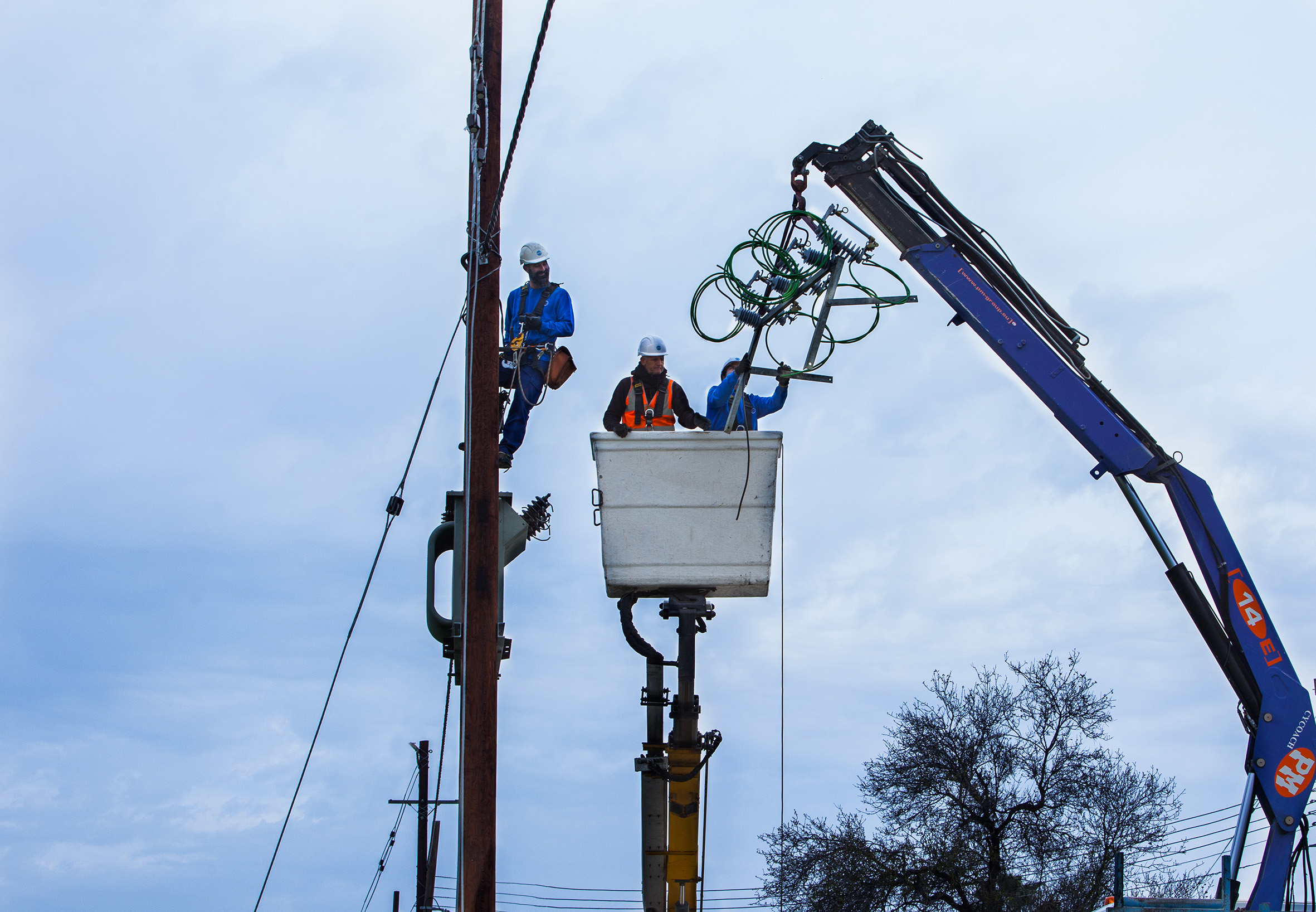
But the number of fires caused by the ageing network has dropped significantly
EAC cables were responsible for several fires that broke out in recent weeks, with the forestry department saying that whilst the situation has vastly improved, the electricity network was responsible for at least five fires this year alone.
Early last week, sparks from EAC cables caused a fire in Orounta, in the Nicosia district, although it was brought under full control within an hour.
One week earlier, a wildfire broke out in the Trachoni area of Limassol. According to the fire department, initial indications suggested that the fire started after a lorry came into contact with overhead electricity cables belonging to the EAC.
Electricity cables causing fires is not a recent problem. In 2024, a series of fires in Psathi in Paphos, as well as Fikaridou and Farmakas unfolded within two weeks were all linked to electricity cables.
Soon after the outbreak of the fire in Farmakas, the fire service blamed a short circuit at an electricity transformer in the area for its outbreak. This was promptly contested by the EAC, which said that power continued to travel through the power lines for hours after the blaze was noticed.
Following the fires, former Environmentalist Movement MP Charalambos Theopemptou made a public statement warning of naked and worn-out electricity cables running through forested areas, which he said posed a significant fire threat.
A year earlier, in July 2023, a fire in Elitzies in the Paphos forest prompted a similar blame-game between the EAC and the forestry service, with the forestry directorate unequivocally blaming the EAC’s lack of maintenance of installations and the authority denying the accusations.
As a result, the Stavros tis Psokas forestry station had to be powered by emergency generators for over ten months. Replacement works of the cables were initiated by the EAC approximately one year after the fire.
7 per cent of forest fires caused by short circuits
“Short circuits in power cables have long been one of the causes of forest fires in Cyprus,” forestry department spokesperson Glafkos Kyriacou told the Cyprus Mail.
According to data by the forestry department, the number of forest fires caused by short circuits in power cables stood at seven per cent in the period between 2015 and 2024, peaking at ten per cent in 2024.
“So far in 2026, at least five incidents have been recorded and reported as being linked to the EAC’s electricity network, caused by short circuits, sparks or birds coming into contact with live wires,” he said.
But Kyriacou was quick to state that this figure is particularly low compared to previous years, partly attributing it to the “excellent” cooperation between the EAC and the forestry department.
“The replacement of overhead cables with underground cables, the undergrounding of the network where technically feasible, as well as systematic inspections and maintenance work, are crucial preventive measures,” he said, adding that at the same time, the department was carrying out forestry works including the clearing of vegetation around relevant infrastructure and transformers to limit spreading in the event of a fire.
“The measures, implemented in collaboration with the EAC, have contributed significantly to reducing the risk and limiting the number of incidents,” he stressed.

Who is responsible for maintaining electricity cables?
“Electrical cables can sometimes produce sparks because, particularly when it is windy, tree branches press against the cables, causing them to come into contact with each other and resulting in sparks,” EAC spokeswoman Christina Papadopoulou told the Cyprus Mail.
She added that in some cases, such as wet palm trees, this can cause sparks even by touching only one conductor as the electrical current can find a path to ground.
“Private property owners should ensure that their trees are properly trimmed before they get close to the electrical lines,” she says.
Papadopoulou says that annual coordinated tree-trimming operations had been brought underway in cooperation with the forestry department to limit the risks of fire outbreaks.
“In urban areas, we continuously take preventive measures. We install twisted, insulated cables and, in many cases, use spacers to prevent the two conductors from coming into contact with each other,” she said.
Meanwhile, the EAC is proceeding to install underground cables wherever feasible.
“All new extensions within cities are carried out using underground cables,” Papadopoulou emphasised.
Regular inspections as a key preventive measure
So, what is the true level of risk posed by electricity cables?
Speaking to the Cyprus Mail, fire service spokesman Andreas Kettis sought to reassure the public about potential dangers.
“The cables are not generally and unconditionally considered to be a cause or risk factor for the occurrence of a fire,” he said, “however, they may constitute a potential source of ignition when specific conditions are present.”
Kettis explained that EAC cables may under certain conditions constitute potential sources of ignition, particularly in the event of sparking or other malfunctions within the network.
“There have been recorded incidents in which fires were attributed to sparking from EAC cables, with the most recent incident occurring in the area of Orounta, in Nicosia district,” he said.
“With regard to cooperation with the EAC in addressing this issue, in every incident where a fire is identified as having potentially originated from sparking or malfunction involving EAC cables or other electrical infrastructure, the EAC is notified accordingly,” he added.
Although the risk is small, EAC cables do pose a clear fire hazard.
Ensuring that trees are pruned, particularly near dry vegetation and wildlife is therefore crucial for the prevention of potential outbreaks.
However, authorities can only take action in public spaces. Both the EAC and the forestry department lack permission to do so on private property.
The responsibility for maintaining trees therefore falls on the owners and therein lies the difficulty. Ensuring that the latter fulfil this responsibility is a far harder task than maintaining a line of cables and an untended branch, left to grow toward the wires may prove the greater spark of danger than the cables themselves.



Click here to change your cookie preferences