
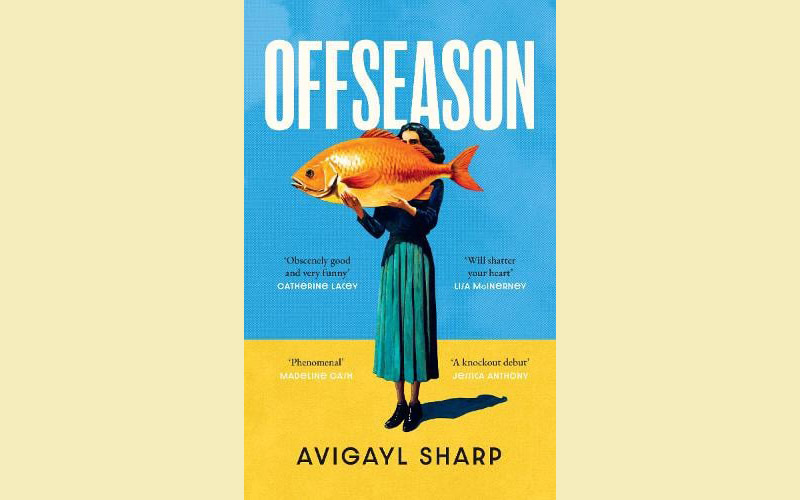
Book review: Offseason by Avigayl Sharp
Novels set in boarding schools have been taking up a lot of my time recently. Mostly in the form of PG Wodehouse’s earlier work, so it was sort of fitting that I came across a boarding school novel that could hardly be more different from something like The Little Nugget on this year’s shortlist for the Bollinger Everyman Wodehouse prize. Some of you might remember that I encountered some bafflement when reading the books on last year’s shortlist due to the fact that none of them seemed to be funny. Thankfully, either the judges or I have had a necessary mental realignment this year, because Offseason is hilarious.
In the title to this review, I’ve called Offseason a trauma novel. Broadly speaking, I hate trauma novels. For this reader, no amount of well-crafted sentences can make up for an author choosing to write an entire book focused on self-indulgent misery-inducing misery. As with all terrible things, if you can’t eradicate them, you can at least make fun of them. Avigayl Sharp does so magnificently.
Offseason’s first-person narrator has trauma. Take it from her: ‘Don’t quote Stalin at me, he said. I have trauma, I said.’ Oh, yes, and she’s obsessed – probably sexually – with Stalin. Indeed, in one of her rare moments of self-awareness, she tells us that, ‘I knew, deep in my heart, that I was a horrible teacher, prone to irrelevant and rambling digressions about my personal life and the childhood maltreatment of Iosif Vissarionovich Stalin at the hands of his drunken shoe-cobbler father’.
She’s right. She is an awful, awful teacher. But thankfully she has a prescription for ‘methamphetamine’s cousin’ that allows her to feel that her digressions are actually incredibly valuable, and which encourages her to periodically abandon her class in the middle of a year-long study of Bleak House to go for long walks by the seashore. She also has a mother who bends fact and fiction to her will, an eating disorder, a skin complaint, an almost total detachment from everyone she knew before she was 18, a commitment to the belief that she has been violated, brought down, and ruined by malevolent external agents, and an understanding that ‘looking like a wet baby with a brain problem was sexually attractive to men’ which makes her sad to have wasted ‘the years in which I looked most similar to a baby.’
And, of course, what the narrator has most of all, is her inventor’s humour. The lines are brilliantly crafted and deadpan to a sharpened extreme. Naturally, there are harrowing moments. It would be hard to focus almost exclusively on trauma and keep it light. But ultimately, Sharp manages to make us laugh enough and care enough, that we end up rooting for her massively messed up protagonist even as we marvel at her ludicrousness.





Click here to change your cookie preferences