
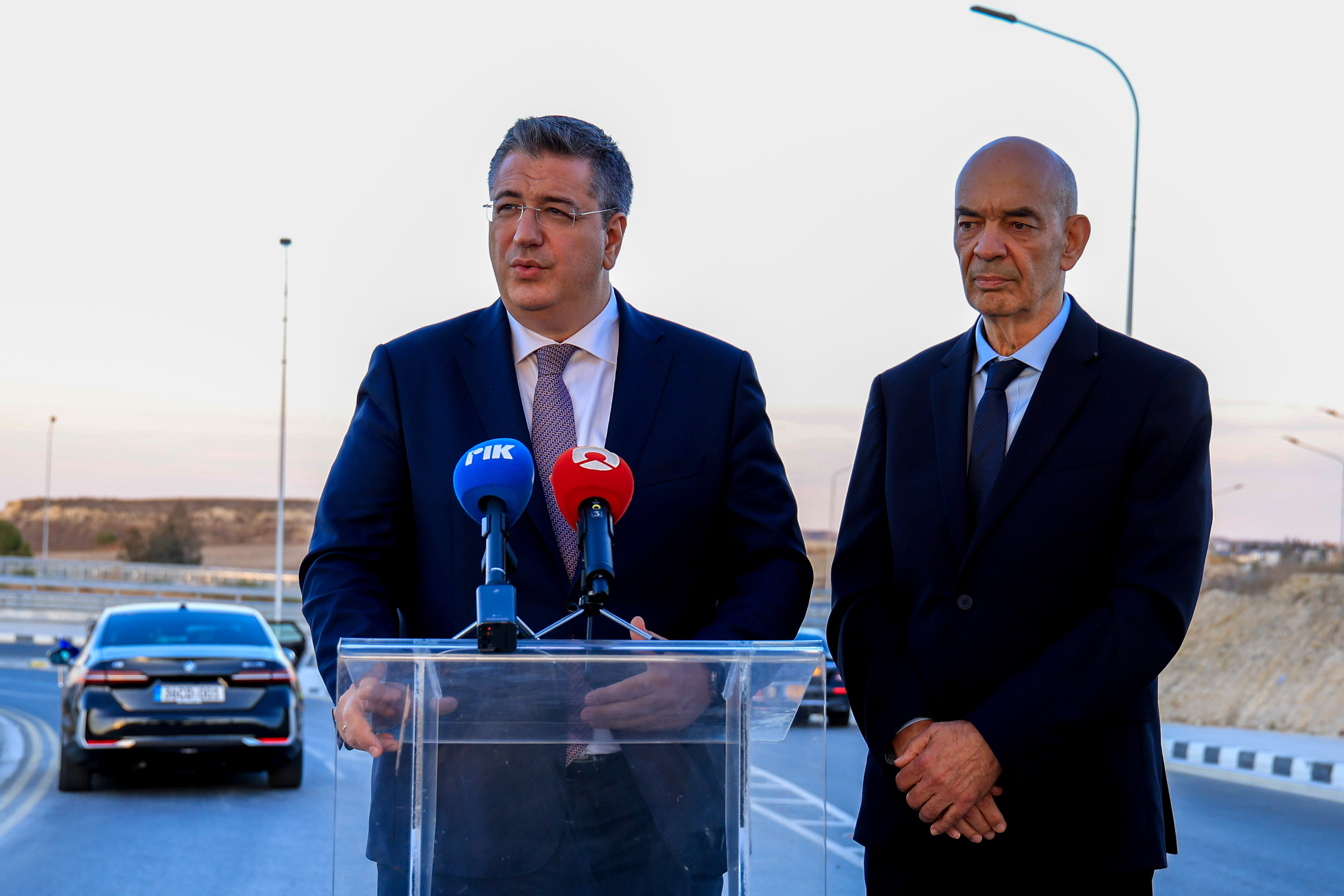
European transport commissioner Apostolos Tzitzikostas on Tuesday said he considers himself to be a second Cypriot commissioner, alongside his “good friend”, fisheries commissioner Costas Kadis.
“For me, Cyprus has two commissioners,” he told journalists, before saying that Cyprus’ undertaking of the Council of the European Union’s rotating presidency at the beginning of next month constitutes a “big moment” for the island.
He added that he expects the island to have a “very active” six-month term, and that in his own domain, that of transport and tourism, he expects work to draw to a conclusion on new EU strategies for ports, shipping, and tourism.
On the matter of these strategies, he had previously said that the European Commission aims “to ensure that Europe’s ports and waterborne industries are equipped to lead the clean and digital energy transition, support defence and trade, and remain globally competitive”.
A draft programme of the Cypriot government’s plans for its six-month term seen by the Cyprus Mail stated that “Europe’s ports serve as vital gateways to the continent and key nodes in our supply chains”.
“Ensuring well-connected and unrestricted access to these ports, where modern supply chains can thrive under the principles of free trade will also be priorities” during that six-month term, the programme stated.
It added that to this end, “particular emphasis will be given to connectivity, security, and the infrastructure needed to achieve decarbonisation goals”.
Tzitzikostas on Tuesday also said that given the proximity of Cyprus’ term and that of Greece, in the first half of 2027, “there are a number of subjects which will be opened during Cyprus’ term and concluded in that of Greece”.
Greece has undertaken the Council of the EU’s rotating presidency on five previous occasions, having most recently done so in 2014 amid a deep economic crisis.
At the time, the country’s then foreign minister Evangelos Venizelos evaluated his country’s six-month term as proof that Greece was a “normal country”.
“Our main goal was to show that Greece is a normal, equal member state. The past six months … helped and will continue to help restore the country’s image,” he said.
The country’s next six-month term may coincide with a general election, with the country required to go to the polls on or before July 25, 2027 at the end of a foreseen four-year parliamentary term, after having had two general elections in 2023.
Cyprus will also have a parliamentary election during its own term – in May – though unlike in Greece, a parliamentary election cannot bring about a change of government, as Cyprus has a presidential system of governance.



Click here to change your cookie preferences