
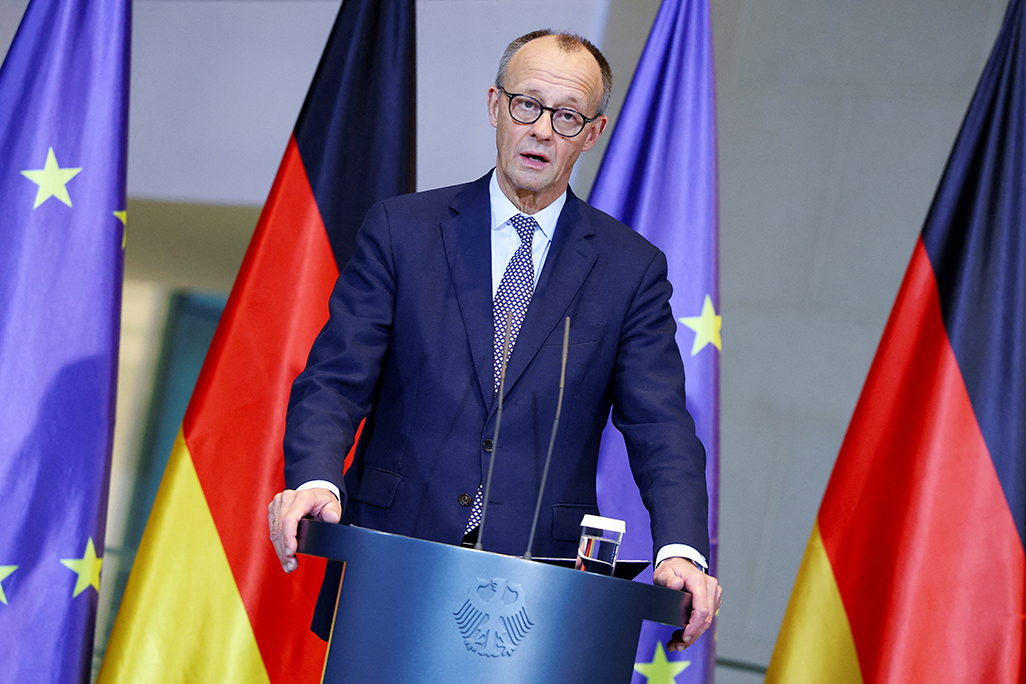
German Chancellor Friedrich Merz narrowly averted a government crisis after securing an absolute majority for a pensions bill in parliament on Friday, despite an earlier revolt within his own conservatives that had highlighted his weak authority.
The bill, which raises pension spending by around 185 billion euros over the next 15 years, passed with 318 votes in the 630-seat Bundestag, without requiring a last-minute offer of help from the left-wing opposition.
The fact its passage had been uncertain until the last minute, however, has highlighted Merz’s lack of authority over his unruly coalition of conservatives and centre-left Social Democrats (SPD) just seven months after taking office.
The row has also heightened doubts about the coalition’s ability to pass much-needed reforms to revive an ailing economy, Europe’s largest, and rebuild Germany’s long-neglected armed forces.
Coalition rows are helping boost support for the far-right Alternative for Germany (AfD) to new highs, with the party now topping nationwide polls and on track to make strong gains in five state elections next year.
“The chancellor is a weakened victor today,” said political scientist Johannes Hillje. “The debate has exposed the limits of his authority. Governing reliably and predictably is very difficult under these conditions.”
“The government’s management will have to improve,” he said.
The parliamentary vote tally showed seven conservatives voted against the bill, while two abstained — an unusually large number of rebels, said Hillje.
PENSIONS: FLASHPOINT ACROSS EUROPE
The bill fixes pensions at the current level of 48% of the average wage until 2031, rather than letting them fall relative to wages. It was a pillar of the deal to form the ruling coalition in May, and particularly important to the SPD.
The youth faction of the conservatives, which has 18 votes, opposed the bill saying it perpetuated a financially unsustainable system, leaving younger generations to foot the bill.
Given the coalition only has a slender majority of 12 votes in parliament, that left it unclear until the last minute whether or not it could pass the bill with its own majority.
The opposition far-left Left Party had made a last-minute intervention, offering to abstain so the coalition would need fewer votes to pass the bill, in order to protect pensioners.
Pensions and generational fairness are turning into political flashpoints across Europe as populations age and public finances tighten, with smaller working-age populations supporting larger numbers of pensioners.
Economists say the German pensions bill ignores the reality and only worsens the situation.
“The government still would like to live in a never-ending present, one in which demographic changes and increasing government debt and debt sustainability issues can simply be ignored,” said Carsten Brzeski, global head of macro at ING.
A SERIES OF BLUNDERS
During the election campaign, Merz, who had never previously held government office, railed against the infighting within the coalition of his SPD predecessor Olaf Scholz.
Expectations were high after he secured a historic agreement for record spending on infrastructure and defence before even taking office, and made clear he intended to return Germany to the international stage as a major player.
But his own coalition has proven shaky.On the day he took office he became the first chancellor ever to require a second round of votes to secure formal approval of parliament.
In the summer, Merz also failed to marshal his conservatives behind the SPD’s agreed candidate for the constitutional court, dooming the vote.
“The government’s public image as ineffective, divided and poorly managed is becoming increasingly entrenched,” said Jan Techau at consulting firm Eurasia Group.
Merz has won plaudits abroad for his strong engagement for Ukraine, but at home his popularity has sunk to around 25%, making him one of the least popular chancellors in memory.
Meanwhile combined support for the conservatives and SPD is down to 39% from 44.9% in February’s election, according to the latest poll by Forsa. The AfD, which surged into pole position in August, remains in the lead on 26%.




Click here to change your cookie preferences