
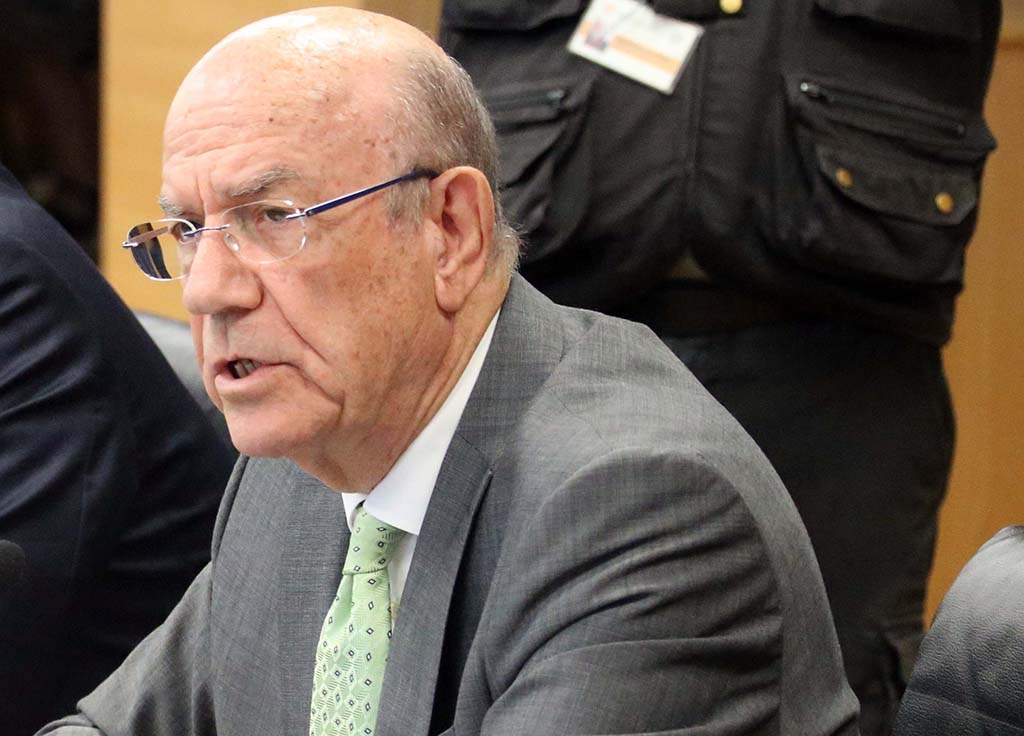
Finance Minister Makis Keravnos on Monday said he will submit amendments to the government’s tax reform bills to parliament on Tuesday as he appeared in front of the House finance committee.
“There remain some basic principles and elements which are related to the resilience of our economy and to the basic principle that a key objective of tax reform is to regulate the tax burden in a fairer manner [with] a fairer distribution,” he said.
He then described the planned reform as “an important issue for the economy and for society”, before warning MPs not to be overzealous in their own amendments to the bills, saying that “there are some key pillars … which cannot be dismantled, otherwise it would ruin the entire thing”.
However, he did state that he and the government are “open to dialogue” over the matter, telling MPs that “I am following the discussions and positions carefully and there are some issues for which we can find solutions”.
Former finance minister Harris Georgiades, who served under Nicos Anastasiades, and two fellow Disy MPs Onoufrios Koullas and Savia Orphanidou asked him to “take a position” on whether he will raise the tax-free income threshold further from the government’s initially planned €20,500 per year.
That figure is already €1,000 higher than the current level, at which it has sat since Cyprus introduced the euro in 2008, though when asked after the session how much the threshold could be increased, Orphanidou did not specify the amount.
Georgiades also called for a better deal for “businesses which pay the most taxes”, but said that this should be worked out “without disrupting the state’s finances”, while the Disy MPs said the government’s stated aim of simplifying Cyprus’ tax code “has not been achieved with the proposed bills”.
Akel MPs Andreas Kafkalias and Christos Christophides said their party has “submitted a number of legislative proposals to support the public”, including a proposed reduction of value added tax on electricity and “energy upgrades” to five per cent and a zeroing of VAT on “basic necessities”.
They also called on the government to increase the tax-free income threshold further than the planned €20,500 and said it would be “necessary to increase tax breaks for small businesses and not tax people’s incomes arising from provident funds.
However, Keravnos said he had received a letter last week from the European Commission regarding the issue of taxation of incomes arising from provident funds, and said the government must “analyse [it] with great care” before proceeding, as the letter said the proposal to abolish the tax “constitutes state aid”.
President Nikos Christodoulides set out the plans in February, and in addition to the tax-free threshold increase, other tax exemptions are set to be granted to other groups.
Parents will receive an extra €1,000 for every dependent, while Christodoulides’ plan also foresees €1,500 of tax-free income for every parent who is either buying their first house or renting, and €1,000 for a “green investment” on the part of every parent.
Single parents will receive double the ringfenced tax-free amount
The plans also foresee that Cyprus’ 35 per cent top income tax rate would only apply to those earning more than €80,000 per year, rising from its current level of €60,001.
At the same time, he said corporation tax will increase from 12.5 per cent to 15 per cent, bringing Cyprus in line with European Union requirements.
Since then, those plans have been added to by new measures aimed at combating tax evasion, including plans to allow authorities to seal off businesses which repeatedly fail to issue receipts or invoices, criminalising the non-payment of income tax, and raising the fines levied at tax offenders.



Click here to change your cookie preferences