
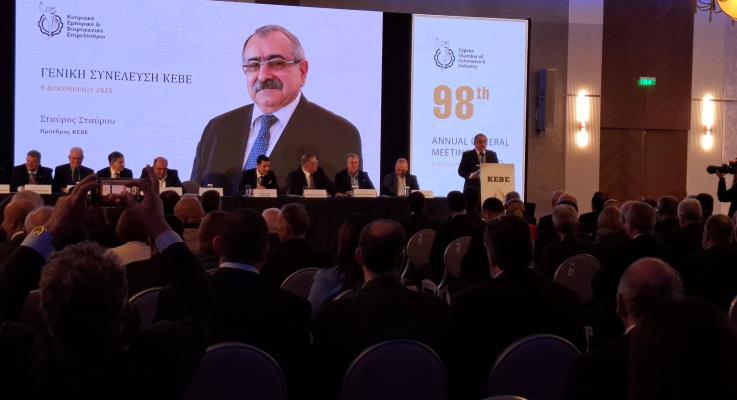
Cyprus’ business community urged the government this week to accelerate economic modernisation, as the Cyprus chamber of commerce and industry (Keve) outlined a wide set of proposals at its 98th annual General Assembly, attended by President Nikos Christodoulides.
Keve’s president Stavros Stavrou said Cyprus is navigating “a period of intense upheaval”, referring to the war in Ukraine, the peace agreement in Gaza, shifting energy dynamics and the rapid entry of artificial intelligence into daily life.
These global pressures, he noted, make the Chamber’s mission “more complex and its work more demanding”.
Turning to geopolitics, he said the chamber believes “another effort will soon be made” to resolve the Cyprus problem, pointing to the regional climate, the government’s diplomatic initiatives and recent energy developments.
He also expressed hope that the leadership of Tufan Erhürman among Turkish Cypriots would support this direction, adding that “we expect that all these factors will contribute to Turkey finally changing course”.
Against this backdrop, Stavrou stressed that Cyprus’ upcoming Presidency of the Council of the EU represents “very high stakes”, arguing that the island should use it to promote its cities, tourism, economy, investments and entrepreneurship.
Presenting the chamber’s economic proposals, he called for the continuation of a “consolidated and prudent fiscal policy” and a restructuring of public spending to contain inelastic costs and increase development expenditure.
Moreover, he urged the state to offer only targeted support to households that genuinely need it.
He noted that the public-sector payroll accounts for 28 per cent of the state budget, describing it as significantly higher than appropriate.
Consequently, he appealed for limits on new public-service hiring, full digitalisation and decentralisation of state services, and greater interchangeability of staff.
In addition, he said outdated laws that “gigantize bureaucracy” should be abolished or modernised, while public-service schemes should be realigned with today’s realities to end the phenomenon of everyone being rated as excellent.
Stavrou also referred to the agreement on the cost of living allowance (CoLA), saying the “compromise on the CoLA” does not modernise the system and does not remove its “distortions and inequalities”.
Still, he acknowledged it avoids a destructive conflict at a sensitive time for economic stability.
He called on unions to appreciate the employers’ stance and “to realize that businesses do not have unlimited strength”, adding that the reinstatement of the CoLA to 100 per cent and its extension to minimum-wage earners would significantly raise labour costs without an equivalent rise in productivity.
He reiterated that the Keve wants “a fairer, more modern system of support for employees, which will reward real performance, will not put a burden on the competitiveness of businesses and will not burden the state with new expenses”.
On labour relations, he said the chamber “cannot tolerate actions or acts that causelessly and unjustifiably poison labour relations”, noting that the economy needs calm and stability.
As a result, he urged unions to exercise the right to strike “with the seriousness it deserves”.
Furthermore, he called on the government to advance legislation regulating strikes in essential services to “end the unnecessary and destructive mobilisations” that disrupt the public and impose significant costs on the economy.
Moving to tax reform, Stavrou said the chamber proposes incentives for the energy transition of businesses, the encouragement of industrial investment, the strengthening of technological companies, the return of talent and the reduction of administrative burdens.
For a more modern tax framework, he asked for digitalised tax services, simpler procedures, the abolition of unnecessary taxes and faster service for taxpayers.
The goal, he said, is a “modern, flexible and simplified tax framework” aligned with EU trends and Cyprus’ economic needs.
Although he acknowledged that several reforms implemented in recent years were “correct and necessary”, he argued they “suffer from distortions, poor implementation and problems”, and therefore require reassessment.
Energy policy, he continued, requires immediate decisions. Cyprus must clarify its position on importing natural gas, exploiting domestic exclusive economic zones (EEZs) deposits, advancing the electrical interconnection with Greece and Israel, completing energy infrastructure and strengthening renewables.
Stavrou said the chamber supports healthy competition, transparency and lower electricity prices, as well as upgrades to the grid, greater RES capacity, self-production and storage.
He also called for incentives, subsidies and specialised schemes for industry.
He stressed that the chamber rejects claims that employers seek to “squeeze workers’ incomes”, adding that Cyprus cannot “close its eyes to the new era” but must modernise and move forward.
The assembly also heard an address by the president of the Cyprus Employers and Industrialists Federation (Oev), George Pantelidis, and was attended by party leaders, ministers, MPs, mayors, ambassadors and members of the business community.



Click here to change your cookie preferences