
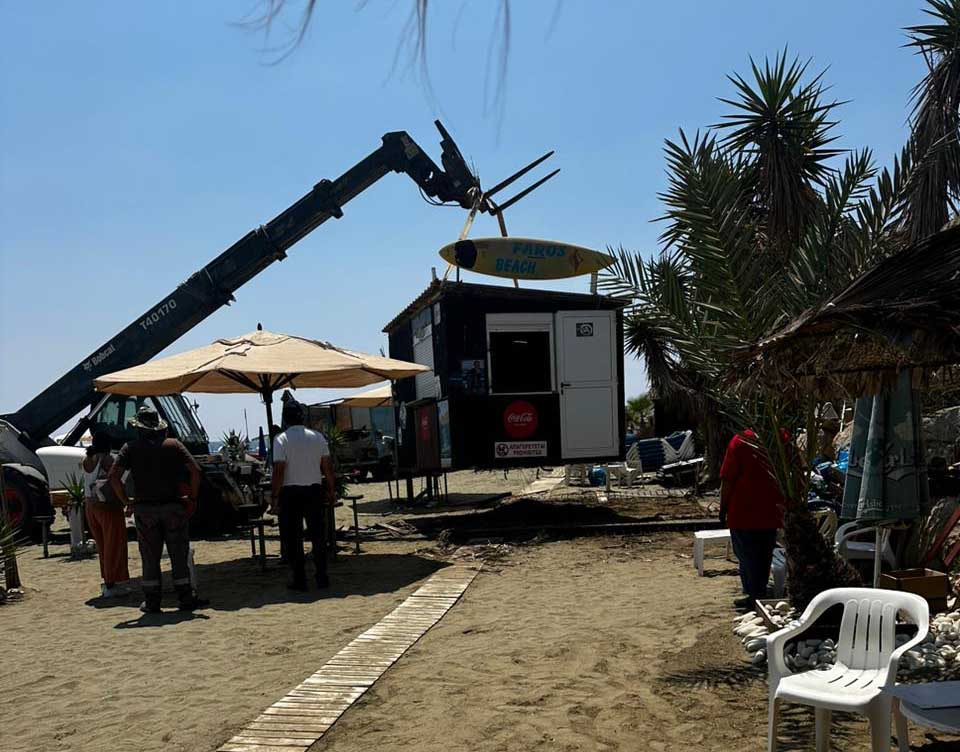
Municipal authorities have begun demolishing illegal structures along the Pervolia beachfront on Saturday.
The demolitions follow actions taken by the Larnaca municipality during 2024 and 2025 to remove premises operating illegally within the beach protection zone.
In a written reply to a parliamentary question, interior minister Constantinos Ioannou said the measures were taken under the coastal protection law after the facilities were deemed to fall within the definition of a “construction”.
Among the structures removed were seaside bars as well as an additional premise used as a canteen.
A third case remains pending before the courts.
The minister said the final removal of said structure, including an illegally installed power generator, depends on the outcome of legal proceedings.
“The generator could not be detached independently without demolishing part of the masonry,” he said, adding that final actions will follow a court decision.
A criminal case has been registered against the owner or manager of the premises, with the matter now handled by the Larnaca building authority.
At the same time, Dromolaxia municipality has submitted applications to the department of lands and surveys to lease state owned coastal plots.
According to the minister, the aim is to proceed with the legalisation of some constructions such as kiosks, within reasonable grounds.
The objective, he said, is “a definitive and lawful settlement that will end the current state of arbitrariness”.
The broader planning effort is linked to the second phase of the coastal pedestrian walkway project in Pervolia.
Ioannou affirmed that illegal encroachments along the route will be removed as part of the project.
He confirmed that relaxations have been approved under the beach protection law to allow specific constructions, including changing rooms, shelters, parking areas and a small kiosk.
The project tender is expected in the first quarter of 2026, with construction scheduled to begin in June 2026.
The estimated cost is €1.5 million, with two thirds funded by the state and the remainder by the local authority.
Construction is expected to last till 2028.




Click here to change your cookie preferences