
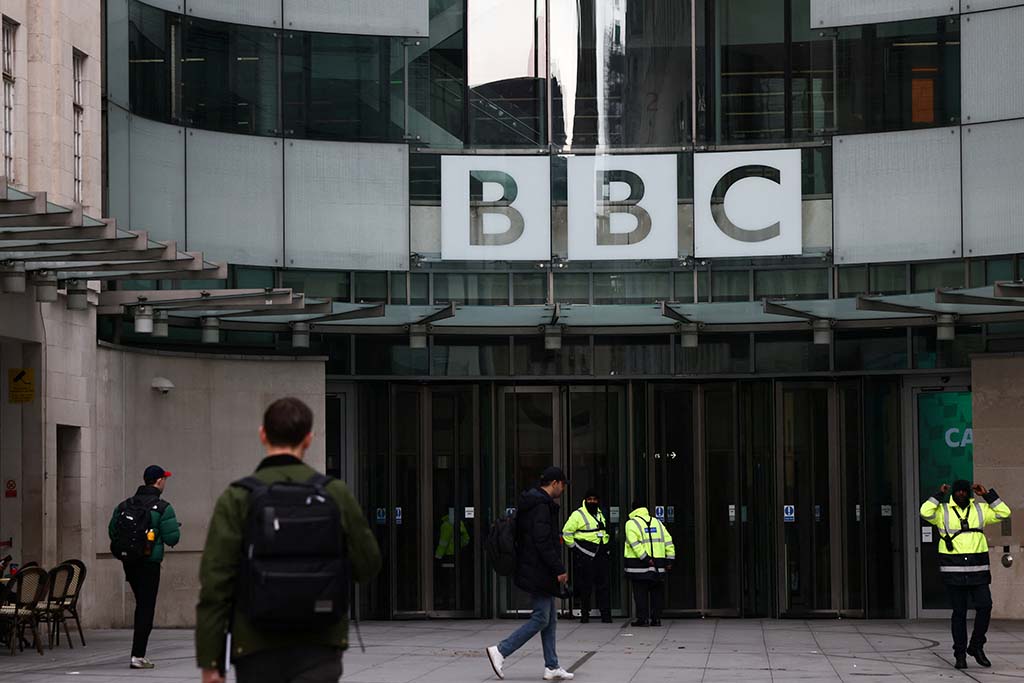
Defamation is a niche branch of the law for the rich and powerful but the $5 billion claim by President Trump against the BBC for defaming him is off the scale. As his fellow New Yorker and former tennis champion, John McEnroe, would say: “you cannot be serious.”
The BBC spliced two clips from opposite ends of the well-known speech Trump gave on January 6. 2021 for a panorama programme shown on October 2024 a few days before the US presidential election — splicing is editorial jargon for the seamless joining of different clips. The splice made it look as though he had encouraged the violent attack on the Capitol that day, which Trump claims was a malicious falsehood.
By the way, a billion is a thousand million, not a million million, and Trump is claiming a further $5 billion in a related cause of action under Florida’s deceptive trade practices legislation that allows lawsuits against defendants that cause reputational harm and financial loss by unethical means.
Whether the deceptive trade legislation can be extended to compensate damage to purely political reputations has not been established in US case law and its inclusion in the claim against the BBC was done to compensate the Trump brand for financial loss caused to it as a business. Trump also asked for a jury because he has a better chance before a jury in Florida and because there is no cap on jury awards
But for the Florida courts to have jurisdiction to hear Trump’s case and for the splice to be defamatory, it needs to have caused serious harm to Trump’s reputation in Florida, which means he must prove it has been viewed there by a significant number of people.
The BBC claimed the programme could not have caused serious harm to Trump’s reputation in the US, as he won the presidential election of November 2020. But Trump is a very litigious businessman president — according to former prime minister Theresa May, he advised her to sue the EU during the Brexit negotiations — and the serious harm he claims is not necessarily limited to his reputation as a political leader but to his good name more generally.
Besides, the BBC is a perfect target for Trump. It is progressive and liberal — woke, even — with a huge third world audience that Trump and his ilk don’t care for very much. He has been presented with a golden opportunity to sue on a silver plate by incompetence and treachery at the BBC and relishes the prospect.
The betrayal at the BBC that brought the stupid splice to Trump’s attention beggars belief. It seems that a disgruntled clique at the BBC decided to expose it as institutionally biased in favour of left-wing causes. They resurrected a stale splice that had not bothered Trump at all until it they leaked it to the Daily Telegraph. Trump now threatens to sink the BBC, the UK’s most effective soft power weapon — so much for the special relationship!
Anyone who remembers the speech Trump made on January 6, 2021, knows that Trump addressed a crowd near the Capitol in an attempt to get Congress to reverse the 2020 election result that was about to declare Joe Biden President.
Here is what he said early in his speech “We are going to walk down to the Capitol and we’re going to cheer on our brave senators and congressmen and women … because you’ll never take back your country with weakness. You have to show strength and you have to be strong. We have come to demand that Congress only do the right thing and only count the electors who have been lawfully slated…I know that everyone here will soon be marching over to the Capitol building to peacefully and patriotically make your voices heard.”
Trump is a good orator, and his speech had all the hallmarks of good oratory: theme, repetition and crescendo: Here is how Trump ended his speech: “We fight. We fight like hell. And if you don’t fight like hell you are not going to have a country anymore… so we are going to go down Pennsylvania Avenue… and we are going to try and give our republicans, the weak ones because the strong ones do not need any of our help, we are going to try and give them the kind of boldness and pride they need to take back our country.”
The BBC reversed and compressed what Trump said at the end of his speech but did this by clumsily splicing passages from opposite ends of a long speech: “we’re going to walk down to the Capitol, and we fight, we fight like hell,” which was substantially what Trump said at the end of his speech.
The verb fight has many shades of meaning: to struggle using physical violence; to strive for a cause; to make an effort to achieve resistance or defeat something or someone, to name a few. In a speech to a motley crowd, it could mean all the above to different persons in the same audience.
Trump’s case is that the BBC splice presented a false, defamatory, deceptive, disparaging, inflammatory, and malicious depiction of Trump. He has a good case on most of the above except proof that the splice was false. How is he going to prove he had not incited the violence that occurred at the Capitol?
If the case goes to trial, he will be cross-examined about what he said and did before the speech and what he said and failed to do while his supporters were violently attacking the Capitol and why he pardoned them after he became president.
Trump did say “We fight. We fight like hell” at the end of his speech and taken out of context it is some evidence that he incited the kind of violence that occurred that day — it is not quite in the league of king Henry’s “stiffen the sinews, summon up the blood” but “fight like hell” is not a form of gentle persuasion either.


Click here to change your cookie preferences