
Thailand and Cambodia ended weeks of fierce border clashes on Saturday with a second ceasefire in recent months in the worst fighting in years between the Southeast Asian nations.
The ceasefire was holding, a Thai Defence Ministry spokesperson, Rear Admiral Surasant Kongsiri, told Reuters about two hours after it went into effect at noon (0500 GMT).
“So far there’s been no report of gunfire,” he said.
Cambodia’s Ministry of National Defence did not report any clashes after what it said had been a Thai airstrike early on Saturday before the ceasefire announcement.
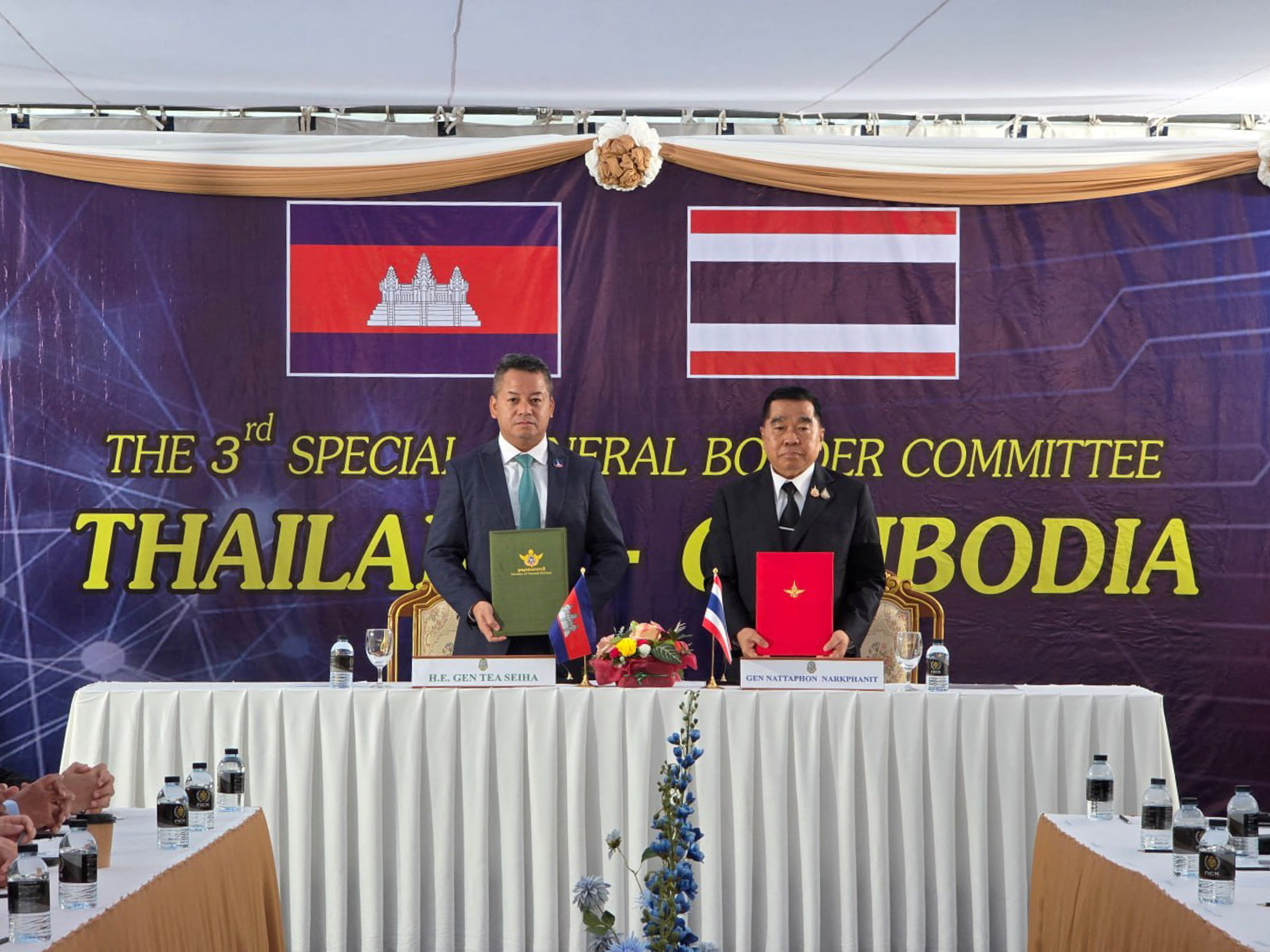
The agreement, signed by Thai Defence Minister Natthaphon Narkphanit and his Cambodian counterpart Tea Seiha, ended 20 days of fighting that killed at least 101 people and displaced more than half a million on both sides and included fighter-jet sorties, exchanges of rocket fire and artillery barrages.
The clashes were reignited early this month after a breakdown in a ceasefire that U.S. President Donald Trump and Malaysian Prime Minister Anwar Ibrahim had helped broker to halt a previous round of fighting.
“Both sides agree to maintain current troop deployments without further movement,” the ministers said in a joint statement on the ceasefire.
“Any reinforcement would heighten tensions and negatively affect long-term efforts to resolve the situation,” according to the statement released on social media by Cambodia.
Cambodia’s top diplomat, Prak Sokhonn, and his Thai counterpart, Sihasak Phuangketkeow, will meet with Chinese Foreign Minister Wang Yi in China’s Yunnan province on Sunday and Monday to discuss the border situation, according to a statement from Cambodian foreign ministry and a Thai official.
For more than a century, Thailand and Cambodia have contested sovereignty at various undemarcated points along their 817-km (508-mile) land border – a dispute that has occasionally exploded into skirmishes and fighting.
The new ceasefire will be monitored by an observer team from the Association of Southeast Asian Nations bloc as well as direct coordination between both countries, Natthaphon said.
“At the same time, at the policy level, there will be direct communication between the minister of defence and chief of the armed forces of both sides,” he told reporters.
Tensions between the two neighbours came to a head in July, when they clashed for five days along some parts of the frontier, leaving at least 48 people dead and 300,000 displaced before Trump intervened to bring about a truce.
That ceasefire broke down in early December with each side accusing the other of moves that led to clashes.
Anwar, currently the ASEAN chair, and Trump had been unable to stitch together another ceasefire, as fighting spread from forested regions near Laos to the coastal provinces on the Gulf of Thailand.
The renewed ceasefire came after a special meeting on Monday of ASEAN foreign ministers in Kuala Lumpur, followed by three days of talks between the warring sides at a border checkpoint, where the two defence ministers met on Saturday.
They agreed on the return of people displaced from affected border areas, while underlining that neither side would use any force against civilians.
Thailand will also return 18 Cambodian soldiers in its custody since the July clashes if the ceasefire is fully maintained for 72 hours, according to the agreement.
Saturday’s pact, however, will not impact any border demarcation activities under way between both countries, leaving the task of resolving disputed areas along the frontier to existing bilateral mechanisms.
“War and clashes don’t make the two countries or the two people happy,” Thailand’s Air Chief Marshal Prapas Sornjaidee told reporters. “I want to stress that the Thai people and the Cambodian people are not in conflict with each other.”


Click here to change your cookie preferences