
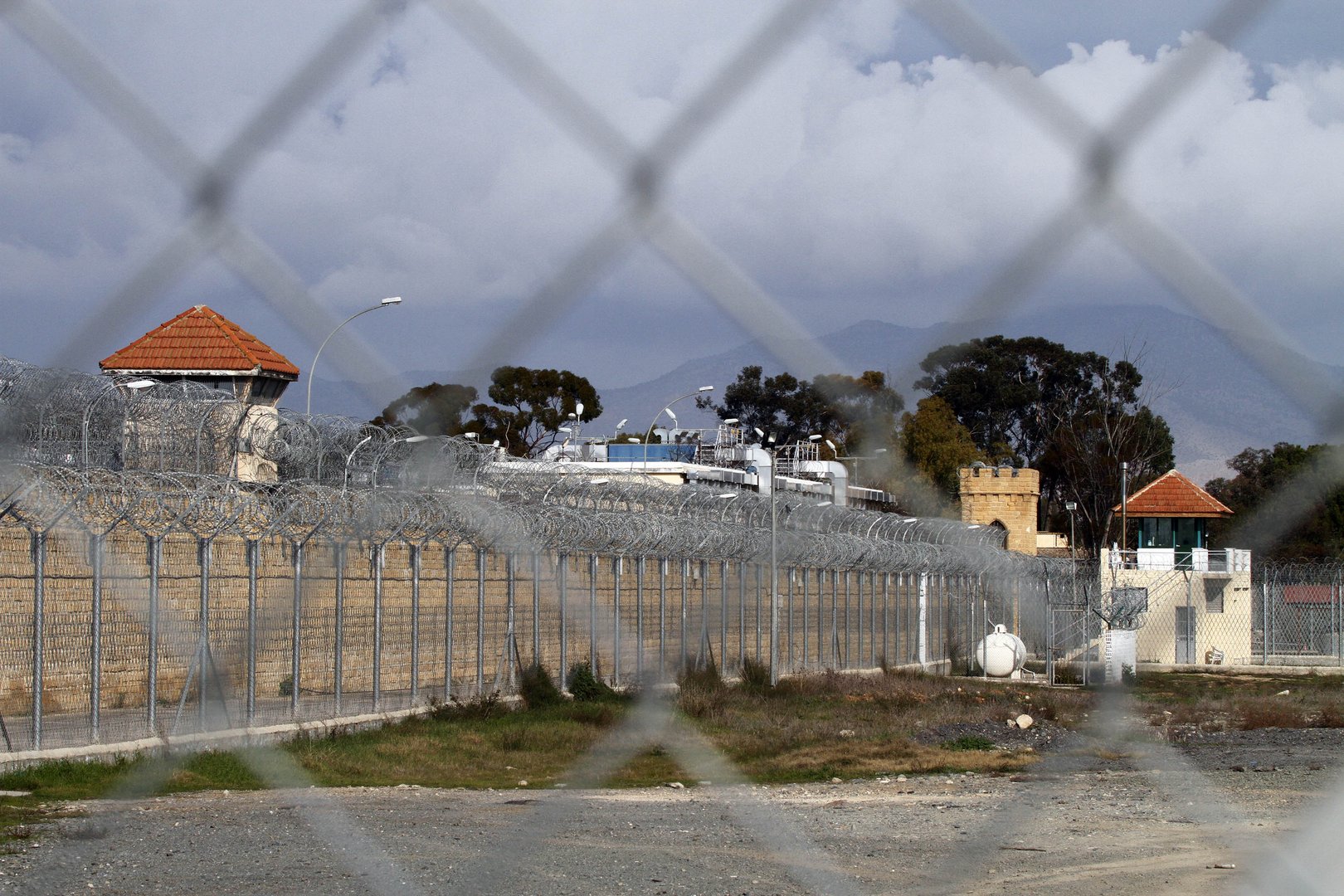
Inmates of the central prison who have committed minor crimes could be released before serving their full sentence due to the facility’s overcrowding crisis, the government said on Tuesday.
“All foreign nationals who are in central Prisons and whose conviction does not concern serious crimes will be deported or returned to their countries of origin, and will be placed on the stop list to be banned from entering the Republic of Cyprus,” President Nikos Christodoulides wrote in a post on Twitter.
Government spokesperson Yiannis Antoniou told the Cyprus Mail that the government was currently exploring the possibility of an early release from prison for a total of 175 inmates, convicted of minor crimes, 100 of which are of foreign origin.
According to Philenews, a total of 1,120 people are currently imprisoned in Cyprus. These include 521 Greek Cypriots and 599 foreigners.
Of the Greek Cypriot inmates, 376 are convicted criminals and 145 are detained suspects, whereas among foreign inmates, 378 are convicted criminals and 221 are detained suspects awaiting trial.
In an interview with Phileleftheros, Christodoulides said the government had already contacted the attorney general, as well as Justice Minister Costas Fitiris “in order to immediately record the state of affairs in relation to the prisoners, their country of origin and the offences for which they were convicted or are being tried.”
He added that the proposed measures would combat overcrowding, as it would lead to a significant reduction in the number of prisoners and tackle several other problems the facility is currently dealing with.
The government press office declined to provide the Cyprus Mail with further details on the timeframe, criteria or applicable procedure.
It furthermore remains unclear, how or whether foreign inmates would benefit from agreeing to a voluntary deportation, and whether or if similar benefits apply to Cypriot inmates.
In addition, the proposed measure may raise legal questions if the respective foreign inmates live on the island and have been granted asylum or subsidiary protection and/or are nationals of a country which is currently not deemed safe.
The central prison in Nicosia has been battling an overcrowding crisis for many years.
The situation has been described as tense by prison guards groups and prisoner rights groups, prompting the director of the association for the protection of their rights Alexandros Clerides to urge the minister to take immediate measures.
“Every death in the central prison is a nullification of democracy itself,” Clerides wrote shortly before Christmas and after two deaths occurred in the facility within one week in December.
The Council of Europe’s committee for the prevention of torture had earlier in December published a scathing report in which it spoke of “grave concerns” over prison conditions, highlighting “high levels of inter-prisoner violence” connected to the persistent staff shortage which had allowed prisoner groups “to dominate and impose informal punishments, undermining safety and order”.
According to the report, “severe overcrowding” and insufficient access to sanitary facilities have resulted in inmates at the central prison facing “very poor” living condition.
The report details how, at present, as many as four inmates were being accommodated in cells of less than six square metres, and that due to a lack of staff available to let prisoners out of their cell, some were forced to have their waste collected in bottles and, at times, to defecate in bags.
The prison guards branch of the Pasydy union, referring to the “constant clashes, murders, and criminal cases planned inside [the] prisons” described the state of the facility as a “disgrace.”



Click here to change your cookie preferences