
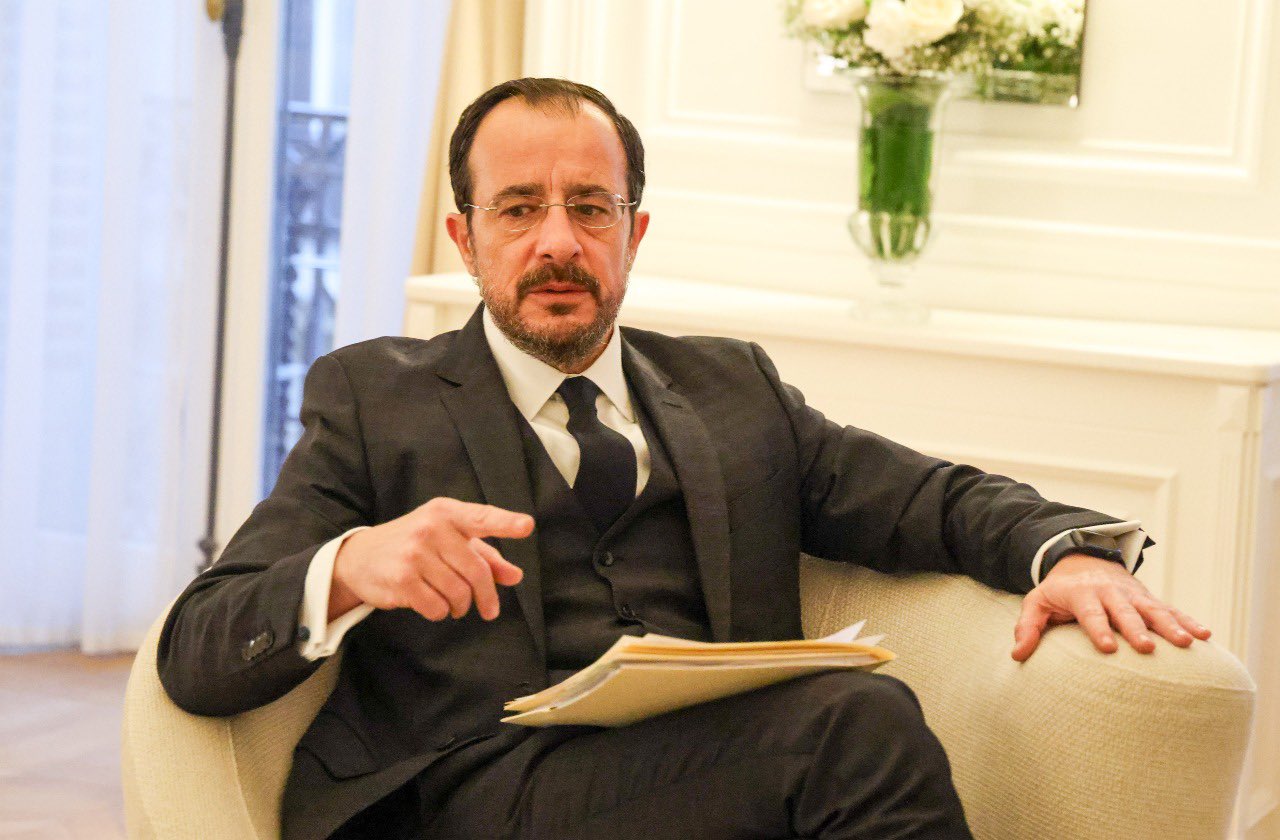
The government on Thursday seemed to reel from the release of a video posted online purporting to reveal how President Nikos Christodoulides and associates engaged in illicit methods to bypass election campaign spending caps while also describing a pay-to-play scheme giving businesspeople access to the president and the first lady.
In a statement, government spokesman Constantinos Letymbiotis said of the video – circulated on the X platform – that an initial analysis pointed to “hybrid activity” directed against the Republic of Cyprus.
The attorney-general and the police chief have been alerted, the spokesman added.
“A preliminary assessment by the competent state agency suggests the video is malicious and the product of montage/splicing,” Letymbiotis said in the initial government reaction.
“It uses false and misleading claims and arbitrary conclusions in order to harm the image of the government and of the country.”
Likewise former energy minister Giorgos Lakkotrypis, featuring prominently in the eight-minute-long clip, released a statement dismissing the allegations made.
“It is clear from the video that the remarks attributed to me have been edited in such a way so as to distort the discussions, the ultimate aim being to damage our country, the president, and me personally.
“It is no accident that the video was leaked a day after the commencement of the Cypriot presidency of the EU Council.”
Lakkotrypis added that he has reported the matter to Nicosia CID, to whom “I will hand over all the evidence I have at my disposal”.
In a post on social media, Annita Demetriou – leader of opposition part Disy – said she hoped the contents “do not correspond to reality. I expect authorities will do the self-evident.”
The provenance of the video – first leaked on X by an account called ‘EmilyTanalyst’ – could not be verified. The account was first created in 2022, and as of Thursday afternoon, had fewer than 400 followers.
The video appears as a documentary-style production, with some parts from publicly available footage while other segments appear to have been recorded undercover.
The narrator, speaking in a British accent, begins the video: “He funded his campaign with illegal cash – disguised as ‘donations’ – to bypass the €1 million limit.”
It portrays Lakkotrypis – energy minister from 2013 to 2019 – as the first point of contact for businesspeople seeking access to Christodoulides. Speaking to a person off-camera, Lakkotrypis appears to walk them through the process.
It appears as if he’s being filmed without his knowledge.
Lakkotrypis is heard saying: “In the elections they have a cap of about €1 million. So sometimes they have to depend on cash, to be able to go above that budget.”
In a different setting, Lakkotrypis says: “He has a cap of €1 million for his campaign. You know, it has to be cash, so they go there with cash. And they spend the money in cash. This is what I’m telling you, this is in cash.”
Next, the narrator says that “When the president needs cash, he calls his chief of staff – his brother-in-law:”
The video then shows Charalambos Charalambous, director of the office of the president – Christodoulides’ brother-in-law.
Charalambous is married to Kristia Karsera, sister of the first lady Philippa Karsera.
Lakkotrypis explains Charalambous’ role:
“The president, we will build for sure a relationship with him. But the president trusts him. He entrusted him with his finances during the campaign. So, very very sensitive stuff. He’s his chief of staff.”
The other person, off-camera, asks: “Cash to whom?”
Lakkotrypis responds: “To his campaign manager.”
The other person comes back: “They give an envelope to the campaign manager?”
To which Lakkotrypis responds: “Yeah yeah. And they pay it…they pay instead of a bank transfer.”
The narrator then states: “The mechanism works like this: the chief of staff uses his connections to find groups willing to pay cash for special treatment. Money for favours, influence and access.”
Next, Charalambous is speaking to someone off-camera: “We are the main contacts here in…at the palace,” he says.
“Decide what you want to do exactly…and then you can come to the president and you can offer…I’m telling you off the record now…you can come and say ‘Okay we want to do this business and we’ll have this amount of money to go for CSR [Corporate Social Responsibility] purposes.’
“For example, the other day, I’m going to tell you just one small example…the other day an American, he has very good ties with the country, he wanted to make a contribution to the government, to the country of €500,000.”
The next segment switches back to Lakkotrypis, who is asked by the unseen person: “This mechanism you describe was used also in the last election? You know it’s working?”
Lakkotrypis replies in the affirmative: “This is exactly how it works.”
In the next frame, in a different setting that looks like a restaurant, a seated Lakkotrypis says: “What I’m trying to say is that for someone like Nikos [meaning Christodoulides] who doesn’t have a party behind him, it’s not easy for them to find the money. So this why Charalambos told me ‘Look, when the time comes, we will need money in the campaign, we will need help in the campaign’.”
In the following segment, the narrator states of Christodoulides: “He provides assistance to oligarchs under EU sanctions in exchange for substantial payments.”
Lakkotrypis then appears again, saying to the person off-camera: “The pharma company, between you and I, had a bigger issue. The main work I do with them is that their holding company, LetterOne, has two sanctioned individuals. They had Fridman and Aven as two of their shareholders.”
Mikhail Fridman and Petr Aven, co-founders of investment firm LetterOne, were sanctioned by the EU and UK in March 2022 following Russia’s invasion of Ukraine, leading them to resign from the company and freeze their shares.
The next frame pans to the website of OFAC – the Office of Foreign Assets Control – showing the names of Fridman, a dual Russian-Israeli national, and Aven, a dual Latvian-Russian national.
Lakkotrypis then states: “So Fridman and Aven are sanctioned, but they found a way…” and the audio drops off.
“And the third one is [Andrei] Kosogov.”
“Besides all the other things that I work with Remedica, I also make sure that Cyprus puts a firm stance in EU for this third guy [Kosogov] not to be sanctioned.”
The person off-camera asks: “How do you do that?”
Lakkotrypis replies matter-of-factly: “I speak to the president.”
He goes on to explain: “Remedica, the pharmaceutical company, donated after my advice €75,000 to the presidential palace. They got the attention of the president.”
The interlocutor asks: “You mentioned that you had this issue with the pharma company. They have problems with the local staff etc. And then you brought them to the president, right?”
Lakkotrypis: “They issued the permit in two weeks.”
The narrator then comes back: “This mechanism is being actively used by major companies like Cyfield, Cyprus’ leading construction company.”
The next frame shows Giorgos Chrysochos, CEO of Cyfield. The person asks him: “This gives you an opportunity to talk to Christodoulides…”
Chrysochos replies: “I can talk to him freely. I mean, I see him every two weeks…”
Asked if he and the president ‘hang out’, Chrysochos says: “Not in public. Because otherwise they will say ‘That’s why he’s helping him’. But if I call him now he will answer. No, I mean the relationship is one of the biggest assets we have.”
Holding his smart phone, as if he’s checking something on it, Chrysochos says:
“We have everyday communication. Let’s see what we…it’s like my girlfriend.”
Regarding the first lady Philippa Karsera, the Cyfield boss states: “You should always be under the radar. So we gave her [the first lady] €10,000 every year. It’s not much, but we support other initiatives as well. I have to pay, I’d say, €250,000 every year on donations.
“Every time the government is hosting a philanthropy event, the president, I am there.”





Click here to change your cookie preferences