
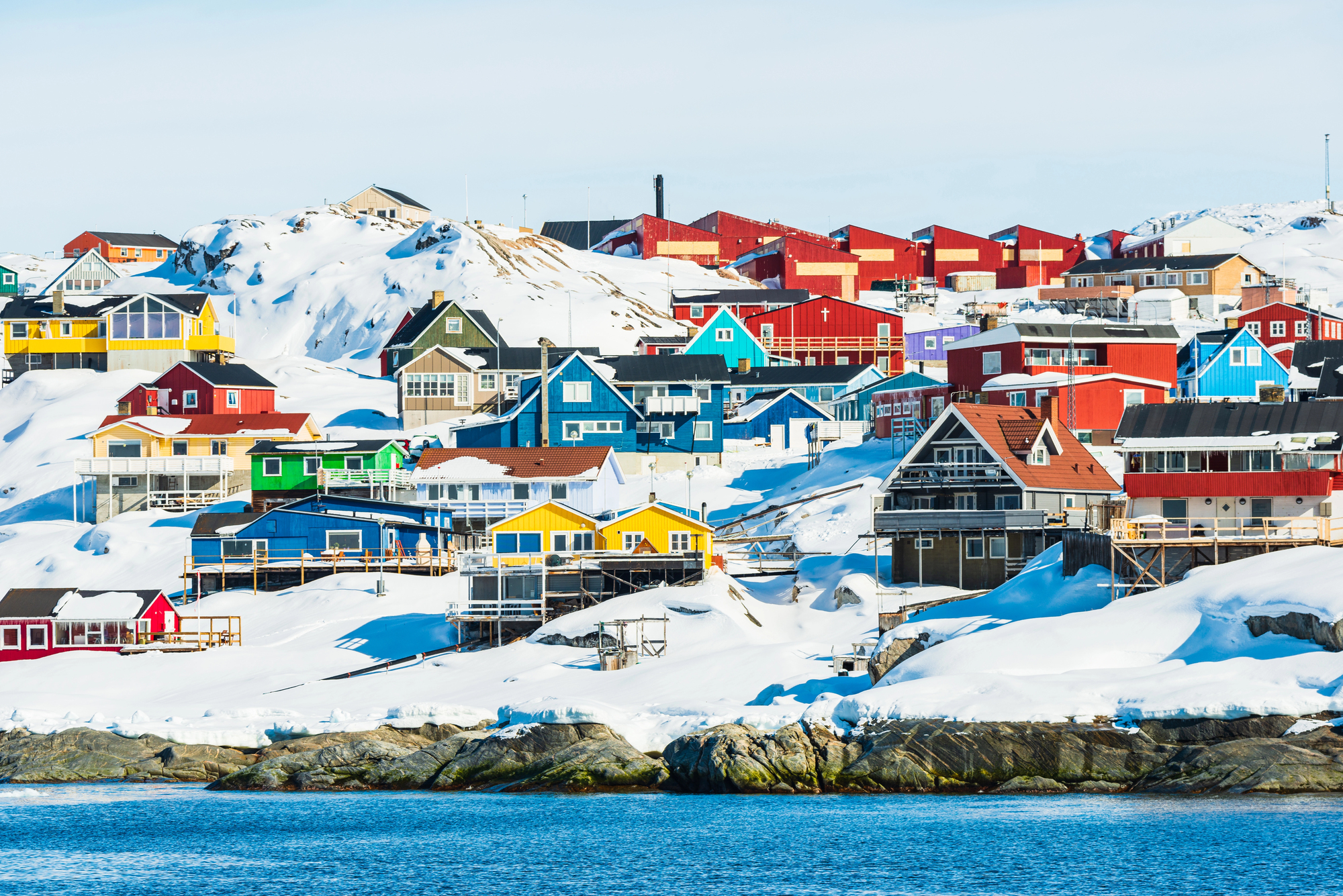
President Donald Trump reiterated on Wednesday that the U.S. needs Greenland and that Denmark cannot be relied upon to protect the island, even as he said that “something will work out” with respect to the future governance of the Danish overseas territory.
The remarks, which came after a high-stakes meeting between U.S., Danish and Greenlandic officials, indicate that there are still fundamental, if not intractable, differences between how Washington, Copenhagen and Nuuk see the political future of the island.
“Greenland is very important for the national security, including of Denmark,” Trump told reporters in the Oval Office. “And the problem is there’s not a thing that Denmark can do about it if Russia or China wants to occupy Greenland, but there’s everything we can do. You found that out last week with Venezuela,” he said.
After meeting with Secretary of State Marco Rubio and Vice President JD Vance at the White House on Wednesday, Danish Foreign Minister Lars Lokke Rasmussen and his Greenlandic counterpart Vivian Motzfeldt said the U.S. and Denmark would form a working group to discuss a broad array of concerns regarding the island that could meet in the coming weeks.
GREENLAND ‘NOT FOR SALE,’ COPENHAGEN AND NUUK SAY
But they also made clear that Washington had not budged on its position that it must acquire Greenland, an autonomous territory of Denmark that is strategically located and rich in minerals. Rasmussen and Motzfeldt described such an outcome as an unacceptable breach of sovereignty.
“We didn’t manage to change the American position,” Rasmussen told reporters outside the Danish embassy in Washington. “It’s clear that the president has this wish of conquering over Greenland.”
Trump has not ruled out taking Greenland by force. Before the two-hour meeting, he argued on social media that NATO would become far more formidable and effective with Greenland in the hands of the U.S. “Anything less than that is unacceptable,” he wrote.
In recent weeks, he has frequently repeated longstanding claims that acquiring Greenland is a national security imperative and that Denmark is not capable of warding off Russian and Chinese influence in the Arctic region.
Greenland and Denmark say the island is not for sale, that threats of force are reckless and security concerns should be resolved among allies. Prominent EU countries have backed Denmark, a member of the NATO alliance.
Ahead of the meeting, Greenland and Denmark said they had begun to increase their military presence in and around Greenland in close cooperation with NATO allies, as part of their promise to beef up Arctic defense.
Late on Wednesday, a Danish Air Force plane landed at Nuuk airport and personnel in military fatigues disembarked, footage showed. The Danish military will support the preparation of exercise activity, according to the nation’s Joint Arctic Command.
Germany, Sweden and Norway have also announced that they would send military personnel to the island.
The increased military presence would include a range of exercise activities throughout 2026, according to the Danish defense ministry.
AVOIDING A ZELENSKIY MOMENT AT THE WHITE HOUSE
In their remarks to reporters, Rasmussen and Motzfeldt called the meeting respectful and emphasized that Denmark shared U.S. concerns about Arctic security. But they firmly rejected the idea of the island becoming American.
While Trump has at times portrayed the island as besieged by Russian and Chinese ships, Rasmussen rejected that characterization, saying “it is not a true narrative that we have Chinese warships all around the place.”
The meeting presented an opportunity for Copenhagen and Nuuk to de-escalate the crisis and find a diplomatic path to satisfy U.S. demands for more control, analysts said.
Noa Redington, an analyst and former political adviser to previous Danish premier Helle Thorning-Schmidt, said concerns were high in Denmark and Greenland that Motzfeldt and Rasmussen could be treated in the same way as Ukrainian President Volodymyr Zelenskiy, when he suffered a public humiliation in a meeting with Trump – and Vance – at the White House in February 2025.
“This is the most important meeting in modern Greenland’s history,” he told Reuters.
Denmark and Greenland had originally sought a meeting with Rubio, hoping to have a discussion among top diplomats on resolving the crisis between the two NATO allies. But Denmark’s Rasmussen said Vance had also wanted to participate.
European diplomats had said the White House had for months brushed off Denmark’s attempts to engage on Greenland at a high level. Wednesday’s meeting was the first principal-level encounter between U.S. and Danish officials on the issue.
Anxiety has been high in Greenland.
“I have been sleeping very, very badly, really,” said Liv Aurora Jensen, a craftswoman and designer in Nuuk, right before she watched the Motzfeldt and Rasmussen press conference on television.
“I was talking to my sister yesterday and I told her: ‘I’m trying not to get a panic attack.'”
‘WE STAND WITH THE KINGDOM’ OF DENMARK, GREENLAND SAYS
Greenlandic leaders appear to be shifting their approach to handling the diplomatic crisis. Until recently, they were stressing Greenland’s path to independence, but now their public statements put more emphasis on Greenland’s unity with Denmark.
“It’s not the time to gamble with our right to self-determination, when another country is talking about taking us over,” Greenlandic Prime Minister Jens-Frederik Nielsen told Greenland daily Sermitsiaq in an interview published on Wednesday.
“That doesn’t mean that we don’t want something in the future. But here and now we are part of the kingdom and we stand with the kingdom,” he said.
Motzfeldt had a similar message.
“We choose the Greenland we know today – as part of the Kingdom of Denmark,” she said in a statement released by the Danish ambassador to the U.S. late on Tuesday.
Trump’s desire for Greenland contrasts with Americans’ opposition to annexation of the Arctic island, according to a new poll.
Just 17% of Americans approved of Trump’s efforts to acquire Greenland, and substantial majorities of Democrats and Republicans opposed using military force to annex the island, the Reuters/Ipsos poll found.
Some 47% of respondents disapproved of U.S. efforts to acquire Greenland, while 35% said they were unsure, in the two-day poll which concluded on Tuesday.




Click here to change your cookie preferences