
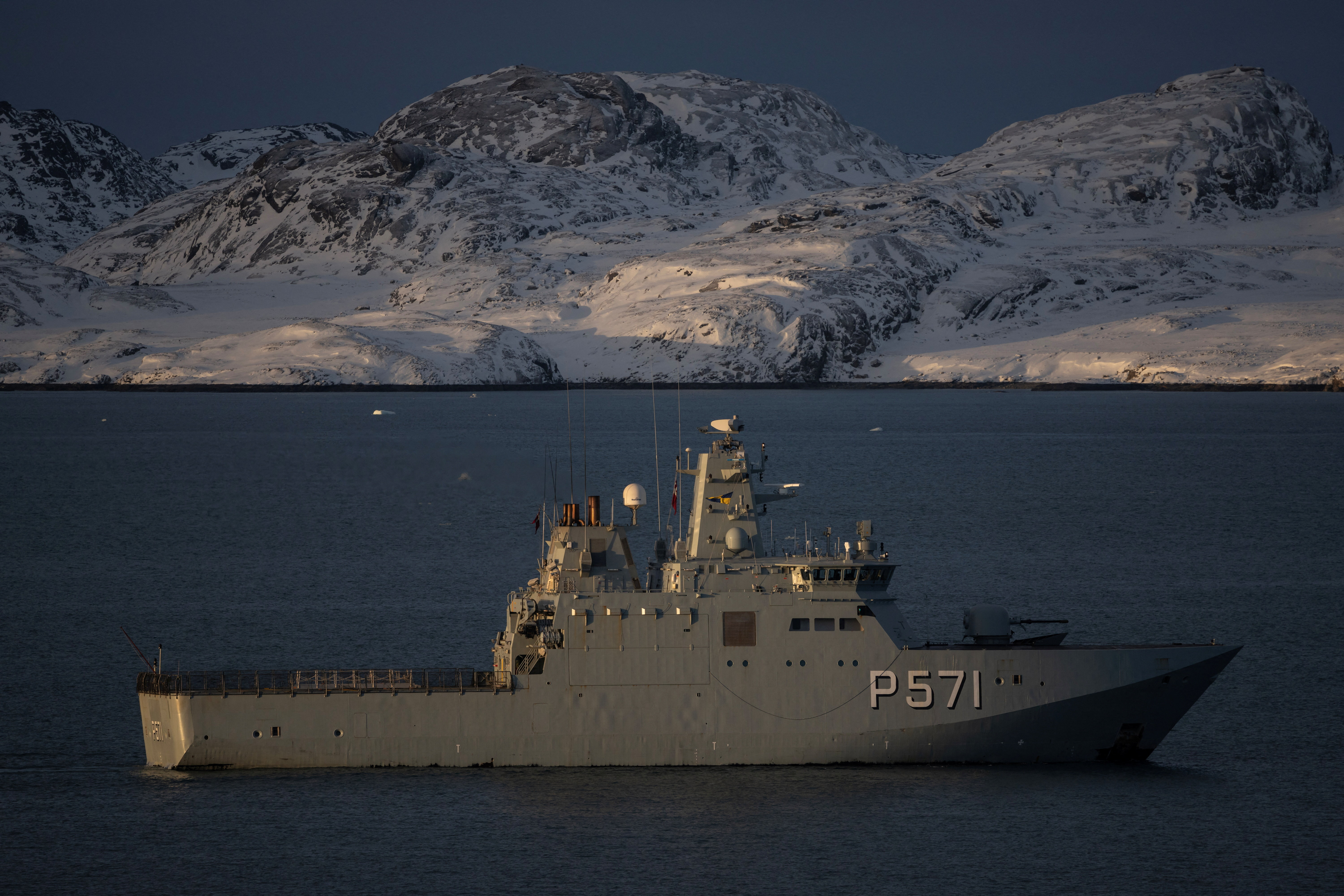
European countries sent small numbers of military personnel to Greenland on Thursday as Denmark said it was pressing on with plans for a “larger and more permanent” NATO presence to secure the island coveted by U.S. President Donald Trump.
The modest European deployments, meant to help Denmark prepare military exercises, sent a strong message of support a day after a meeting of officials from the U.S., Denmark and Greenland failed to reach any breakthrough on the impasse.
After that meeting, Trump repeated his assertion that Denmark could not be relied upon to protect its autonomous territory, Greenland, if Russia or China ever wanted to occupy it.
Trump says the strategically located and mineral-rich island is vital to U.S. security and has not ruled out the use of force to take it. Greenland and Denmark say it is not for sale and that threats of force are reckless.
Denmark’s defence minister, Troels Lund Poulsen, told journalists in Copenhagen on Thursday he did not have a final figure for the envisaged expanded NATO presence in Greenland.
“But it is clear that we now will be able to plan for a larger and more permanent presence throughout 2026 and that is crucial to show that security in the Arctic is not only for the Kingdom of Denmark, it is for all of NATO.”
FEARS FOR NATO’S FUTURE
Prominent EU countries have backed Denmark, warning that a U.S. military seizure of a territory in NATO could spell the end of the military alliance that Washington leads.
The European military deployment to Greenland sent two messages to the U.S. administration, Marc Jacobsen, an associate professor at the Royal Danish Defence College, said.
“One is to deter, is to show that ‘if you decide to do something militarily, we’re ready to defend Greenland’,” he told Reuters.
“And the other purpose is to say: ‘Well, we take your critique seriously, we increase our presence, take care of our sovereignty, and improve surveillance over Greenland’.”
Before Wednesday’s meeting in the U.S., Greenland and Denmark said they had begun to increase their military presence in and around Greenland in cooperation with NATO allies.
Denmark had about 150 military and civilian personnel working at its Joint Arctic Command on the island.
Germany, France, Sweden, Norway, Finland and the Netherlands have said they are sending military staff to begin preparations for larger drills later this year.
In Nuuk, business owner Mads Petersen said it would be strange to see more troops.
“I don’t hope it is the new normal,” he said.
The White House said on Thursday the meeting between U.S. officials and representatives from Denmark and Greenland had been productive and warned sending European troops to Greenland would not affect Trump’s thinking about the territory.
“I don’t think troops in Europe impact the president’s decision-making process, nor does it impact his goal of the acquisition of Greenland at all,” spokeswoman Karoline Leavitt told a briefing.
RUSSIA DISMISSES THREAT TALK AS ‘MYTH’
Russia said on Thursday NATO’s talk of Moscow and Beijing being a threat to Greenland was a myth designed to whip up hysteria and warned of the dangers of escalating confrontation in the region.
Still, any attempt to ignore Russia’s interests in the Arctic would not go unanswered, a foreign ministry spokeswoman later said.
There is currently little evidence that a large number of Chinese and Russian ships sail near Greenland’s coasts.
Danish Foreign Minister Lars Lokke Rasmussen said on Wednesday about 200 U.S. troops were currently stationed in Greenland, which has a population of around 57,000.
The scale of the planned European military build-up has not been made public, but initial deployments appear small.
The German Armed Forces were deploying a reconnaissance team of 13, first to Copenhagen, before heading on to Greenland with Danish personnel. Late on Wednesday, a Danish Air Force plane landed at Nuuk airport and personnel in military fatigues disembarked.
Sweden was sending three officers, Norway two. France was sending about 15 mountain specialists, who would be reinforced in the coming days by land, air and naval assets, French President Emmanuel Macron said.
France and the EU must be “unyielding in upholding territorial sovereignty,” he said.
One British officer was joining the reconnaissance group. The Netherlands said it would send one navy officer. Finland would send two military liaison officers.
After meeting U.S. Secretary of State Marco Rubio and Vice President JD Vance on Wednesday, Rasmussen and Greenland’s foreign minister, Vivian Motzfeldt, said the U.S. and Denmark would form a working group to discuss concerns regarding the island.
A bipartisan delegation of 11 U.S. lawmakers is scheduled to meet with Danish Prime Minister Mette Frederiksen and Greenland Premier Jens-Frederik Nielsen on Friday in Copenhagen, Frederiksen’s office said.
Addressing around 300 Greenlanders gathered in Copenhagen, Nielsen stressed the need for unity, and received a standing ovation when he said the island did not want to be run by, or become part of, the United States.
“We choose the Greenland we know today, as part of the Kingdom of Denmark,” he said.




Click here to change your cookie preferences