
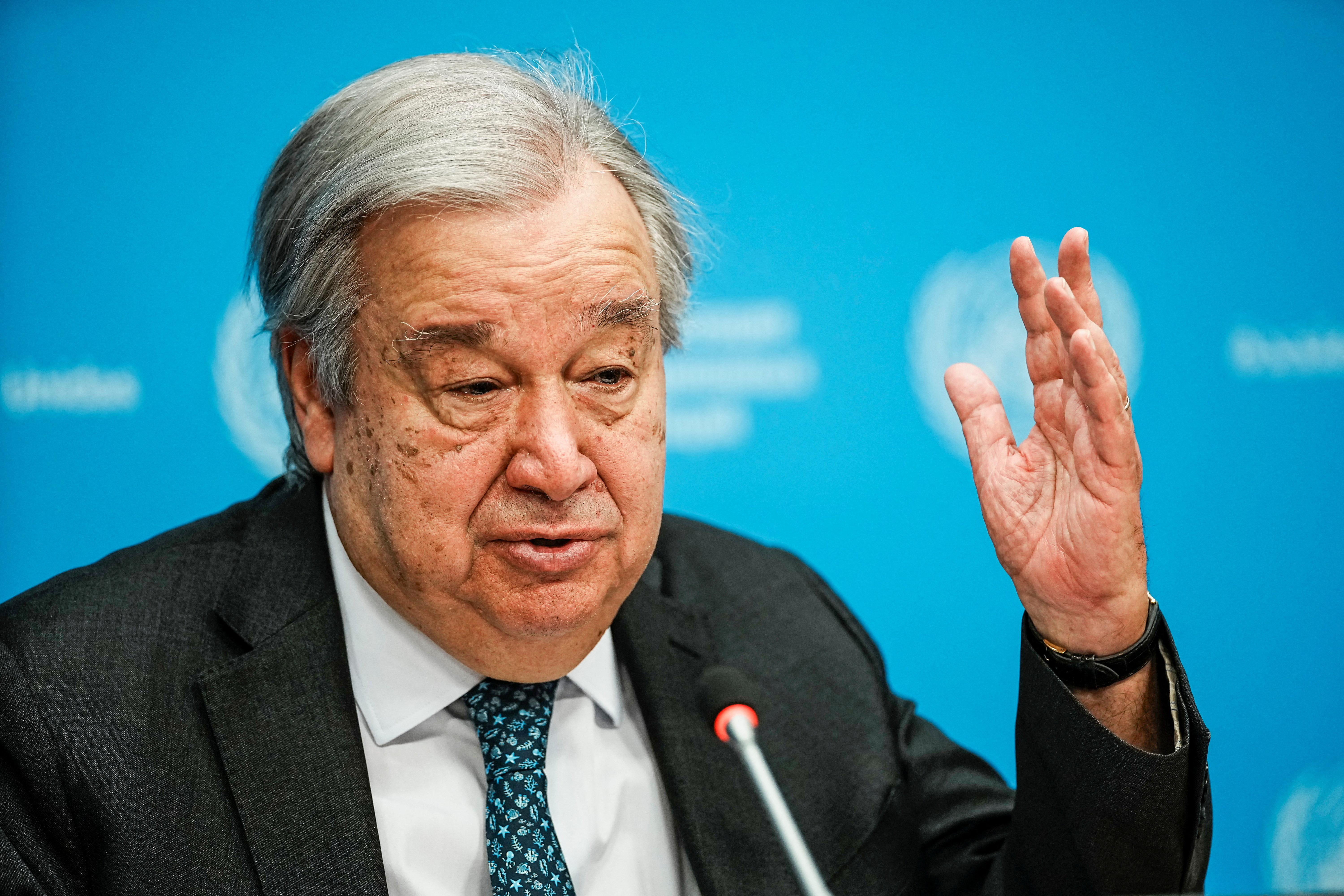
Global problems will not be solved by one power “calling the shots” or by splitting the world into rival spheres, United Nations Secretary-General Antonio Guterres said on Thursday in comments directed at the United States and China.
Guterres spoke to reporters to mark the start of his 10th and final year in office. The U.N. Security Council will choose his successor later this year.
“Global problems will not be solved by one power calling the shots,” said Guterres, later adding it was a reference to the United States. “Nor will they be solved by two powers carving the world into rival spheres of influence.”
When asked to clarify, he said: “We see, and many see, in relation to the future, the idea that there are two poles, one centered in the U.S. and one centered in China … If we want a stable world, if we want a world in which peace can be sustained, in which development can be generalized, and in which – in the end – our values will prevail, we need to support multipolarity.”
The U.S. and Chinese missions to the United Nations did not immediately respond to a request for comment.
U.S. President Donald Trump, who began his second term a year ago, is resuscitating what much of the international community had long spurned as an outdated worldview – spheres of influence carved out by the big powers. He has vowed to restore U.S. dominance in the Western Hemisphere.
UN HAS RESPONSIBILITY FOR INTERNATIONAL PEACE AND SECURITY
Guterres’ remarks come a week after Trump launched his Board of Peace. This was initially designed to cement Gaza’s rocky ceasefire, but Trump foresees it taking a wider role, an approach that worries some global powers.
“In my opinion, the basic responsibility for international peace and security lies with the U.N., lies with the Security Council,” Guterres said. “That is the reason why it is so important to reform the Security Council. And it’s very interesting to see that some that criticize the U.N. for being not effective are the ones opposing the reform of the Security Council. That is the reason why the U.N. can sometimes not be as effective as we all want.”
Guterres’ second five-year term has been marked by Russia’s full-scale invasion of Ukraine, the return of the Taliban in Afghanistan, the conflict in Sudan, the war between Israel and Palestinian militants Hamas in the Gaza Strip, a rapid end to Syria’s civil war and the U.S. capture of Venezuela’s President Nicolas Maduro.
“International law is trampled. Cooperation is eroding. And multilateral institutions are under assault on many fronts,” said Guterres. “Impunity is driving today’s conflicts – fueling escalation, widening mistrust, and kicking the doors open for powerful spoilers to enter from every direction.”
ENDURING PEACE
The U.N. is facing a cash crisis as the world body’s largest contributor – the United States – has slashed voluntary funding to U.N. agencies and refused to make mandatory payments to the U.N.’s regular and peacekeeping budgets. He launched a reform task force in March, known as UN80, which seeks to cut costs and improve efficiency.
Trump has described the U.N. as having “great potential” but said it is not fulfilling that, slamming it for failing to support American-led peace efforts. He says he should get the Nobel Peace Prize after wading into eight conflicts. But the issues that caused them remain unresolved and conflict has flared again in some of the regions.
“Despite all the hurdles, the United Nations is acting to give life to our shared values,” Guterres said. “And we won’t give up. We are pushing for peace – just and sustainable peace rooted in international law. Peace that addresses root causes. Peace that endures beyond the signing of an agreement.”



Click here to change your cookie preferences