
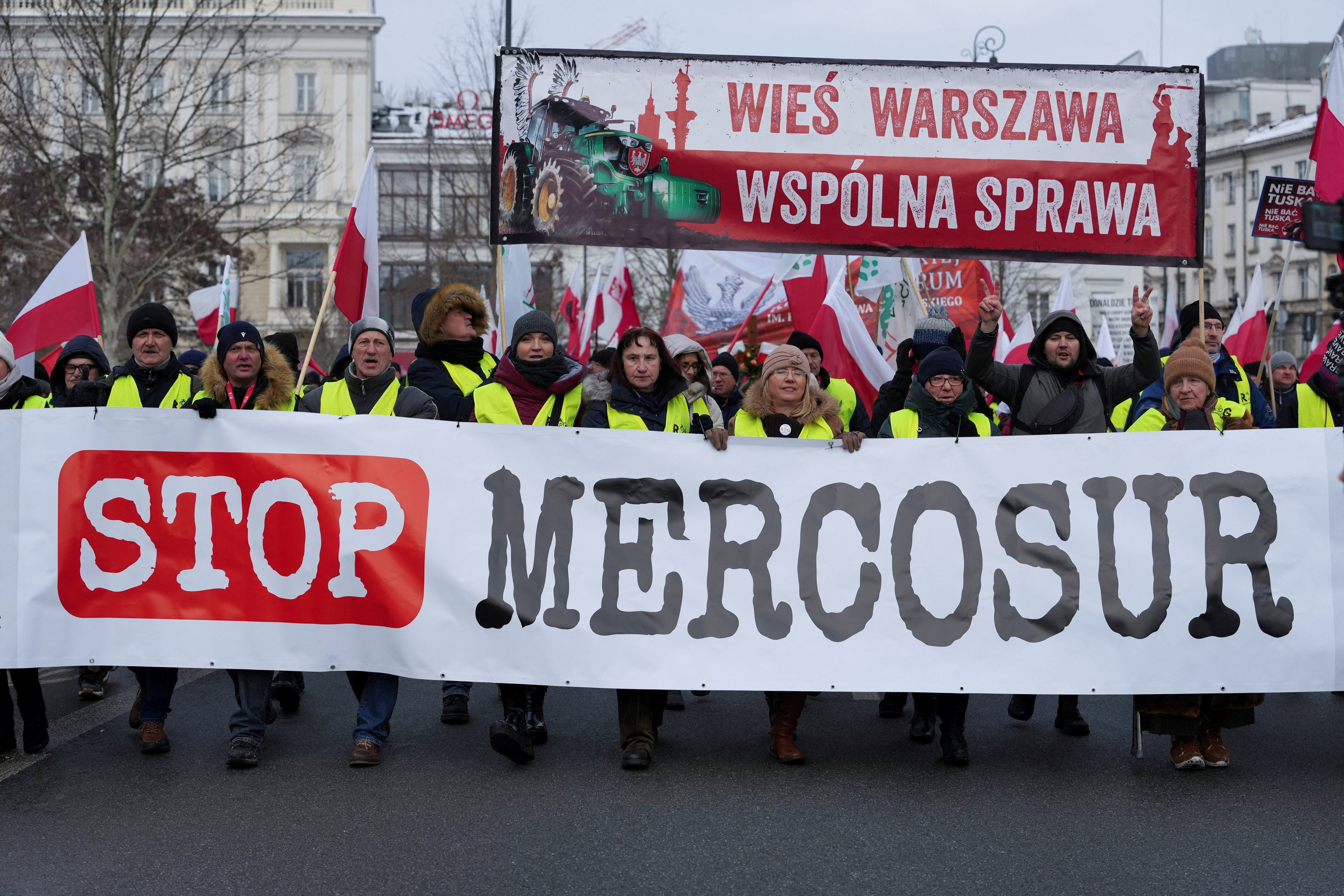
Farmers will take to the streets in protest against the EU–Mercosur trade agreement, MEP George Georgiou confirmed on Friday, warning that the deal threatens food safety standards and the survival of traditional Cypriot products.
Taking to the dais at a press conference in Europe House, Georgiou said the agreement would expose Cypriot producers to unfair competition from low-cost, mass-produced imports, undermining both public health and local agriculture.
“The negatives in many areas are so many that we say we will not accept it,” he insisted, adding that the deal risks eroding food quality while failing to protect emblematic products such as halloumi.
Alongside the press conference, farmers’ union president Michalis Lytras announced fresh protests scheduled for next Saturday, February 14.
A march is planned from Eleftheria square to Europe House and onwards to the presidential palace.
Lytras decried the agreement as “a tombstone for the agricultural sector”.
Georgiou stressed that the European Left and Akel were not opposed to European integration.
“We are not nihilists or Eurosceptics,” he said.
“We recognise the benefits of subsidies, but we want a Europe that serves its citizens, young people, health security and the environment.”
He said amendments to the agreement would again be submitted next week in Strasbourg, despite limited expectations of success.
He also called on the president to build alliances with other affected member states and seek concrete commitments for farmers in negotiations over the EU’s budget.
While conceding that major changes to the agreement were unlikely, Georgiou said political pressure must continue.
“We will fight to limit the damage and to heal the wounds that this agreement will cause,” he said.
Responding to questions, he said a ruling by the European court of justice on whether the agreement breaches EU law is expected within 18 to 24 months but warned that the deal could be implemented before that.
He described this as “institutional deviation” that would prove difficult to reverse.
“If the court vindicates the case, the agreement collapses and new terms are required,” he said, while expressing little optimism.
Georgiou contrasted Cyprus’ position with that of other member states.
He countered that Greece had secured protection for 21 traditional products through impact assessments, while Cyprus “failed even to safeguard halloumi”.
He also criticised production standards in Mercosur countries.
“These products are often made using pesticides banned in the EU, in areas with abundant land and water, at costs our farmers cannot match,” he said.
“We say no to a trade that baptises environmental destruction and deregulation as development,” Georgiou said.
“We do not accept an agreement that measures profit in tons and ignores the cost to our health and the future of our children.”
He questioned who in Cyprus could afford high-quality food if local production declined, warning that consumers would be pushed towards cheaper imports of uncertain quality, with consequences for public health.
Christina Nikolaou, head of the Akel’s environmental committee, said the agreement contradicts EU objectives on deforestation and pollution.
She described this dissonance as “paradoxical”.
Representatives of the consumers’ association, the Laona foundation and beekeepers attending the event also voiced concern, warning that the agreement risks deepening pressure on local producers while weakening environmental and consumer protections across the EU.





Click here to change your cookie preferences