
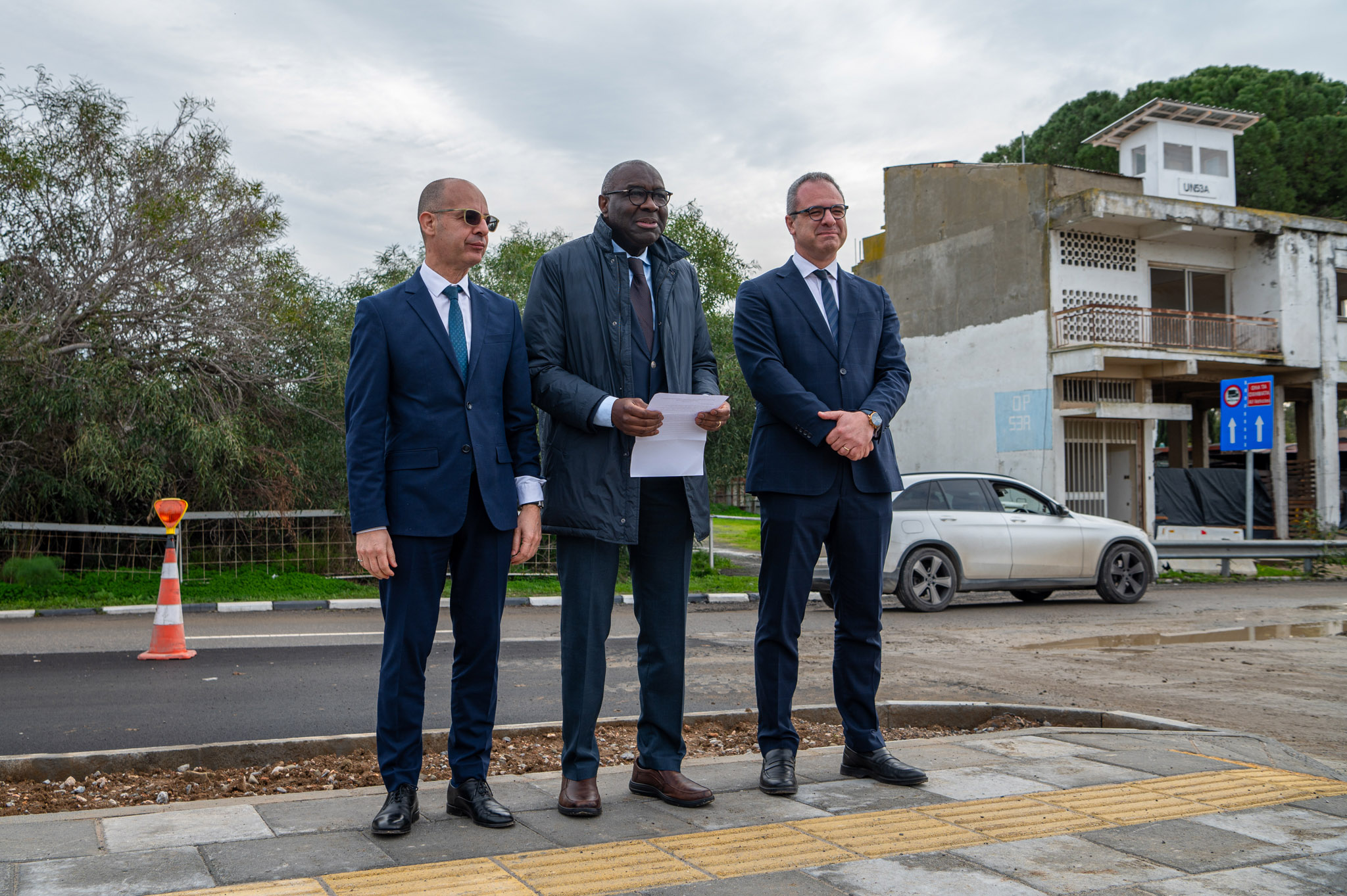
Greek Cypriot negotiator Menelaos Menelaou criticised the approach taken by the United Nations secretary-general’s personal envoy, Maria Angela Holguin, arguing on Monday that her recent public intervention presents “a distorted picture of responsibility” for the lack of progress on the Cyprus issue.
Speaking on CyBC morningradio programme, Menelaou insisted that Holguin’s op-ed, adopted an “equalising logic” that placed both sides on the same footing despite what he described as “sustained obstruction by the Turkish and Turkish Cypriot sides”.
He said the article included elements “never raised by the Greek Cypriot side” and failed to reflect the reality on the ground.
According to Menelaou, the core reason dialogue remains at an impasse is a “deliberate tactic of delay and diversion”.
“The problem is not timing or internal processes,” he said, “but the persistence of positions that undermine the agreed framework for a solution.”
Holguin had argued that Cyprus’ assumption of the EU council presidency as well as the upcoming May parliamentary elections “ends up limiting the possibility of significant changes” as well as the need to allow the new Turkish Cypriot leadership time to settle in made the coming months “a complicated period to achieve major changes in the dialogue process”.
Menelaou rejected that rationale, saying readiness for negotiations depends solely on political will and adherence to the established parameters of the UN.
“Our assessment of the situation is that the obstacles are due to the attitude we face from the Turkish side, and we are not saying this because it suits us or because we are interested in the blame game, but because this is the objective reality based on the facts”, he insisted.
The comments came as Nikos Christodoulides publicly dismissed Holguín’s proposal, saying he was prepared to attend an expanded conference “as early as next week” to announce the resumption of talks “from where they broke down at Crans-Montana in 2017”.
Christodoulides described references to elections and the EU presidency as “laughable” and insisted neither affected the government’s readiness.
Holguín’s op-ed also suggested that the two leaders should continue direct contact without UN mediation, focusing on small joint decisions before returning to formal negotiations later in the year.
She wrote that she would not return to Cyprus for several months, saying she would do so only when she believed her presence could facilitate concrete progress.
Menelaou said such an approach “risks normalising stagnation”.
He argued that delays “only serve to consolidate the faits accompli and weaken the prospect of a settlement based on a bizonal, bicommunal federation with political equality, as set out in UN resolutions”.
Turning to confidence-building measures, Menelaou pointed to the continued deadlock over new crossing points as evidence of the Turkish side’s stance.
He said a United Nations bridging proposal for the Pyroi–Athienou crossing has been on the table since July and was accepted by the Greek Cypriot side immediately.
“The refusal to accept it on Turkish Cypriot side shows where the problem lies”, Menelaou remarked.
The issue of crossings has featured prominently in recent exchanges, with congestion at Ayios Dhometios and delays at Deryneia and Astromeritis cited by the Turkish Cypriot side as examples of Greek Cypriot inertia.
Christodoulides responded that the Republic had long been ready to proceed with improvements and that delays occurred within the buffer zone, adding that proposals for the government to carry out the works itself were rejected.
Menelaou’s remarks also addressed the stance of Tufan Erhurman, who has insisted that any new effort must be preceded by agreement on a “methodology” and by acceptance of convergences reached up to Crans-Montana.
Menelaou said Erhurman’s positions “mirror those previously advanced by Ersin Tatar”, particularly on the question of the basis for a solution and on demands linked to sovereign equality.
Erhurman, who recently met Antonio Guterres in New York, has argued that talks should not restart without guarantees that the process will not collapse again without consequences.
His four-point methodology emphasises lifting what he describes as the isolation of Turkish Cypriots, achieving tangible results and avoiding negotiations “for the sake of negotiations”.
While the meeting with Guterres was described by Erhurman as useful and productive, no timetable or procedural framework emerged.
Turkish Cypriot media portrayed the encounter as an effort to restore dialogue under new terms, while Turkish sources said the key question remained whether the Greek Cypriot side was willing to engage on the basis of sovereign equality.
Menelaou said such demands fall outside the UN framework and cannot form the starting point for talks.
He argued that insisting on preconditions effectively blocks negotiations and shifts responsibility onto the other side.
Menelaou is expected to meet the Turkish Cypriot negotiator, and Erhurman’s undersecretary, Mehmet Dana within the week as part of preparations for a scheduled meeting between Christodoulides and Erhurman on February 24.



Click here to change your cookie preferences