
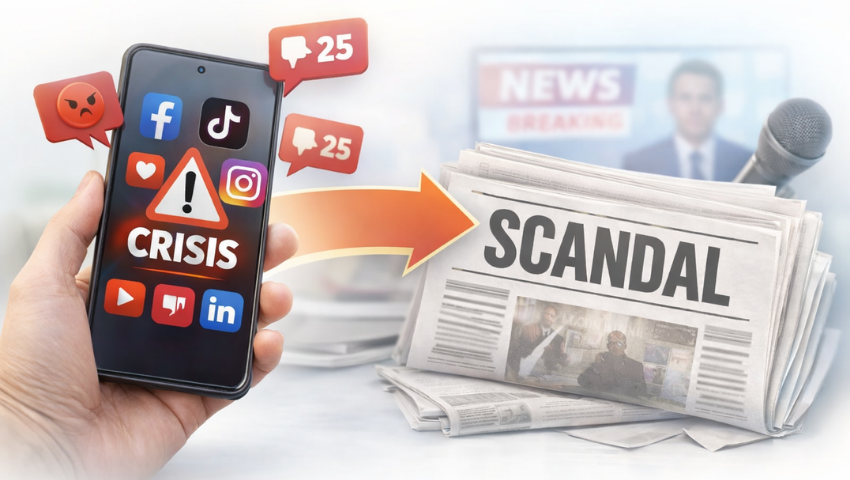
For decades, businesses treated communication crises as phenomena that emerge once an issue reaches traditional Mass Media. Today, however, the starting point of a crisis has shifted.
Before a matter gains publicity in newspapers or on television stations, it has often already developed and escalated on Social Media.
Speed shapes the risk
A negative comment on Facebook, a video on TikTok, or a thread on X can gather thousands of views within just a few hours. In a small market such as Cyprus, a single negative comment can turn into a public issue within hours. Information travels fast, and reputation is affected immediately.
By the time an issue reaches traditional media outlets, the narrative has already been formed, often without the company’s participation.
The question, therefore, is not whether a company will receive negative comments. It is whether it will detect them in time.
When delay comes at a cost
In a recent case in the Cypriot market, an individual customer complaint in a Facebook post began to generate increased engagement within a few hours. Other users added their own experiences, the content was reproduced in stories, and it was shared in local groups.
By the next morning, the issue had gained broader traction, with a strong negative tone. The company became aware of it only after it had already turned into a public discussion.
In another case, a user-generated short-form video began attracting a significant number of views, raising questions about a specific product. The discussion developed in the comments section, with users expressing doubts and requesting clarifications. Two days later, the issue was picked up by a news website, now presented as a “story” with an already established narrative.
In both cases, the difference was not the incident itself, but the timing of its detection.
From monitoring to prevention
The modern approach to reputation management is not limited to reaction. It is based on timely information.
Systematic monitoring of keywords related to the brand, products, executives or critical issues allows for:
- Immediate detection of mentions
- Evaluation of context and tone
- Identification of recurring patterns
- Faster activation of crisis management mechanisms
The difference between a controlled situation and a crisis with multiple implications is often determined within the first few hours.
The strategic advantage of early insight
Businesses that integrate Social Media Monitoring into their strategy do not treat it as a technical tool, but as an early warning mechanism.
Analysing mentions does not only help prevent crises. It also provides insight into:
- Market perception
- The momentum of specific issues
- Opportunities for intervention
- The need to adjust messaging and campaigns
In an environment where reputation is an intangible yet critical asset, timely information becomes a competitive advantage.
The new reality of corporate communication
The shift from fragmented tracking to an organised Social Media Monitoring system is now a core pillar of modern corporate communication.
Systematic detection of mentions across platforms such as Facebook, Instagram, TikTok, X, YouTube and LinkedIn enables businesses to manage their public image with greater accuracy, speed and consistency.
In Cyprus, where the connection between businesses and the public is direct, timely information is a key factor in reputation management.
Clip News provides comprehensive Social Media Keyword Monitoring services, covering all major Social Media platforms and supporting businesses in the timely detection and effective management of mentions.
Ultimately, a crisis does not begin when it becomes headline news. It begins when someone presses the “Publish” button.





Click here to change your cookie preferences