
Cyprus’ outbreak comes exactly 25 years after a similar outbreak in the UK which saw millions of animals culled
By Claire Powell
The confirmation of foot and mouth disease on a number of livestock units in the Larnaca region on February 20 is a chilling coincidence of dates. Exactly 25 years before, on February 20, 2001, (FMD) was confirmed in pigs at an English abattoir in Essex.
This was the first case of an epidemic which over the next 11 months, cleared over 9,000 British farms of livestock and claimed the lives of millions of animals – cattle, sheep, pigs, goats, deer and “others”.
The financial costs – £8 billion in direct costs to the British government.
Costs to rural and tourism businesses, caught up in the despair which froze the British countryside, were uncalculated. Many small businesses did not survive.
The heartbreak cost? No figure high enough.
During the traumatic days of 2001, many FMD lessons were learned, in particular, what an ingenious, devious and surviving traveller the FMD virus is, able to hide away, unseen, for long periods of time in many places, some of them mobile.
Many British farmers wish they had known in January 2001, what they were to learn from February 20, 2001 onwards.
A look back at the British FMD experience of 2001 may provide valuable information for Cypriots attempting to contain and eradicate the FMD virus.
The FMD virus in Britain was the pan-Asiatic type ‘O’ strain which can survive for considerable lengths of time in meat, frozen lymph nodes, bone marrow, internal organs, salted and cured meats and non-pasteurised dairy products.
The virus can also survive in slurry for six months, on hay or straw for 20 weeks and in water for up to 50 days.
It would be easy to assume that the virus is spread only by cloven-hoofed animals. However it can also be spread by intermediaries which have been in contact with affected animals/meat and/or dairy products.
Intermediaries include: humans, hides, hair, wool, hay, straw, sacks and packing fabrics, milk, manure, urine, animals, especially cats and dogs, hares, rabbits, rats, mice, hedgehogs and birds.
The virus can also be spread by wind, watercourses and vehicles.
The FMD virus can survive in a human nose for up to 48 hours, making a human who has had contact with an infected animal or material, a potential carrier and spreader of the disease.
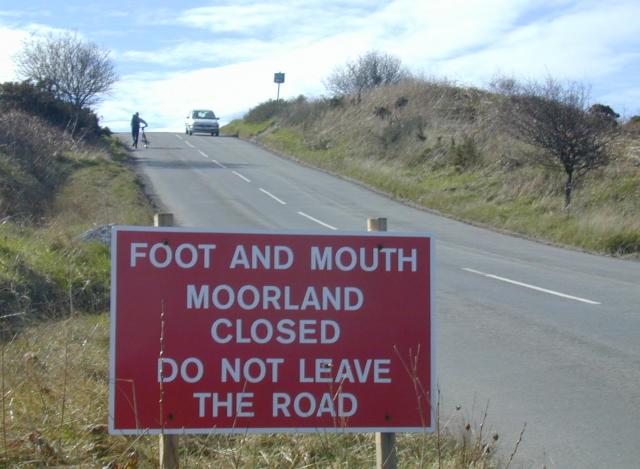
A brief look at the timeline
On February 20, the first confirmed case was in cull sows at an Essex abattoir. At the abattoir, these sows had mixed with sows from a farm in Northumberland in the north east of England, which had been slaughtered on February 16.
On February 23, FMD was confirmed in pigs at the Northumberland farm. Veterinary assessment of lesions of inspected animals suggested the pigs had been infected on February 7.
Also on February 23, FMD was confirmed at another Northumberland farm, a sheep and cattle unit approximately two miles north of the pig farm. Cattle were the first animals to display symptoms. Sheep then found to be infected.
Sheep can harbour the FMD virus without displaying symptoms. Consequently, infective sheep can spread the disease un-detected. In 2001, the non-display of symptoms in sheep, created massive problems.
Sheep from the Northumberland beef and sheep farm had been sold in a local market on February 13.
On February 15, some of these sheep were then traded through Britain’s largest sheep auction in Cumbria, in north west England. It seems that infected sheep traded through the Cumbria auction transported the virus throughout a large part of Britain before the first confirmation of FMD on February 20.
The 2002 Anderson “Lessons to be Learned” Inquiry into the 2001 FMD outbreak stated that “at least 57 farms in 16 counties were infected by the time the first case (at the Essex abattoir), was confirmed.”
With confirmation of Foot and Mouth Disease on February 20, those with memories of the previous major UK outbreak in 1967, pleaded with the then agriculture minister to implement an immediate and total livestock movement ban throughout Great Britain on February 23.
The virus continued to spread until the end of September 2001. The UK was declared free of FMD on January 14, 2002.
From February 20, when FMD was first confirmed, until February 23, when the livestock movement ban was imposed, other than movement restriction zones around confirmed cases, British livestock were traded and transported normally, with large numbers travelling hundreds of miles in numerous directions.
Sheep originating from the beef and sheep farm in Northumberland, where FMD had been confirmed on February 23, had been traded through Britain’s largest sheep auction in Cumbria on February 15.
A farmer and livestock trader in Devon had purchased 380 lambs from the Cumbria auction. Several days later, lambs from the Devon farm were transported to Dover docks, where they were penned with many more British sheep destined for export to Europe. The lambs were at Dover on February 20.
With the confirmation of FMD in Britain, European countries slammed a total and instant ban on the importation of British animals and animal products.
As an example of the spread, on February 23 lambs from a Herefordshire farm were traded through the local market’s prime (for slaughter) auction.
This market is close to where the county borders of Herefordshire, Monmouthshire and Gloucestershire meet. By April 7, over 90 FMD cases had been confirmed in these three counties. Individually the counties of Herefordshire and Gloucestershire suffered more FMD cases than Northumberland, the assumed county of origin.
It seems likely that the farmers themselves, not animals, had taken the virus back to their farms, either on their footwear, clothing, vehicles, or in their ears/nostrils.
As the disease swept through Britain, farms became fortresses, yet still the virus got in.
Foot and Mouth lessons learnt during the 1967 outbreak included the crucial importance of speedy disposal of slaughtered carcasses on farms where infection had been confirmed, either by burial or rapid burning.
Disposing of the carcasses
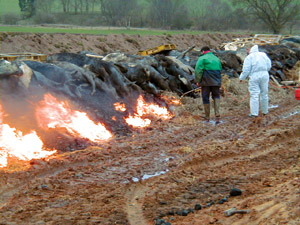
Although the animals were dead, the virus still existed. Birds and scavenging mammals which feasted on the carcasses, either as they lay, awaiting disposal, or from slow burning pyres, then spread the virus.
Slow burning pyres were especially problematic – the virus travels in the wind and smoke. The worst fears of some farmers, downwind of a slow burning livestock pyre, were realised when their own stock soon tested positive for FMD.
In 2001, the virus spread rapidly. A month after the first confirmed case, almost 400 further cases had been confirmed and around 200,000 slaughtered animals were still on-farm, not only a source of infection, but a stinking torture for the farmers who had lost their stock.
On March 20, the army was called in to assist in the slaughter of animals and disposal of carcasses. The army brought organisation and authority but did not have the necessary equipment and hands-on know-how to deal with the grisly reality of the situation.
A Scottish company called Snowie was contracted to work alongside the army. Snowie, run by four farming brothers, had the necessary equipment and expertise, along with an international reputation in containment and neutralisation of industrial and chemical spill and pollution incidents.
On March 24, the army and Snowie chose a 120 acre airfield in Cumbria for a mass animal carcass burial site. The airfield was transformed into a network of 29 burial trenches, each capable of containing up to 30,000 carcasses.
Geological tests of the trenches, along with treatment of all on-site effluent and wash down water, ensured no off-site pollution.
Up to 60,000 carcasses per day were buried at the Cumbrian airfield. By early June, over half a million carcasses lay beneath the soil. The epidemic raged on for over three more months.
Vets, politicians and farmers who lost their stock in 2001 learnt many lessons, in particular, the foot and mouth virus is an ingenious survivor, an eager traveller and merciless predator.
Claire Powell covered the UK’s 2001 foot and mouth outbreak for the Daily Telegraph




Click here to change your cookie preferences