Chief Scientist Demetris Skourides used a speech in Greece to argue that women’s leadership must be treated not as a parallel issue to innovation, governance and economic growth, but as a strategic priority tied directly to competitiveness, technology and the future direction of Cyprus and Greece. 

Speaking at the G100 political diplomatic event, an initiative of Olga Pavlides Koutroubis, former vice mayor of Athens, and supported by Cyprus G100’s Maria Militsopoulou, Skourides said societies cannot claim to be ready for the future while leaving part of their talent behind. 

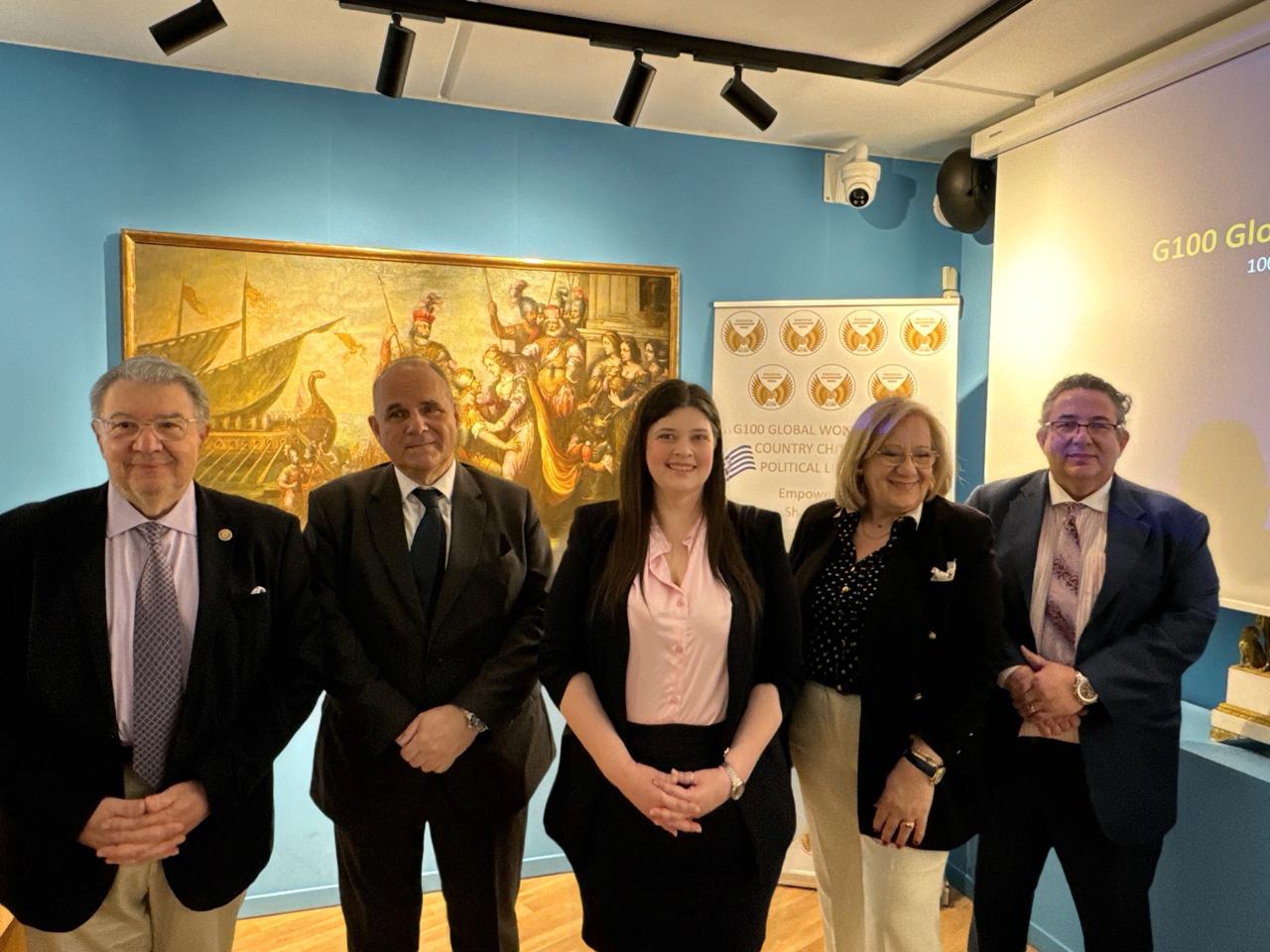
The event, held under the theme “Open the Door, Expand the Future”, brought together diplomats, policymakers, founders, innovators, women’s organisations and male allies supporting female leadership, with Skourides among those invited by Koutroubis to participate in his capacity as a G100 Denim Club Global Advisor on the Global Advisory Council for Humanity, Innovation and Technology

He opened by invoking Greece’s historical legacy, describing it as a country where “the very foundations of democracy, philosophy, and civic life were shaped”.  

Yet he quickly turned from heritage to exclusion, asking “who has historically been invited to shape that future, and who has not?” 

From there, Skourides framed women not as observers of history, but as agents of change. “From the very beginning of history, the world has often called great change impossible, until a woman stepped forward and made it real,” he said. 

At the same time, he argued that progress had never been built “by discovery alone”, but by “courage, by vision, and by those who refused to accept the limits placed before them”

Linking the ancient world with the present, he referred to HypatiaAspasia of MiletusAgnodice and Laskarina Bouboulina, saying these women “were not exceptions” but “architects of possibility”

He then widened the picture to include Marie Curie and Fei-Fei Li, insisting that women “are not following innovation” but “defining it”

However, he said access to capital, visibility and influence remains constrained.  

The problem, Skourides argued, has “never been talent” but rather “access to systems that recognise, fund, and scale that talent”

He described the current period as “a defining moment in history”, with technology reshaping economies, innovation redrawing global competitiveness and leadership increasingly judged not only by results, but also by “responsibility, foresight, and purpose”

In that context, he said, “No society can claim readiness for tomorrow if it leaves half its talent on the sidelines.” 

Skourides also pointed to funding figures to underline the imbalance. Startups with at least one female founder, he said, raised a record $73.6 billion in venture capital in 2025, yet all-female founding teams still receive only around 2 per cent of global funding

“This gap is not just inequity,” he said. “It is inefficiency at a global scale.” 

Women, he added, remain underrepresented in senior leadership, especially in technology, despite evidence that organisations with greater gender diversity outperform in innovation, decision-making and long-term growth. 

“This is not anecdotal. This is arithmetic,” he said, before adding that “Technology without humanity is fragile”, “Innovation without inclusion is incomplete”, and “Leadership without diversity is inherently limited.” 

From there, he called for women to be present “at the tables where decisions are made”, in boardrooms, laboratories, startups, ministries, venture funds and research centres, not “as participants”, but “as leaders”

Because, as he put it, “when women lead, systems evolve.” Innovation becomes “more human-centred”, institutions become “more responsive”, and decisions gain “depth, perspective, and foresight.” 

At the same time, he acknowledged the more subtle barriers that still persist. A woman, he said, can present a strategy and see it questioned, while “a man presents the same idea and it is endorsed.”  

Likewise, “She is described as too assertive. He is described as decisive.” 

Even so, he said women continue to deliver, building companies, leading scientific breakthroughs and driving progress across sectors. What matters now, he argued, is removing the friction that still blocks talent. 

“When talent flows without friction,” he said, and when access to “funding, mentorship, and opportunity is based on merit”, that is “not inclusion” but “acceleration.” 

He said every woman founder who secures funding creates “jobs, intellectual property, and momentum”, every woman scientist expands “the boundaries of knowledge”, and every woman who rises to lead reshapes what the next generation believes is possible. 

The issue, therefore, is no longer whether women have impact, but whether institutions are prepared to “recognise, accelerate, and scale that impact.” 

Skourides then widened the responsibility. Governments, he said, should “build policies that open pathways”, institutions should create cultures where “capability is recognised and trusted”, and investors should understand that backing women founders “is not philanthropy” but “a high-performance strategy.” 

He also addressed men directly, saying that in many systems and many rooms they still hold disproportionate influence over access and opportunity. In that context, he said they face a choice: “To remain observers of change. Or to become enablers of it.” 

“Allyship is practical. It is deliberate. It is consistent,” he said. 

He urged men to “Recommend the brilliant woman whose name is not yet on the list”, to “Advocate for her work in rooms where she is not present”, and to “Sponsor talent early, before it becomes visible.” 

“That is leadership. That is system change,” he said. 

That emphasis on male allies was also visible at the event itself, where Skourides, John Chrysoulakis, Elia Gourgouris, also known as Dr Happiness, were presented as the three men supporting female leadership within the wider G100 setting.  

Chrysoulakis was described as one of the most prominent figures in engagement with Hellenism worldwide, while Gourgouris brought the leadership and wellbeing dimension to the discussion.  

Together with Skourides, their presence reinforced the “He-for-She” message running through the event. 

The gathering also had a broader diplomatic and civic dimension. Representatives attended from the embassies of Bangladesh, Romania, Albania, Montenegro, Panama, Lithuania, Austria and Slovakia, while a wide range of associations and organisations linked to women’s advancement, equality, education, civic participation, journalism and social welfare were also represented. 

These included AHEPA, which supports women’s leadership, education and community service within the AHEPA family; Rotary International Greece, which engages women leaders in service projects linked to education, health and community welfare; and the Daughters of Penelope Greece Chapter, which advances women through philanthropy, advocacy and community support. 

They also included the YWCA of Greece, which empowers women and girls through education, support services and equality initiatives; the Panathenaic Women’s Association of Greece, which promotes cultural heritage and women’s civic and philanthropic engagement; and Lions Clubs International Greece, which includes women leaders in service initiatives supporting health, welfare and inclusion. 

Also present were the Union of Women of Greece, which advocates women’s rights, equality and social protection; The American College of Greece, which promotes women’s advancement through education, leadership programmes and equality policies; and the Meropeio Foundation, which supports social and educational initiatives benefiting women and families. 

The media and professional sphere was represented too, through ESIEA, the journalists’ union of the Athens daily newspapers, which protects women journalists’ rights and promotes gender equality in the media sector, as well as Naftemporiki, which highlights women’s role in journalism, business and the economy. 

The wider ecosystem also included Soroptimist International Greece, which empowers women and girls through education, advocacy and community projects; the Adopt a Ship programme, which encourages girls’ participation and visibility in maritime education and careers; ITEP, the Institute for Tourism Research and Forecasts, whose work supports women’s employment and advancement in tourism; and the European Union of Women – Greece Section, which promotes women’s rights, leadership and political participation across Europe. 

Taken together, their presence gave the event a broader institutional character and reinforced the argument that women’s leadership is no longer a niche or symbolic issue, but part of a wider agenda spanning diplomacy, education, media, social policy, entrepreneurship and economic strategy. 

Within that framework, Skourides also referred to his own role in the G100 structure. He said he had been invited by Koutroubis, while Militsopoulou supported the initiative and participates as a Global Advisor for Humanity, Technology and Innovation

Skourides said his induction into the G100 Denim Club was exclusive and forms part of the G100 Mission Millions initiative, a project of the Women Economic Forum aimed at involving one million women and men in the global movement for gender equality. 

As part of that role, he said his work as a global advisor focuses on policy influenceHe-for-She advocacy, and strategic integration

On policy influence, he said he seeks to use his expertise to shape policies that support digital transformation, inclusive innovation and sustainable economic growth

On the He-for-She side, he said he represents the mission of the Denim Club, made up of prominent male leaders who use their institutional influence to support women leaders and gender parity. 

And on strategic integration, he said his role is to connect the goals of the G100 with governance, technology and science, helping bridge the gap between cutting-edge innovation and more inclusive leadership structures. 

He said that work aligns with his broader commitment as Chief Scientist, particularly in supporting gender equality and female participation in innovation ecosystems. 

In that context, Skourides said this was the third event in March in which he had taken part in support of female leadership, in addition to the two-day mentoring and ecosystem engagement he invests in each month to help develop women’s participation. 

Altogether, he said, this accounts for roughly 33 per cent of his monthly time allocation

Towards the end of his speech, Skourides widened the focus further, moving from women’s leadership inside institutions to the role of the Cypriot and Greek diaspora

“Talent is not confined by geography,” he said, adding that across the world there is “a powerful and deeply connected community of Cypriots and Greeks of the diaspora” made up of “leaders, scientists, entrepreneurs, and innovators shaping global industries.” 

They are not, he said, distant from the national ecosystem, but “part of our national capability.” 

Within that global network lies “one of our greatest strategic opportunities”, he argued, especially if Cyprus and Greece succeed in activating not only the diaspora as a whole, but specifically “the women of the diaspora; a highly accomplished and globally positioned force of leadership and innovation.” 

He described them as people who “operate across ecosystems”“bridge cultures and markets”, and “connect ideas, opportunities, and people.” 

That led him to the strategic direction set by President Nikos Christodoulides around “Minds in Cyprus”, which he described as “a national call to action”“a call to reconnect, to collaborate, and to co-create”, and “a call to unite Cypriot minds across the world.” 

He said the vision should align with priorities that will define the future, including research, innovation, digital transformation, artificial intelligence, entrepreneurship and sustainable growth

For that strategy to succeed, however, it must be “inclusive by design” and must “actively engage women as leaders and co-architects.” 

Because when countries activate the women of the diaspora, he added, they do more than expand the talent pool, “We multiply it.” 

That, he said, brings “global experience into the national ecosystem”, accelerates partnerships and strengthens Cyprus’ role “as a bridge between regions, markets, and ideas.” 

It also sends a message to the next generation,  “That leadership has no borders. That opportunity is not limited by geography. And that Cyprus is not only a place you come from. It is a place you can shape.” 

Skourides said this is how small nations become powerful, “Not by size. But by connection. By alignment. By the ability to mobilise their people, wherever they are in the world, towards a shared vision.” 

“When we unite our minds across the diaspora,” he said, “we do more than strengthen an ecosystem. We build a nation that competes globally because it collaborates globally. A nation that leads because it includes.” 

He closed by urging institutions and countries alike to move forward “with intention”, to “open doors, within our institutions and across borders”, and to activate “the full spectrum of our talent, including the extraordinary women of our diaspora.” 

“And let us ensure,” Skourides said, “that the future of Cyprus, and the future of innovation, is shaped by all of its minds. Not some. All.”