
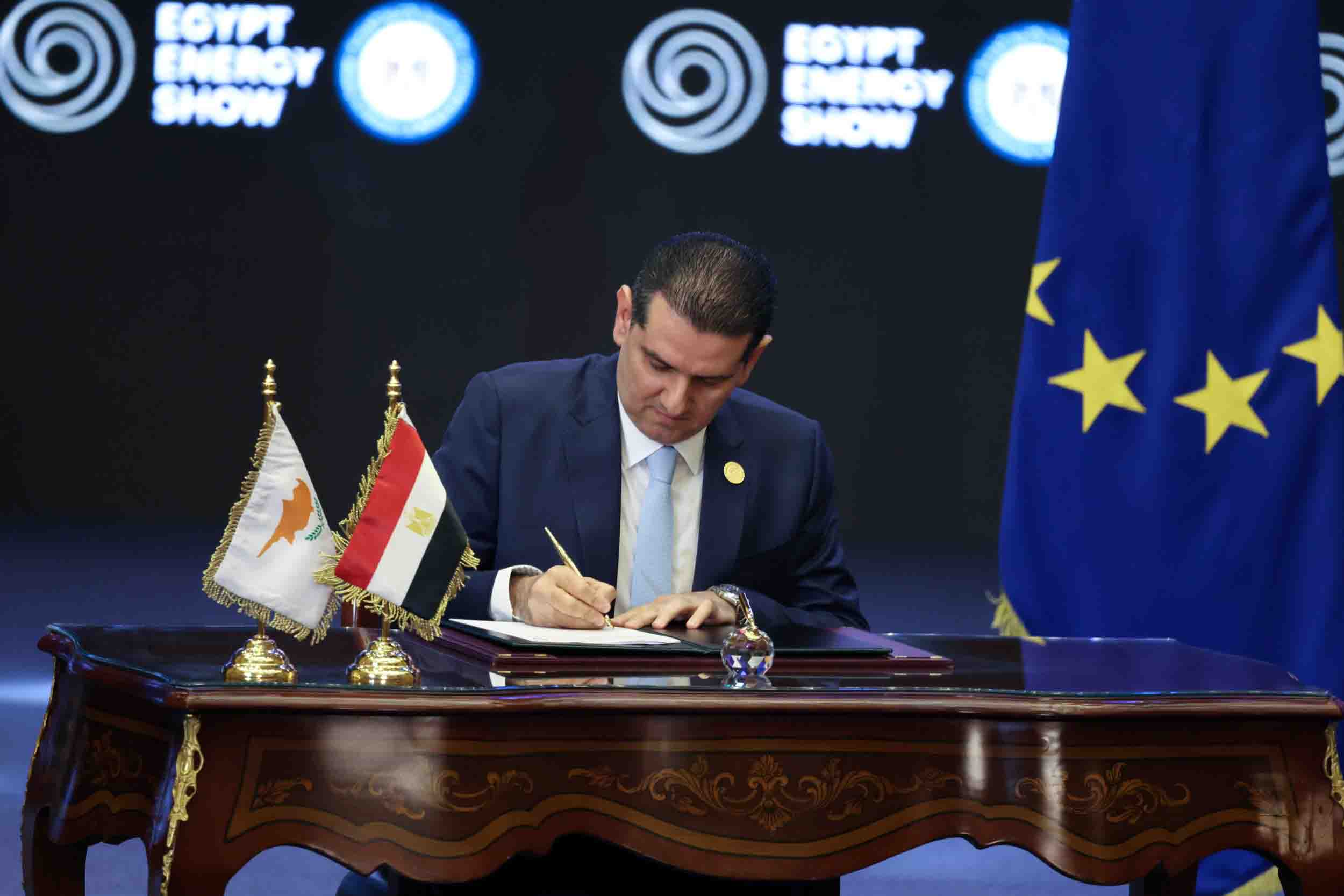
The governments of Cyprus and Egypt on Monday signed a “framework agreement” for the commercial development of natural gas, on the sidelines of the Egypt Energy Show in Cairo.
Energy Minister Michael Damianos said the agreement “reaffirms the strategic choice of the two states to export Cypriot natural gas to Egypt”.
Presidential press office director Victor Papadopoulos described the agreement as a “tangible step which can provide the impetus for the acceleration and completion of the pending energy agreements concerning the exploitation of the Cypriot gas fields, Aphrodite and Kronos”.
Damianos did admit however that the agreement “does not differ at all from a similar agreement signed in the past”, but said that now, “essentially, Kronos and Aphrodite are included together in relations to the intention to take the deposit to Egypt”.
The agreement will also bring about the creation of a joint technical committee, which, according to Damianos, will “undertake the negotiation of the terms of sale of natural gas”.
“In essence, a joint committee will be established regarding the sale of natural gas to Egypt or to Egyptian state-owned companies,” he said, before adding that the committee will “operate at a technical level and will examine both commercial and technical parameters”.
Its aim, he said, will be to “optimally utilise Cypriot hydrocarbons and cover part of Egypt’s energy needs”.
He added that the agreement is “mainly a political confirmation of the direction which the two countries have already chosen”, and that “the implementation of projects depends to a large extent on the companies operating in the blocks”.
“We are restating the intentions, especially regarding the existing deposits, in order to push them forward,” he said.
It had initially been hoped that Italian energy giant Eni would have confirmed its final investment decision for the Kronos field, which is located in Block 6 of Cyprus’ exclusive economic zone (EEZ) in advance of the Egypt Energy Show, though this has not yet come to pass.
European Commission President Ursula von der Leyen had been expected to attend the Egypt Energy Show alongside President Nikos Christodoulides, and while Christodoulides was there, von der Leyen was not.
Given the proximity of the Kronos field and Block 6 to Egypt’s Zohr gas field, which Eni also operates, Eni will be able to use its own infrastructure to take the Cypriot natural gas to the Segas liquefied natural gas (LNG) terminal in the Egyptian port city of Damietta, and export the gas to Europe and, if required, elsewhere from there.
The previous agreements to which Damianos was referring were signed by Cyprus and Egypt last year, saw the Egyptian government designated as the “host government” for Block 6.
Another agreement signed at the same time was a memorandum of understanding signed by both Cyprus and Egypt, as well as American multinational corporation Chevron, Israeli energy company NewMed Energy, and the BG Group, which is owned by Royal Dutch Shell, and concerned the Aphrodite field, which is located in Block 12 of Cyprus’ EEZ.
The Cypriot government had said at the time that this memorandum of understanding “establishes the framework for the effective commercialisation of the natural gas which will come from the field”.





Click here to change your cookie preferences