
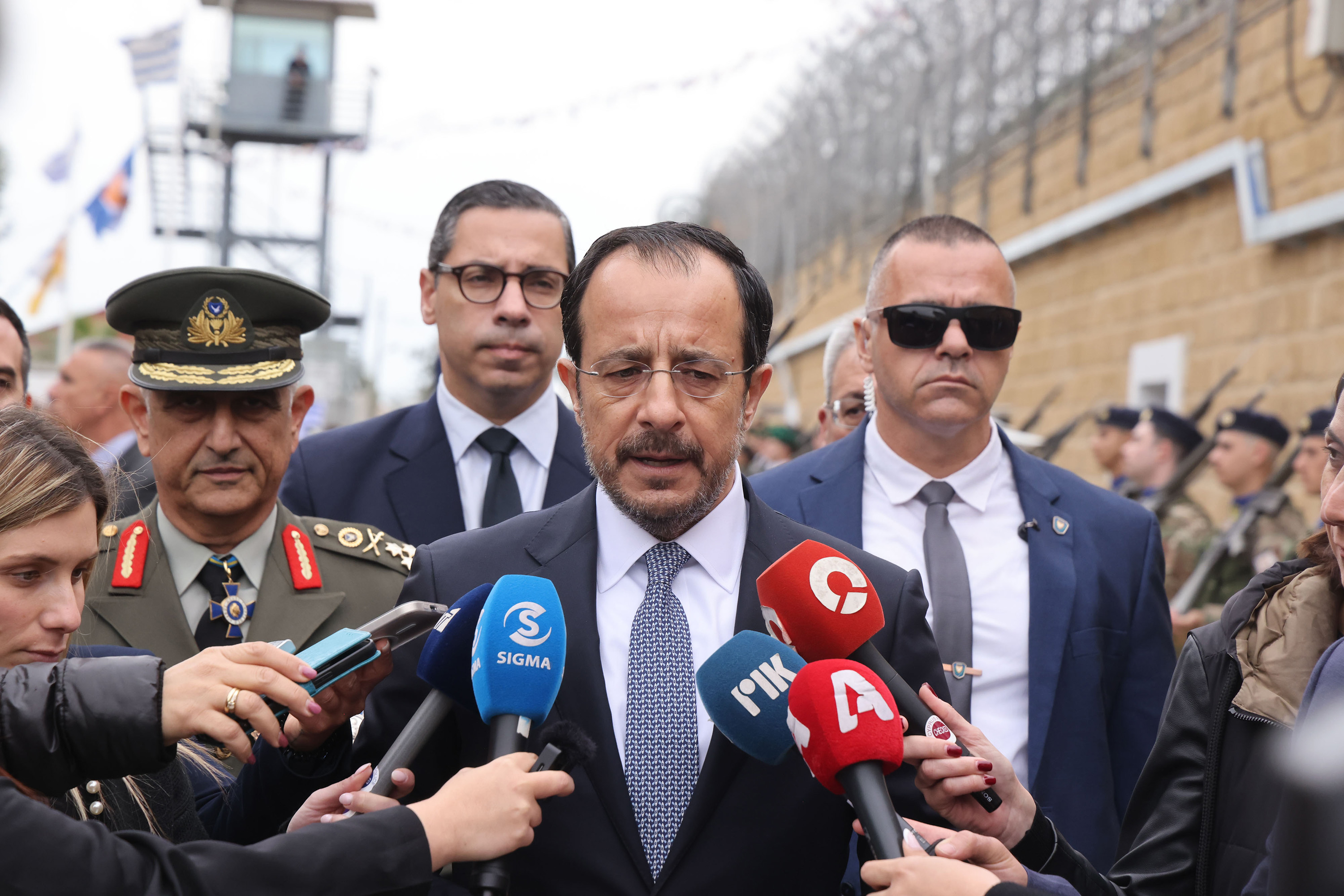
President Nikos Christodoulides affirmed on Tuesday that he was treating the allegations made by Makarios Drousiotis with “the utmost seriousness” and confirmed that a police investigation is already underway following instructions issued by Justice Minister Costas Fitiris.
He said that Drousiotis has been summoned to provide evidence and is expected to appear with legal counsel, with findings to be formally assessed before any further decisions are taken at cabinet level.
“We do not downplay or dismiss any allegation,” the president said.
“Everything will be judged on the basis of the information submitted.”
Christodoulides also expressed concern over the broader implications of such claims circulating publicly, warning of potential consequences for democratic stability.
“As president and guardian of the constitution, this greatly concerns me,” he said.
“We do not operate in anarchy, there are laws, there are procedures, and if further measures are required, we are ready to take them.”
The reaction followed wide-ranging allegations by Drousiotis, which began circulating publicly on Monday, outlining what he claimed was a structured, clandestine system involving figures in the judiciary, politics and business.
Former Supreme Court judge Michalakis Christodoulou has rejected as “morbid fantasies and falsehoods” allegations that he is connected to a covert network described by Drousiotis as operating under the Rosicrucians. Those named have responded with categorical denials.
Central to his claims is the assertion that a modern incarnation of a Rosicrucian brotherhood operates within Cyprus, exercising influence over institutions and facilitating unlawful activity.
Christodoulou dismissed the claims in their entirety and indicated he is available to authorities for any investigation.
He also questioned the plausibility of the allegations, rejecting any link to secret organisations or coordinated networks.
Police have since opened an inquiry under instructions from police chief Themistos Arnaoutis, appointing a senior officer to examine the material cited by Drousiotis.
Authorities have called on him to submit all evidence, stressing that the authenticity and origin of the information, including digital communications, must be forensically assessed.
In his account, Drousiotis describes a network with both domestic and international dimensions, referring to a “brotherhood” which he associates with Rosicrucianism.
He suggests that this structure connects individuals across key sectors and influences decision-making processes, including within the justice system. The claims extend to references of criminal conduct, including corruption, manipulation of legal cases and coordinated financial activity.
Rosicrucianism is a philosophical and esoteric tradition that emerged in Europe in the early 17th century through a series of texts describing a secretive brotherhood focused on knowledge and reform.
Historians generally treat it as an intellectual and symbolic movement rather than evidence of a syndicate operating in a modern political context.
Drousiotis’ claims depart from this interpretation, presenting it instead as an active and structured entity.
He maintains that his reporting is based on extensive documentation, including messages and other material gathered over time.
“The world needs to know,” he said, adding that he can substantiate his claims “down to the last detail”.
He has indicated that additional evidence exists beyond what has already been published and that he will provide it to investigators, while requesting to do so in the presence of legal counsel.
Among those named in the allegations are former president Nicos Anastasiades, MP Nikos Tornaritis, former MEP Dimitris Papadakis and Edek deputy leader Morfakis Solomonides, alongside references to judicial figures.
Papadakis has taken formal legal steps, filing a complaint with police alleging the publication of false information.
He stated that he retains the mobile phone linked to the period referenced and is willing to submit it for forensic analysis.
“I categorically declare that I do not know the person in question… I have never exchanged messages with him,” he said, adding that independent examination of his device will demonstrate the claims are unfounded.
Solomonides described the allegations as “fabricated” and said material presented as evidence has already been shown to be manipulated.
“This is purely the spread of false news and none of it is true,” he stated, confirming that he will pursue legal action.
Tornaritis also rejected any involvement, stating that he has instructed legal advisers to examine the publication and take necessary measures.
Anastasiades responded by referring to previous positions he has expressed in his book the Sycophant, regarding Drousiotis’ credibility, reiterating his rejection of the claims.
Former Supreme Court president Myron Nikolatos similarly denied any connection, describing related allegations as “fiction” and stating that he is willing to allow examination of financial records if required.
Christodoulou, addressing both institutional and personal elements of the claims, reiterated his position that the allegations are baseless. He dismissed suggestions of influence over judicial processes or participation in any form of organised network, expressing disbelief at the nature of the accusations.
The dispute also centres on the evidentiary basis of Drousiotis’ claims, particularly screenshots of alleged communications.
Several individuals named have questioned their authenticity and called for detailed forensic analysis by specialised police units.
Drousiotis has defended his approach, stating that his work is the result of long-term research and that disclosure is justified on public interest grounds.
He has also called for the appointment of an independent criminal investigator, arguing that such a measure would strengthen confidence in the process.
While expressing reservations regarding the state’s ability to handle as delicate a situation as he levies, Drousiotis said he will proceed with submitting evidence to police if necessary, reiterating that he has “a wealth of other evidence” beyond what has been published so far.
Drousiotis has repeatedly stated that his material is corroborated by his research.
“The published material is a small sample. There is a wealth of other evidence,” he told Politis in a radio interview.
Police spokespersons have confirmed that Drousiotis has been contacted regarding the submission of all material relevant to potential criminal offences.
Volt, the party for which Drousiotis is a parliamentary candidate, called for “an immediate and in-depth investigation”, stating that allegations concerning institutional corruption require examination and accountability.
Other parties, including Akel and Dipa, also called for a full and independent inquiry, without endorsing the claims.
Drousiotis asserted that “I have more than ample evidence on these accusations. Everything has been cross-referenced with my lawyer.”
On the question as to whether he could substantiate his accusations, he assured that “as a journalist I would not publish this unless I could substantiate the claims.”
He further confirmed that he has given formal notice to President Nikos Christodoulides regarding the accusations and made clear his “preference for an investigation to be conducted by a European entity”, though if necessary he fully intends to comply with local authorities.
“I am not afraid of lawsuits; I am prepared to take these matters to court,” he said.




Click here to change your cookie preferences