
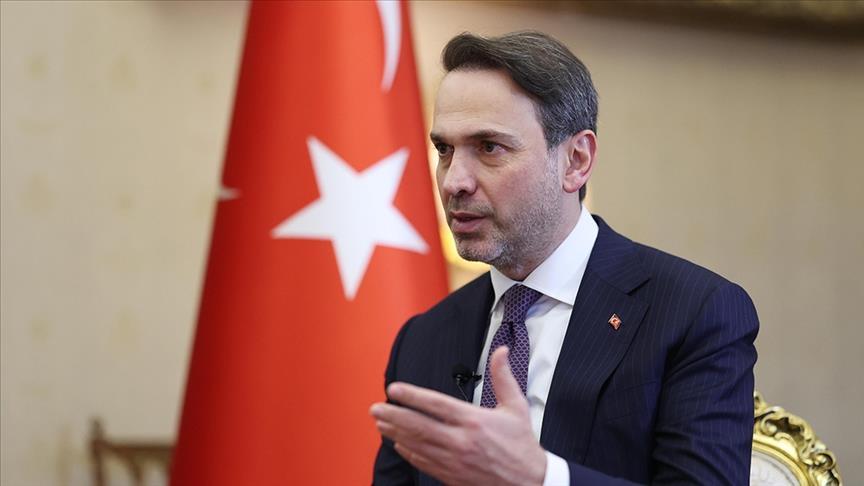
Turkey plans to construct a natural gas pipeline to Cyprus, the country’s Energy Minister Alparslan Bayraktar said on Wednesday.
“We have not given up on the Mediterranean. In the past, we conducted nine deep-sea drillings. Unfortunately, we did not have a discovery like we did with the Black Sea natural gas. Our focus is on increasing production in the Black Sea,” he told journalists on the sidelines of an event held by Turkish first lady Emine Erdogan’s Zero Waste Foundation.
Despite this, he stressed, “we have not given up on exploration in the Mediterranean”.
“In a new project, we are working on a natural gas pipeline to the Turkish Republic of Northern Cyprus,” he said, before adding that Turkey’s state-owned oil and gas pipeline company Botas “is conducting engineering studies”.
“God willing, we can later supply the gas we find there to Turkey via a pipeline. This connectivity is the most important issue,” he said.
When asked to comment on said statements by Bayraktar regarding exploration activity in maritime areas around Cyprus, President Nikos Christodoulides retorted that “I cannot know the reasons why the Turkish minister made these specific statements.”
He added that the republic continues its energy planning “always on the basis of international law, the relevant UN Convention on the Law of the Sea of 1982.”
He also spoke about the under-construction Akkuyu nuclear power station, which is located on the southern coast of Turkey’s Mersin province, 65 kilometres from Kyrenia.
“We have no problems with the Russians at Akkuyu, but there are some difficulties with the Akkuyu project. There were equipment delays and financing problems, but these were overcome thanks to the support of the Russian state, especially from President Vladimir Putin,” he said.
He said that financing has now been secured for the first two reactors, of which four are eventually planned.
Construction at Akkuyu began in 2018, with it expected that the first reactor will enter service this year and the second reactor will enter service next year. Each reactor will provide a total of 1,114 megawatts of electricity – around 2.5 per cent of Turkey’s electricity consumption each.
Talk of a natural gas pipeline to connect Cyprus and Turkey first surfaced in 2019 after the European Commission declared the planned EastMed pipeline as a project of common interest, having contributed almost €35 million to complete technical, economic, and environmental studies for the project between 2015 and 2018.
The EastMed pipeline was set to cost €6 billion, and was planned to transport natural gas from the Levantine Sea to Greece, via Cyprus.
Following a fruitless tripartite meeting of then president Nicos Anastasiades, then Turkish Cypriot leader Mustafa Akinci, and United Nations Secretary-General Antonio Guterres in Berlin, the Turkish Cypriot administration, which was by then led by nationalist political party the UBP, announced the plans.
Turkish Cypriot ‘energy minister’ of the day Hasan Tacoy said a week after the Berlin conference that “foreign experts” had told him that “it is essential that we build natural gas pipelines and interconnections as soon as possible”.
“As a minister of a country whose life is sustained by water from Turkey, I can confidently say that connecting Cyprus to Turkey in both natural gas pipelines and electricity is an unavoidable necessity,” he said.
The following year, Turkey’s then energy minister Fatih Donmez told the country’s parliament that “studies related to both cable and pipeline projects related to the island’s energy needs are continuing”, but that “there is no timeline yet”.
Shortly afterwards, plans for the EastMed pipeline appeared to hit the buffers, with Ioannis Kasoulides, the Cypriot foreign minister at the time, lamenting in 2022 a lack of interest on the part of energy companies in the project, and describing that lack of interest as “worrying”.
By then, the United States’ state department had already withdrawn its support for the project, informing the Greek government that it could no longer support projects which did not contribute to environmental targets, while also concluding that the pipeline was neither economically nor commercially viable.





Click here to change your cookie preferences