
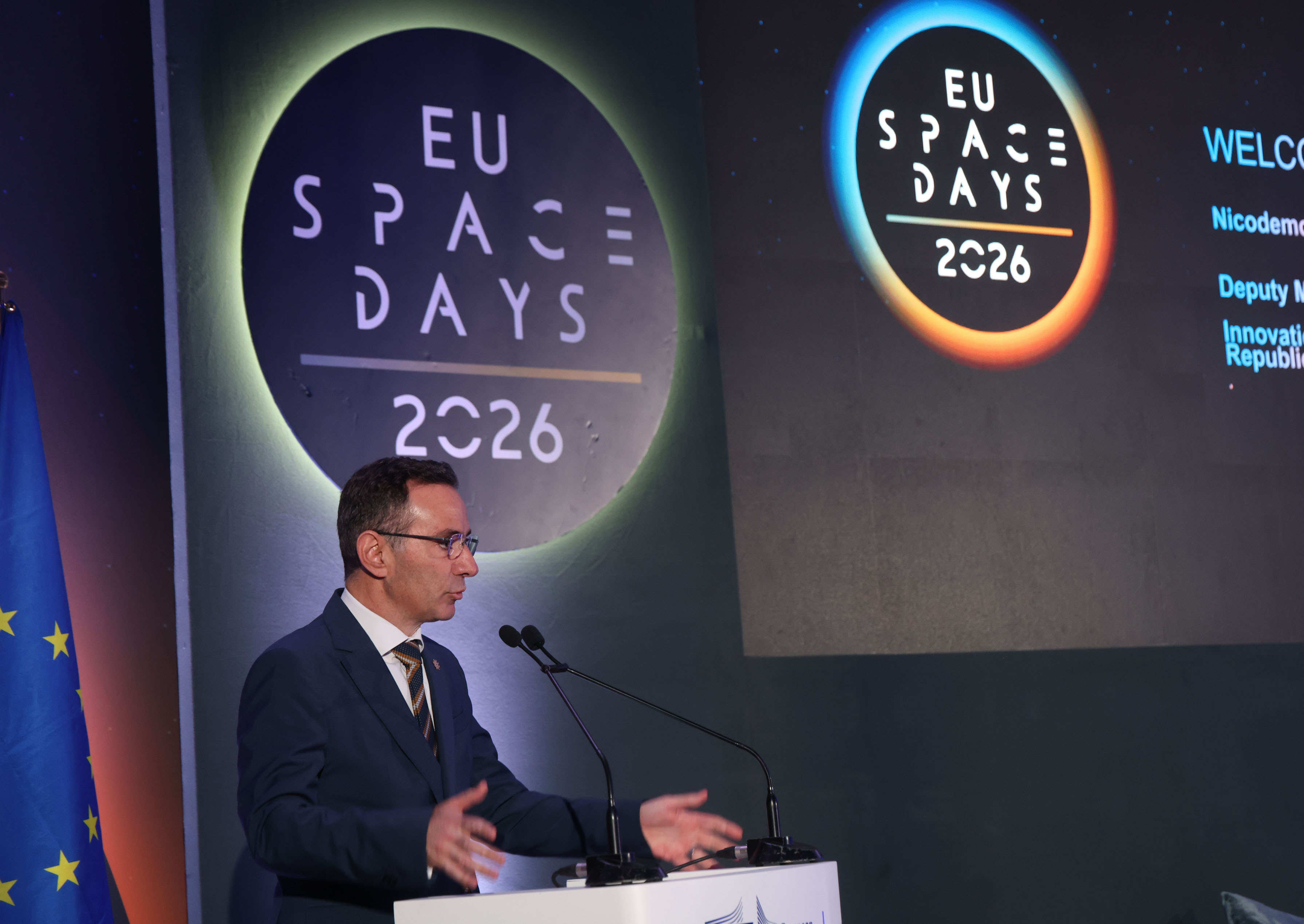
Europe needs a modern regulatory framework for space that inspires confidence among operators, investors and citizens, Deputy Research Minister Nikodemos Damianou said on Tuesday at the opening of the high-level EU Space Days 2026 conference in Nicosia.
Damianou said space had become a critical sector for Europe’s competitiveness, security, resilience and strategic autonomy.
The event brought together representatives from the European Commission, the European Space Agency, the European Union Agency for the Space Programme (EUSPA), industry executives and researchers to discuss the future direction of Europe’s space policy and industrial strategy.
“Space is at the heart of everything that matters for Europe: competitiveness, security, resilience and strategic autonomy,” Damianou said, describing the sector as critical infrastructure underpinning navigation, telecommunications, disaster response, financial systems and connectivity across the continent.
He said the space sector had moved well beyond scientific exploration and was now firmly part of Europe’s geopolitical and economic architecture.
“The global space economy has already surpassed €500 billion and is expected to exceed €1.5 trillion within the next decade,” he said, adding that Europe must strengthen its technological sovereignty and build a genuine single market for space.
Damianou warned that Europe risked falling behind global rivals unless it accelerated efforts to convert innovation into industrial and strategic power.
“Let’s face it, others are moving much faster,” he said. “We need not only innovation, but the ability to turn it into real industrial and strategic strength.”
He said the Cypriot presidency had prioritised advancing the proposed EU Space Act and shaping the future space pillar of the European Competitiveness Fund as part of the EU’s next multiannual financial framework for 2028-2034.
“Europe’s ambitions in space require not only clarity, but also the financial, industrial and technological capacity to deliver,” he said.
ESA navigation director Javier Benedicto Ruiz said space had transformed from a domain of exploration into “a critical arena of competition, opportunity and vulnerability”, warning that Europe’s autonomy increasingly depends on the resilience and security of its space capabilities.
EUSPA executive director Rodrigo da Costa warned that Europe would need resilient supply chains and stronger technological sovereignty to remain competitive after 2028.
Damianou also presented Cyprus as an emerging regional hub for advanced technologies and space services, pointing to its strategic location at the crossroads of Europe, Asia and Africa.
“Our country hosts connectivity gateways and satellite ground stations for leading European providers, as well as four operational satellites making use of Cypriot assets,” he said.
He added that Cyprus was developing an optical gateway linked to Europe’s secure connectivity systems and quantum communications infrastructure. The country also hosts part of the Galileo search-and-rescue network used to detect distress signals, while future EGNOS monitoring stations selected by EUSPA are also planned.
“These are not symbolic projects,” he said. “They are strategic capabilities that directly strengthen resilience, connectivity, security and protection in our wider region.”





Click here to change your cookie preferences