
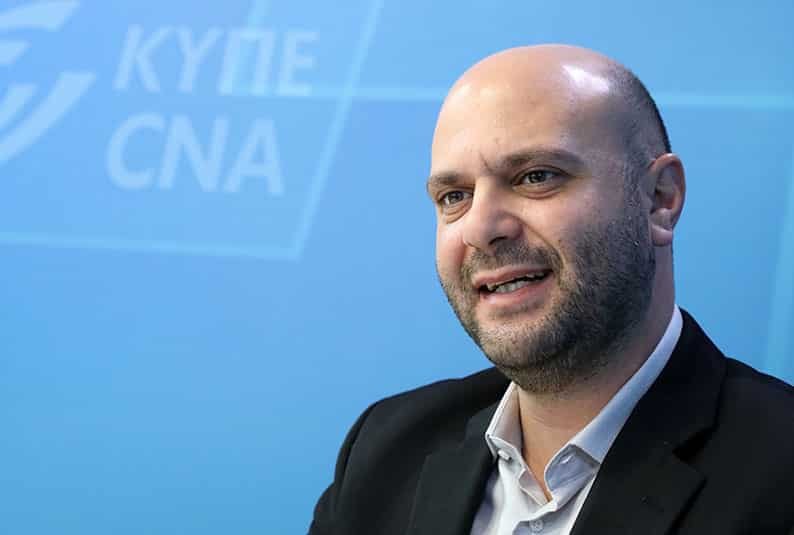
Elam leader Christos Christou said on Wednesday that Elam will seek to chair the parliamentary committees on education and environment in the new House of Representatives, following the party’s strong electoral performance in Sunday’s parliamentary elections.
Speaking on CyBC, Christou said the party intends to claim the leadership of three parliamentary committees, identifying education and environment as two of its priorities while also leaving open the possibility of seeking the defence committee chair.
All three committees have, following the election results, lost their respective chairs, with Diko having held education, Edek with defence and environment being under the auspices of the Ecologists.
Christou said the requests are based on Elam’s electoral strength and parliamentary regulations governing committee representation.
“Based on Elam’s percentages, and in accordance with the regulations of the House, we can assume such committee chair positions,” he said.
Under standing parliamentary orders, only parties controlling at least 12 per cent of MPs, effectively seven seats or more, are formally entitled to claim committee chairmanships.
Following the elections, only four parties meet that threshold, Disy with 17 seats, Akel with 15 seats, and both Elam and Diko with eight seats each.
The composition and allocation of parliamentary committees are determined proportionally through negotiations between parties and overseen by the Committee of Selection, chaired by the House speaker.
The House currently operates through approximately 17 standing committees covering areas including education, defence, finance, foreign affairs, health, legal affairs and the environment.
Christou also pledged to support the allocation of committee chairs to smaller parties, including Alma and Direct Democracy, stating that Elam would insist “that the law be implemented” despite opposition from Disy Akel and Diko who passed the formal threshold.
Although the formal seven seat threshold has existed for years, previous parliaments often distributed committee chairmanships to smaller parties that did not meet the requirement.
During the outgoing parliamentary term, Edek chaired the defence committee with two MPs, Dipa chaired transport with three MPs, while the Ecologists chaired the environment committee despite holding only two seats.
The remarks come days after Elam doubled its parliamentary representation from four seats to eight, emerging as one of the biggest winners of the election and strengthening its position within the new legislature.
Elam had themselves previously been excluded from standing committee chairmanships in the last parliament on the basis of only holding four seats and being outside the qualifying threshold, instead being assigned leadership of a special demographic committee.
On education, previously chaired by formed Diko MP, Pavlos Mylonas, Elam has repeatedly promoted a nationalist and socially conservative platform centred on what it describes as the preservation of Cyprus’ “religious and national identity”.
The party has opposed bicommunal educational initiatives and state subsidies benefiting Turkish Cypriot students, while criticising gender-neutral terminology and diversity policies within the education system.
In January 2025, Elam attacked the Education Ministry’s eDea digital registration platform for using the terms “Parent 1” and “Parent 2”, accusing the ministry of adopting a “woke agenda”.
The party also objected to optional participation in Orthodox religious studies classes, arguing that “religious studies should not be optional or by choice”.
Elam has also sought cuts to state funding linked to bicommunal programmes and Turkish Cypriot student support schemes, including grants connected to The English School.
The party argued that public funds should prioritise Greek Cypriots and opposed what it described as “confidence building measures”.
On environmental matters, formerly chaired by Ecologist MP Charalambos Theopemptou, Elam has attempted to position itself as supportive of conservation issues while concurrently standing by hunting organisations, especially on calls for a more laisse-faire approach to the outright ban on trapping songbirds for the controversial delicacy ‘ambelopoulia’.
The party has also repeatedly opposed development projects in the Akamas Peninsula, describing the area as “the last virgin land in free Cyprus”.
Elam MPs have also campaigned against asphalt plants and industrial developments near residential communities in areas including Mitsero and Vasilikos, arguing that environmental policy must prioritise “public health and the environment”.
At the same time, the party has criticised aspects of European green taxation policies, describing new environmental levies as unfair burdens on taxpayers.
On defence, once held by Edek’s Marinos Sizopoulos, Elam maintains a strongly nationalist security platform focused on military strengthening and opposition to a federal solution to the Cyprus problem.
The party advocates increased defence spending, closer strategic cooperation with Greece and more recently with Israel, and a hardline approach to migration, which it frequently frames as a national security issue.
Christou reiterated on Wednesday that Elam would not support either a candidate backed by Annita Demetriou or a nominee proposed by Akel in the upcoming vote for House president, underlining the party’s intention to operate independently within the new parliament.
Furthermore, in a letter addressed to the parliamentary deputy director, Andreas Christodoulou, on Wednesday, Elam formally submitted proposals to restructure the committee system itself.
The party implored Christodoulou to merge the human rights committee with the legal affairs committee, combining the public expenditure with the institutions committee, and unifying the agriculture and natural resources committee with the environment committee.
Elam also proposed elevating the special demographic committee they formally chaired to a permanent role, describing the matter as one of “seriousness and strategic importance for the future of our homeland”.




Click here to change your cookie preferences