
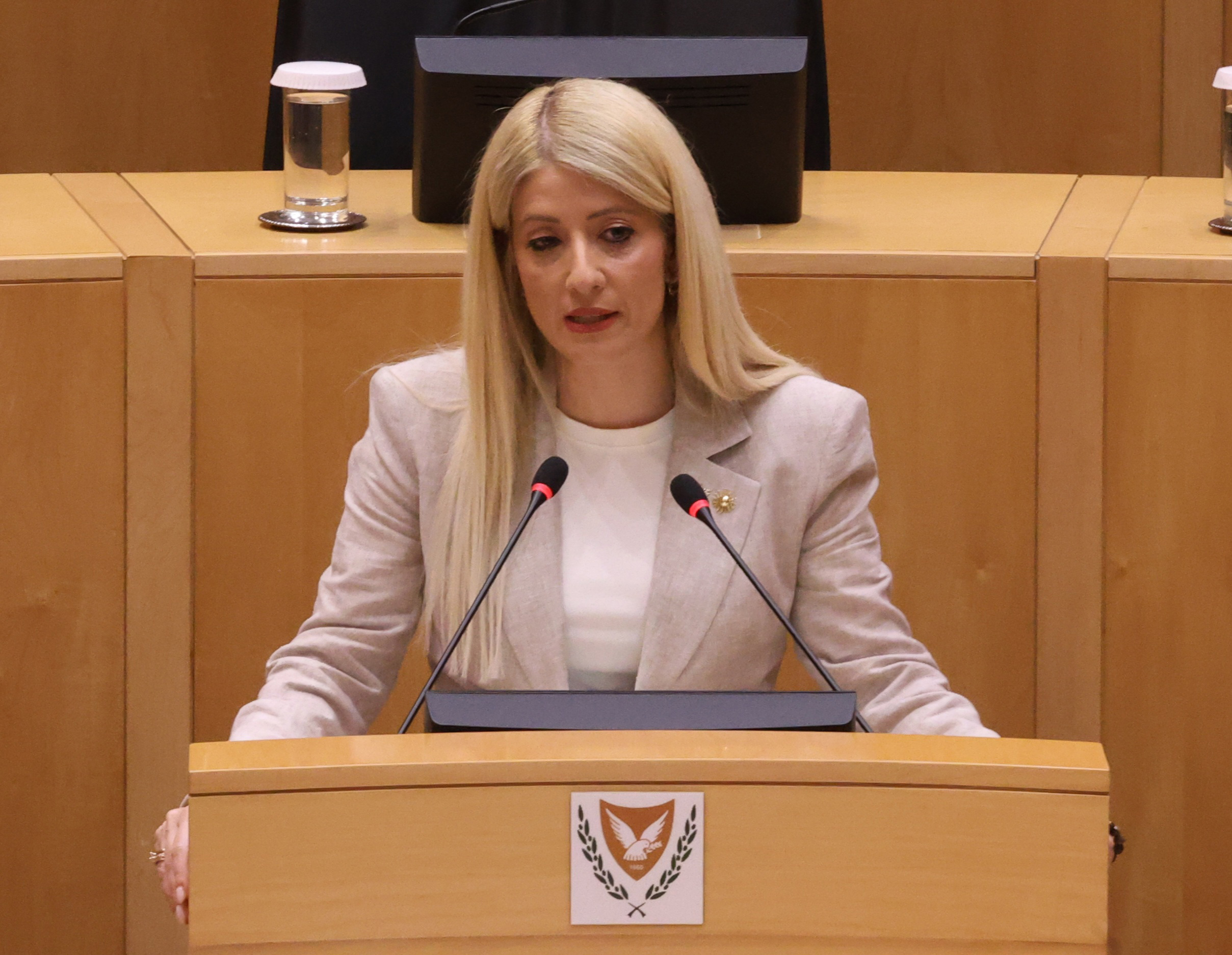
Disy leader Annita Demetriou was on Thursday elected as House president for a second time, receiving the votes of 29 of the 56 members of the new parliament as it opened for the first time after last month’s election.
Under the new, simplified rules for the election of a House president, Demetriou would have required only a simple majority of votes from her peers in the election’s second round. However, having secured the support of two other parties, in addition to her own, she nonetheless attained the support of more than half of the sitting MPs.
She faced off against Akel leader Stefanos Stefanou in the second round, and received votes from her own party, from Diko, and from Direct Democracy Cyprus. Stefanou, who won the support of his own party and Alma, and received a total of 19 votes.
Elam abstained from the second round vote, with newly elected MP Marios Pelekanos having said before parliament opened that his party would support its leader Christos Christou in the first round of voting, and that it would refuse to support Demetriou or any Akel candidate in the second round.
In the election’s first round, Demetriou, Stefanou, Christou, and Diko leader Nicholas Papadopoulos had all stood as candidates, with only the two candidates who received the highest number of votes advancing to the second round.
In total, Demetriou received 21 votes and Stefanou received 19 votes in the first round, while Christou and Papadopoulos received eight votes each. Alma’s four MPs all endorsed Stefanou in the first round, Direct Democracy Cyprus’ MPs voted for Demetriou.
Diko had announced before the holding of Thursday’s election that it would support Demetriou if Papadopoulos did not advance to the second round.
Addressing parliament after securing her re-election, she thanked her fellow MPs for their support and praised both them and parliamentary staff for “the impeccable process” of staging the vote.
“Today’s vote is for me the highest honour and responsibility. As in my first term, and thus in my second, I promise to proceed with absolute faith in the constitution, the laws, and the rules and procedure of the house,” she said.
She added that she will endeavour “to ensure that every member of parliament has the right to be heard, to participate equally, and to contribute substantially to the work of parliament”.
“All of us here represent not only our own voters, but every person – those who voted for us and those who did not. This is what I will do, too, with equality, objectivity, and institutional responsibility. I will defend the institutions without discrimination, without different treatment between those who supported me and those who chose differently,” she said.
To this end, she said that “the presidency of the parliament is an institution” and that “it belongs to the republic”.
“My stance will be firm: respect for different opinions, strict adherence to procedure, always with composure and a sense of justice,” she said.
She then thanked her own party, saying that it “emerged” from May’s parliamentary election “more united and stronger”, and that this result gave the party “the impetus to successfully reclaim this important office of the state”.
Looking ahead, she promised to move forth with a “three-pronged strategy”, saying that she would “further upgrade the institution, prestige, and infrastructure” of parliamentary processes, and increase parliament’s “transparency” as well as the “participation, interaction, and level of information” available to the public.
Thirdly, she said that she will work for “a parliament which functions as an institution for the promotion of the country, as an equal interlocutor in the world, and as a lever for a fair resolution of the Cyprus problem”.
“The greatest danger to democracy is for people to see their own parliament as an entrenched, watertight institution, cut off from society, indifferent to their anxieties,” she said.
On this front, she said that “many times, the wrong message comes out: that we are concerned with our own aspirations or our own privileges while people outside are worried about the cost of living, housing, energy costs, pensions, health, education, and safety”.
“This is not true, and we must all prove it in practice. That is why parliamentarians must mainly be outside, next to the people, to listen, but also to explain. To speak to a tired, angry, and suspicious public,” she said.
She closed her speech by calling on her fellow MPs to “make a joint effort”, so as to “keep the prestige of parliament high, to work with clarity, mutual respect, and results, to prove that our institutions can inspire trust, to help Cyprus overcome challenges and move forward”.

Click here to change your cookie preferences