
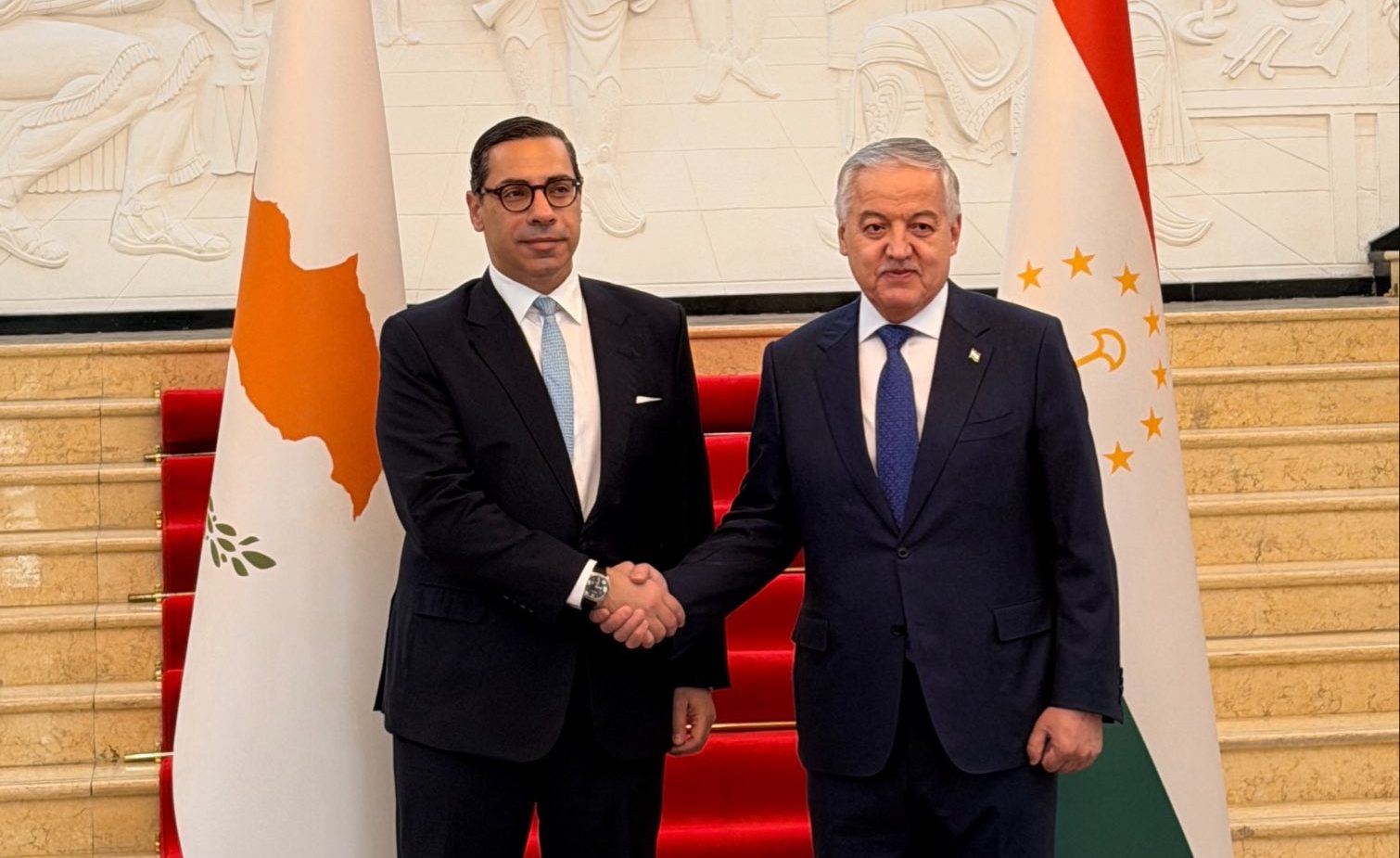
Foreign Minister Constantinos Kombos on Friday said that it is a “distinct honour” to be in Tajikistan, as he arrived in the central Asian country’s capital, Dushanbe, marking the first visit made to Tajikistan by a sitting Cypriot foreign minister.
He said that he had held as “productive meeting” with his Tajik counterpart Sirojiddin Muhriddin, in which the pair had discussed “ways to strengthen” ties between Cyprus and Tajikistan and “expand practical cooperation in fields such as trade, investment, and education”.
“Within this framework, I had the pleasure to exchange with [Muhriddin] a memorandum of cooperation in the field of higher education and research,” he said.
He added that he had “reaffirmed Cyprus’ support for continued engagement between the European Union and central Asia”, and that he and Muhriddin had also discussed “regional security issues”.
Kombos’ arrival on Tajikistan is the second leg of his tour of central Asia, with him having arrived in Kazakhstan alongside President Nikos Christodoulides earlier in the week.
He is also expected to travel to Kyrgyzstan and Uzbekistan.
All four of those states, alongside Turkmenistan, signed a joint declaration alongside the European Union last year precluding any recognition of the north as an independent country, with that declaration coming at a time when the Turkish Cypriot side, led by Ersin Tatar, advocated for a two-state solution to the Cyprus problem.
The joint declaration stated that all five countries “reaffirmed our strong commitment” to United Nations security council resolutions 541 and 550.
Resolution 541 said the security council “deplores the declaration of the Turkish Cypriot authorities of the purported secession of part of the Republic of Cyprus” while calling on UN member states not to recognise the north.
Resolution 550 said it “reiterates the call upon all states not to recognise the purported state of the ‘Turkish Republic of Northern Cyprus’, set up by secessionist acts, and calls upon them not to facilitate or in any way assist the aforesaid secessionist entity”.
That joint declaration provoked anger among Turkey’s opposition, with Ozgur Ozel, the then leader of the CHP who was last month removed from that role by a court ruling, saying that the joint declaration’s signing was evidence of a “collapse” of the country’s foreign policy.
He also claimed that the status of Cyprus was a key part of a deal brokered by Turkish President Recep Tayyip Erdogan and United States President Donald Trump to allow the arrest of Istanbul mayor Ekrem Imamoglu in March last year.
Meanwhile, Turkish Parliament speaker Numan Kurtulmus had said shortly after the signing of the joint declaration that the four Turkic states which signed the joint declaration – Kazakhstan, Kyrgyzstan, Turkmenistan, and Uzbekistan – were expected to “make up for it”.




Click here to change your cookie preferences