
When we came to live in Cyprus 26 years ago now, water was rationed to two days a week on our road. However, the house we later bought had a well in the garden, so we were pleased about that, and I was able to start a garden after all with flowers and not just cacti and succulents, useful though they were.
We quickly learned that two days’ worth of water soon ran out and that the well dried up quite quickly too during the very hot summers, so we had to find some other source, however small, to have some water for the veranda plants, so that they didn’t expire too quickly. It was also a matter of choosing plants that didn’t need constant watering to survive.
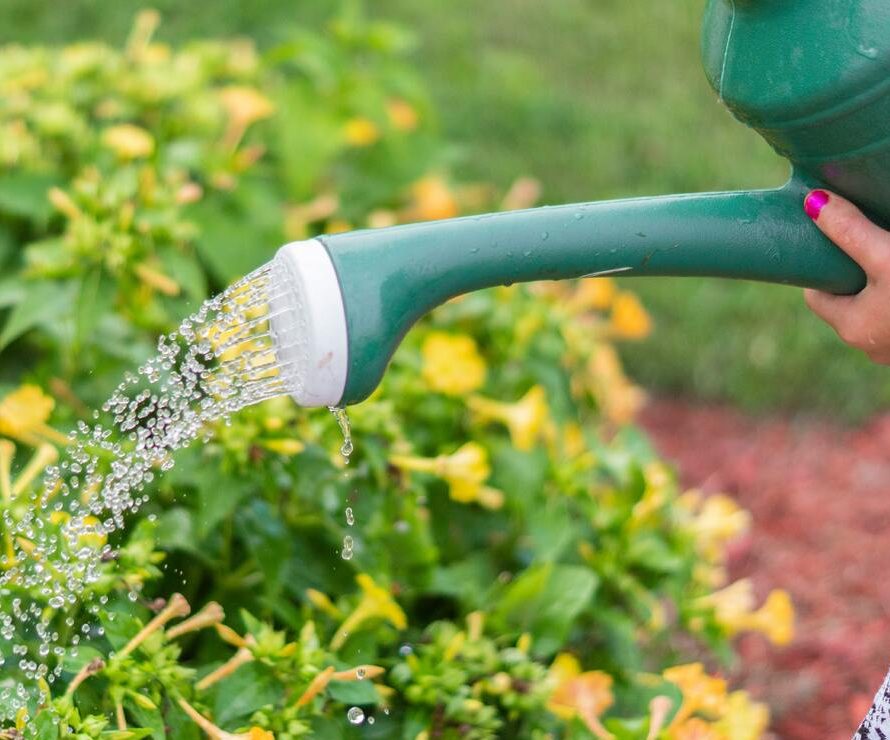
Whether you live in a house or an apartment keep a pail or watering can in your bathroom, so that even that small amount collected daily from the cold water that precedes the hot in the shower, can be used for your plants. It can also be used to flush the toilet!
This year we have been lucky as we had plenty of rain earlier on with the result that not only have the plants enjoyed it, but the weeds have thrived too. So, we hope that our special plants will thrive on this bounty.
Certainly, the many plants of Aeonium arboreum flourished after all the bountiful rain and I have not seen such large flower heads on these plants for years. Their golden flowers certainly dominated parts of the garden.
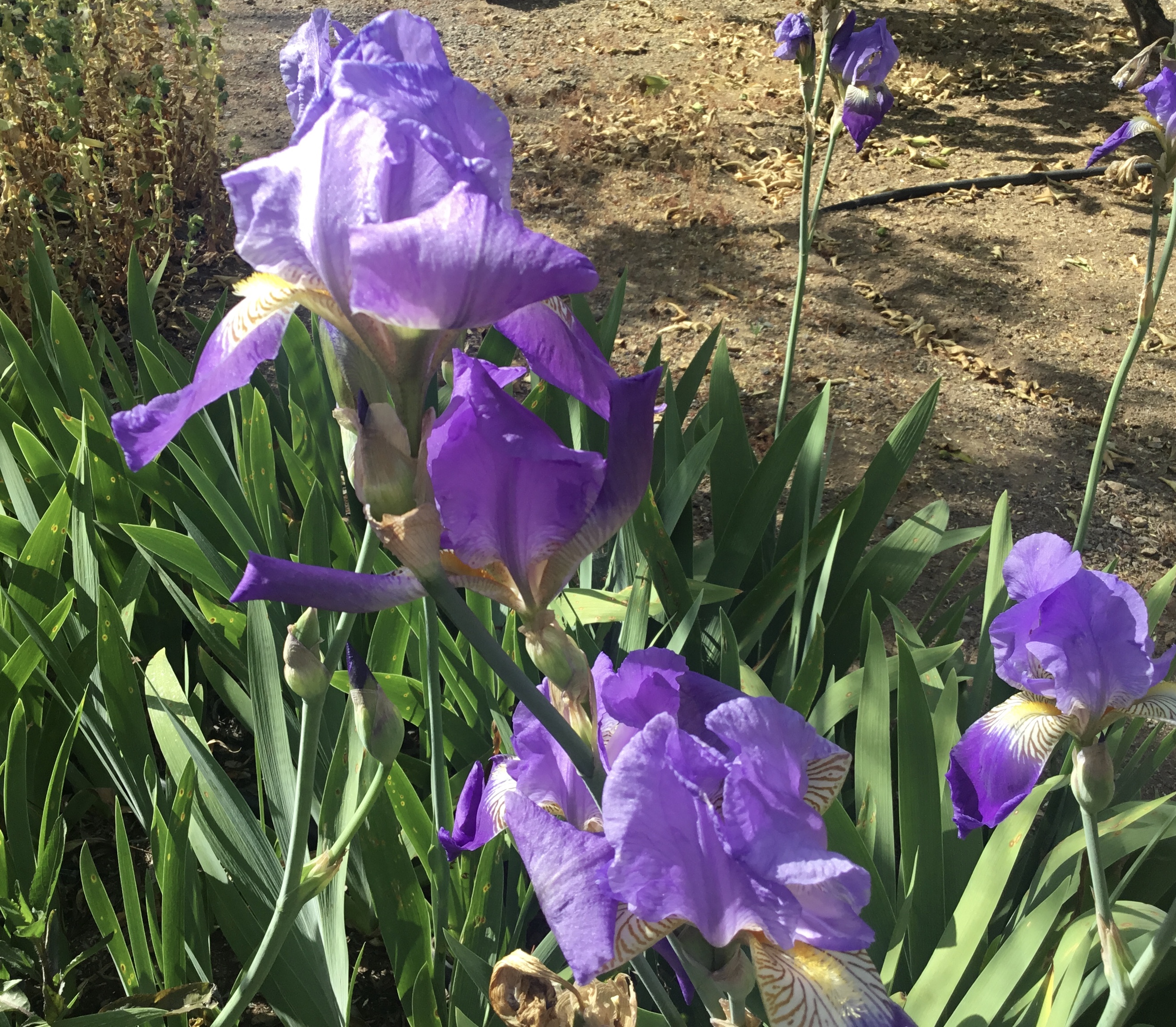
Whilst I was disappointed in the very few stems of the white bearded irises, Iris albicans, the blue irises, Iris germanica, have had many tall, wonderful flower stems for me to enjoy.
A reminder that bearded Irises, and there are many hybrids these days, like to have their rhizomes pointing into the sun. The other kind of irises known here as ‘Dutch Irises’ grow from a bulb and look better in large groups to show off the white, yellow or deep blue flowers.
Looking around the garden, some climbers I thought we had lost altogether through the frost that we had very early on, as well as lack of any early rain, eventually came back into their glory. I thought that we had lost Pyrostegia venusta, which always gives some early colour to the garden before the main beds are in bloom.
Pyrostegia venusta, commonly known as ‘Flame Vine’ or’ Orange Trumpet Vine’, is a plant belonging to the Bignoniaceae family, which is quite a large family. These woody ever-green vines are mostly natives of southern Brazil, Bolivia, northeastern Argentina and Paraguay. They also enjoy the gardens and climate here, but beware they have been known to cover the side of houses.
Campsis radicans is also a member of this family and thrives in a sunny position showing off its large blooms. This climber can put on a lot of growth in a season, so some pruning in late winter or early spring may be necessary to keep it in shape.
Strangely enough, Jacaranda trees also belong to this family and are showing off their pretty blooms just now. However, to enjoy the lovely mauve flowers they need to be grown in sunshine, so don’t grow them if you live at high elevations – around 300 metres is the maximum – and only if you have a lot of space, as they grow very quickly reaching 15 metres and can soon tower over the garden very quickly. Interestingly, if the winter is wet the leaves will appear before the flowers so you may have to wait a while for them after all the winter rain. Sometimes you can be lucky and have a second flowering at the end of the summer. These lovely trees are not salt tolerant, so maybe not suitable for coastal gardens.
Smaller and more manageable trees are likely to be Caesalpinia gilliesii, whose dainty yellow flowers with their long red stamens that dance in any summer breezes, draw much attention to themselves. These delightful trees, originally from tropical America, grow to between 3-4 metres, so are very manageable.
Another small tree or shrub that shares its pretty flowers with us in our pre-summer season is the Australian Hibiscus, with the botanical name of Alyogyne huegelii. This hardy plant prefers dry locations, and is actually classified as a desert plant but it survived our winter frosts and lashing rain to show off its pretty lilac flowers later in the spring.
Alyogyne huegelii causes much comment from passersby. Unlike the usual red hibiscus, which is widely grown here and provides a feast for any mealy bugs, this one does not attract them at all, which is good news! Some pruning after flowering will help keep it in shape. Alas, it is very much a spring flowering shrub, so enjoy it whilst you can.
Most citrus fruits will have been harvested by now and you may find that they are smaller than usual. Of course, lack of rainfall can cause this and with all the winter storms and gales, you may find that this year’s crop is lying on the ground.
The interesting thing about citrus fruits is that if they have endured a hot summer the peel will be thick in order to protect the fruit underneath, whilst a wet summer will produce thinner peels. In regions with cold winters, the skins can be thicker than in areas with mild winters. Young citrus trees tend to produce thicker skins, but once trees mature, they produce better quality fruit.
You may also notice that the skin of fruit on the shady side of a tree is thicker than that of the fruit on the sunnier, warmer side of the tree. Unfortunately, there’s not much you can do about this other than clear away anything that might block sunlight from getting to your trees.
Here, we found that lots of flowers were knocked off the trees during the recent heavy rain storms, so we may not have many fruits at all later on, which is a great pity!
Other parts of the garden have ‘ground cover’ plants, which are blooming now and delight me every year covering parts of the garden where the soil is not as good as other areas. I am not so keen on gazanias, although they are good cheerful ground cover plants and their brightly coloured flowers will brighten up a dull day, not that we get many of those here!
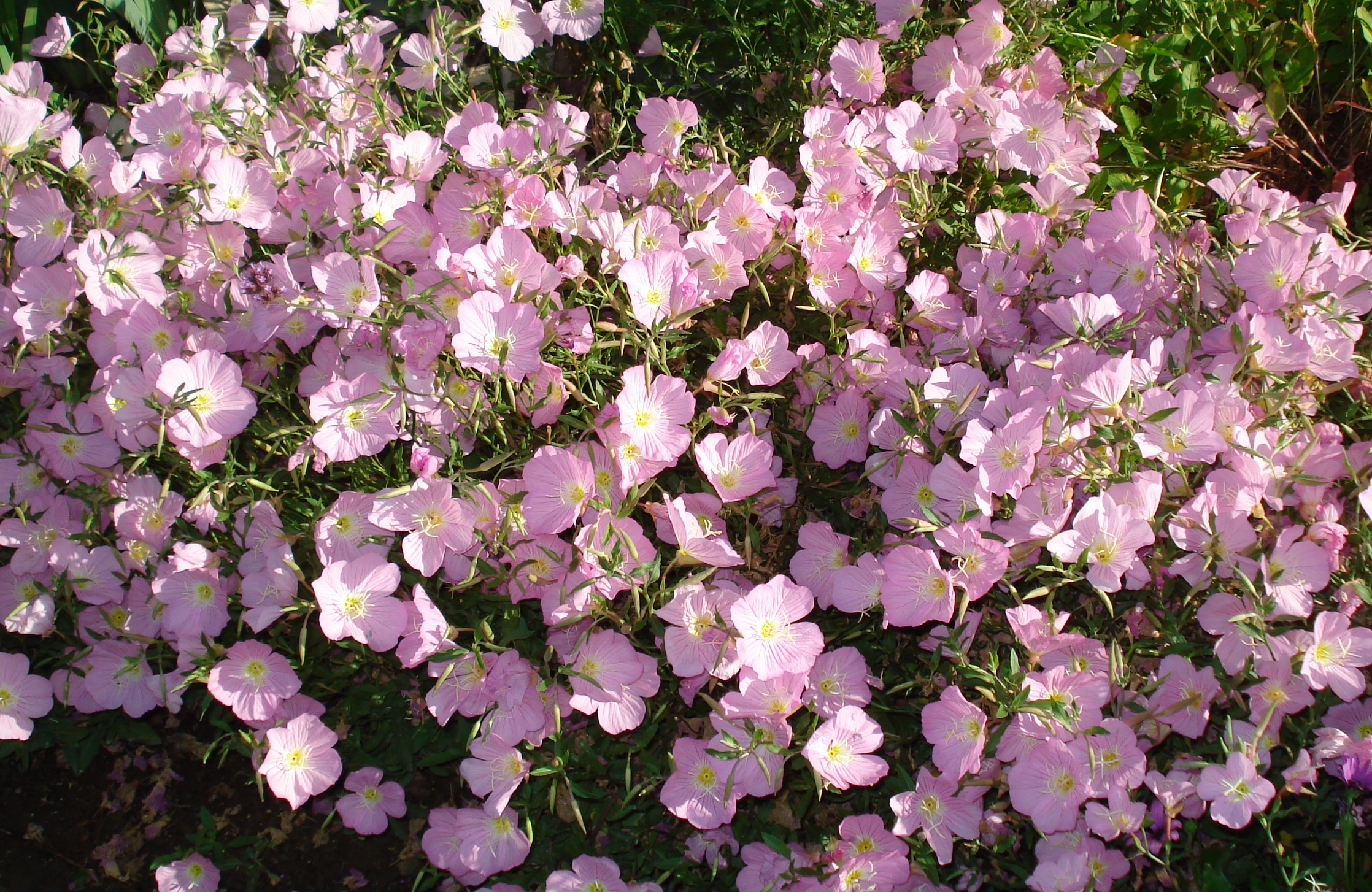
A favourite is Oenothera speciosa. A pretty delicate-looking plant from around the Mexico area, it will grow in a large circle around the edge of a bed with bougainvillea draping downwards and drawing attention to this particular plant. They can become invasive but any visitors to the garden covet this delicate plant, so a cutting or two helps to keep under control!
PLANT OF THE MONTH: Osteospermum
Osteospermum are superb ground cover plants belonging to the Calenduleae family, one of the smaller parts of the sunflower/daisy family from South Africa and are often known as ‘daisy bushes’ or ‘South African daisies’.
In a mild winter it is possible for some of the plants to survive by cutting them back so that they will grow again the next year, though results tend to be mixed and it is often not worth the effort as the stems may become very woody as a result. You can also take cuttings but there is no guarantee that the colours will be the same.
However, you can love them or leave them, as they are very promiscuous and seed everywhere and you may be inundated before long with many seedlings around the mother plant. There is a bonus though that if the bees have done their work, you may have some interesting new petal colourings to follow.
In the garden centres you may find that the lable on some of the pots describes the plant as Dimorphotheca, which is also a member of this family Asteraceae, as well as a native of Southern Africa. These plants are native to Botswana, Eswatini, Lesotho, Namibia as well.
You may ask what is the difference between Osteospermum and Dimorphotheca? Whilst the former are regarded in some places as small shrubs or perennials, they make a wonderful show en masse and some of the petals may curve inwards in an interesting spoon shape.
Although Osteospermums were formerly known as ‘Dimorphotheca’, one has to remember that this name is now only used for the annual forms of this plant, which may die after flowering.




Click here to change your cookie preferences