
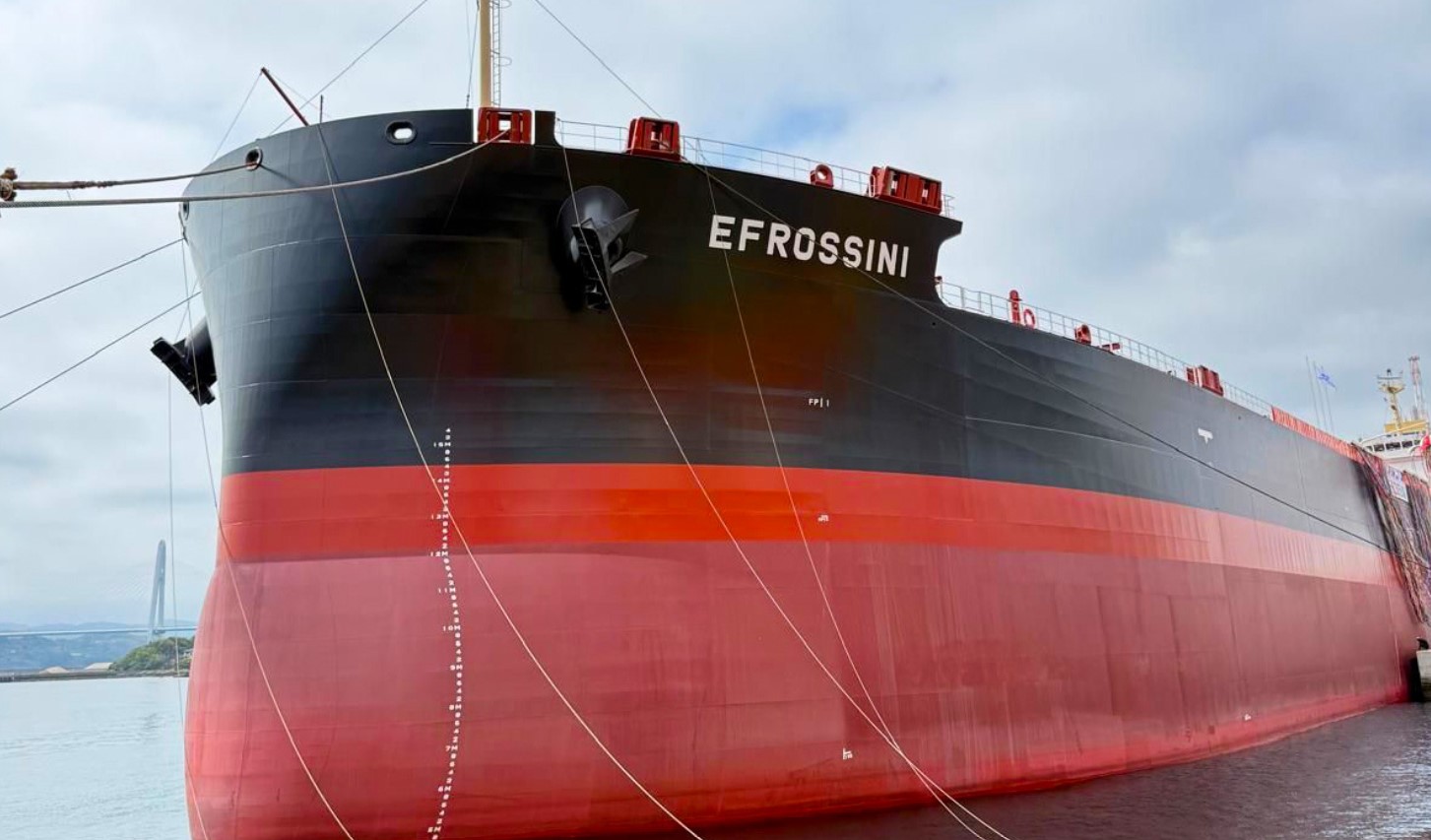
Safe Bulkers has signed a definitive agreement for the construction and acquisition, through financial leasing, of a newbuild capesize vessel with a capacity of 182,000 deadweight tonnes, the company announced.
The transaction, which was first outlined through a framework agreement in May and has now been completed, forms part of the company’s broader fleet renewal strategy.
The vessel will be acquired through a finance lease in the form of a ten-year bareboat charter agreement, beginning upon delivery, which is scheduled for the second half of 2029.
Under the agreement, Safe Bulkers will also have the option to purchase the vessel five years after the start of the charter, at pre-agreed redemption prices up to the tenth year of the agreement.
The structure allows the company to add a high-capacity vessel to its fleet while limiting its initial capital commitment and retaining the option of full ownership at a later stage.
The new capesize has been designed in line with the International Maritime Organisation’s Energy Efficiency Design Index Phase 3 requirements for reducing greenhouse gas emissions.
It will also comply with NOx Tier III regulations, which set stricter limits on nitrogen oxide emissions.
According to the company, the vessel will include advanced energy efficiency features aimed at reducing fuel consumption, a factor that is becoming increasingly important as shipping companies adapt to tighter environmental rules and higher operating costs.
Safe Bulkers’ orderbook now stands at 11 newbuild vessels, two of which are dual-fuel methanol vessels.
Deliveries are scheduled between 2026 and 2029, with three vessels expected in 2026, two in 2027, one in 2028 and five in 2029.
The company has already taken delivery of 13 IMO GHG Phase 3 and NOx Tier III certified vessels, placing it among the more environmentally advanced dry bulk operators.
Safe Bulkers chairman Loukas Barmparis said the company continued to invest selectively in modern vessels as part of its fleet renewal plan.
“Safe Bulkers continues to invest selectively in modern newbuildings, incorporating the most advanced designs from leading shipyards, with delivery schedules aligned with the age profile of our fleet and available berths,” he said.
Barmparis added that “This strategy supports our fleet renewal process, so that we maintain a new, modern, fuel-efficient and environmentally advanced fleet, while preserving our competitiveness.”
The move comes as shipowners face growing pressure to renew older tonnage and improve fleet efficiency ahead of stricter emissions requirements.
It also reflects Safe Bulkers’ conservative approach to the shipping cycle, combining fleet expansion with flexible financing tools and investment in more efficient vessel designs.
The company’s choice of Japanese shipyards is also significant, given Japan’s long-standing reputation for reliable commercial shipbuilding and advanced vessel design.
Safe Bulkers, an international provider of marine drybulk transportation services, transports bulk cargoes including coal, grain and iron ore along global shipping routes.
The company is listed on both the New York Stock Exchange and Euronext Athens under the symbol SB.
Its common shares began trading on Euronext Athens on June 2, 2026, making Safe Bulkers the first shipping company to have a dual parallel listing on both the NYSE and the Greek market.
The dual listing came during Posidonia week and was presented by the company as part of a wider effort to support Euronext Athens as a platform for shipping companies seeking access to European capital markets.
Safe Bulkers is expected to release its financial results for the first quarter ended March 31, 2026 after the market closes in New York on June 17, 2026.
The company’s management will hold a conference call the following day to discuss the results.



Click here to change your cookie preferences